🏕 Camping Food Calculator
Calculate exactly how much food to pack per person for any camping trip — meals, snacks, and total weight in both imperial & metric
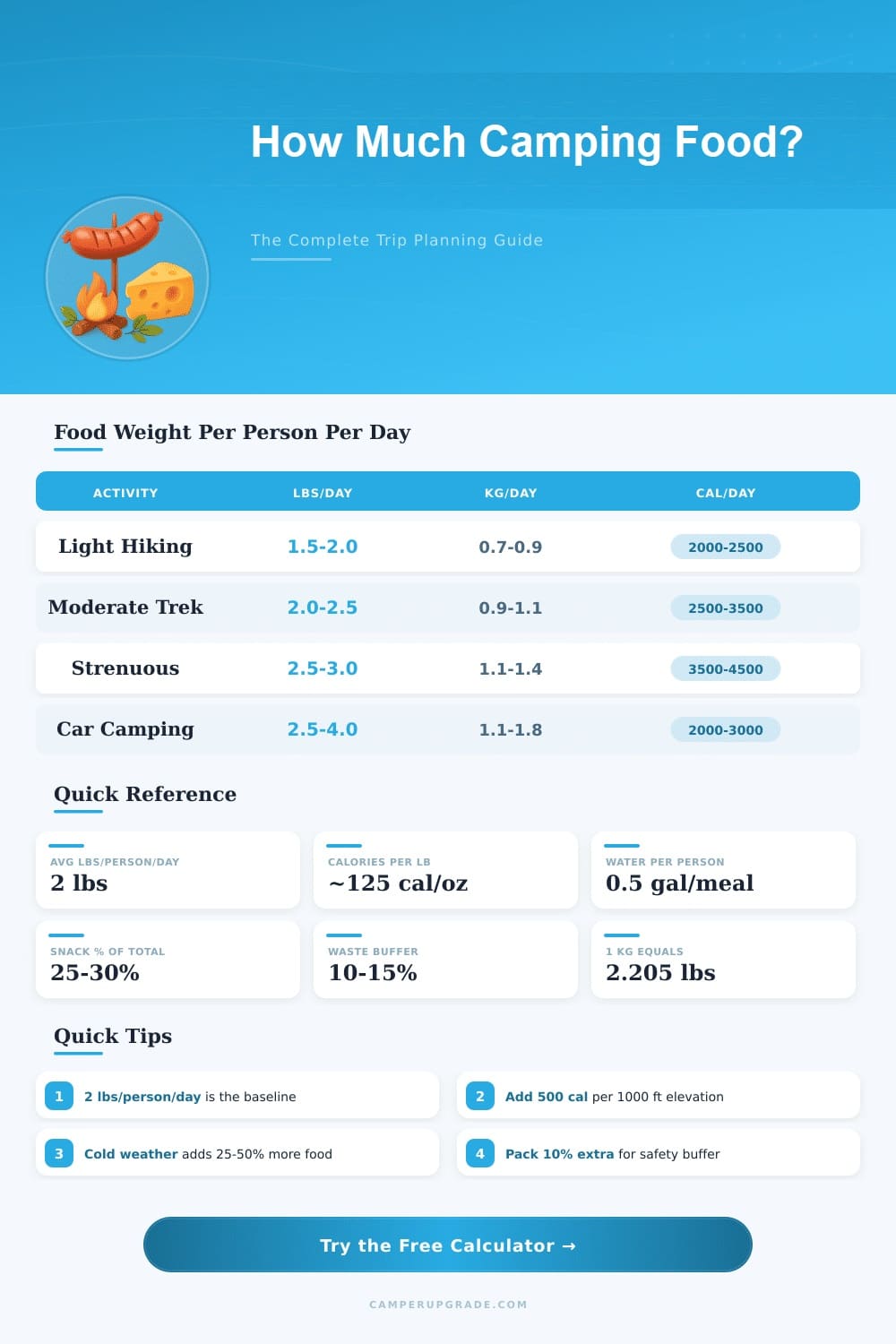
| Activity Level | Calories/Day | Food Weight (lbs) | Food Weight (kg) |
|---|---|---|---|
| Light (day hikes, car camp) | 2,000–2,500 | 1.5–2.0 | 0.7–0.9 |
| Moderate (5–10 mi/day) | 2,500–3,500 | 2.0–2.5 | 0.9–1.1 |
| Strenuous (10+ mi/day) | 3,500–4,500 | 2.5–3.0 | 1.1–1.4 |
| Extreme (winter/altitude) | 4,500–6,000 | 3.0–3.5 | 1.4–1.6 |
| Material | lbs/yd³ | kg/m³ | Best Use |
|---|---|---|---|
| Pea Gravel | 2,400–2,800 | 1,425–1,660 | RV pads, paths |
| Crushed Stone | 2,500–2,900 | 1,485–1,720 | Driveways, pads |
| Decomposed Granite | 2,500–2,700 | 1,485–1,600 | Walkways, patios |
| River Rock | 2,400–2,700 | 1,425–1,600 | Drainage, borders |
| Wood Mulch / Chips | 400–600 | 235–355 | Tent pads, trails |
| Rubber Mulch | 1,100–1,400 | 650–830 | Play areas, pads |
| Sand | 2,600–3,000 | 1,545–1,780 | Leveling, fire pits |
| Crushed Limestone | 2,600–2,800 | 1,545–1,660 | Base layers, roads |
| Depth | sq ft / yd³ | m² / m³ | Bags (2 cu ft) / yd³ |
|---|---|---|---|
| 1 in (2.5 cm) | 324 | 39.2 | 13.5 |
| 2 in (5 cm) | 162 | 19.6 | 13.5 |
| 3 in (7.6 cm) | 108 | 13.1 | 13.5 |
| 4 in (10.2 cm) | 81 | 9.8 | 13.5 |
| 6 in (15.2 cm) | 54 | 6.5 | 13.5 |
| Bag Size | Volume / Bag | Bags / Cubic Yard | Coverage @ 3 in |
|---|---|---|---|
| Small | 0.5 cu ft (14 L) | 54 | 2 sq ft |
| Medium | 1 cu ft (28 L) | 27 | 4 sq ft |
| Standard | 2 cu ft (57 L) | 13.5 | 8 sq ft |
| Large | 3 cu ft (85 L) | 9 | 12 sq ft |
| Project | Area (sq ft) | Cubic Yards @ 3 in | Bags (2 cu ft) @ 3 in |
|---|---|---|---|
| Single Tent Pad (10×10) | 100 | 0.93 | 13 |
| Fire Pit Area (10×10) | 100 | 0.93 | 13 |
| Campsite (20×20) | 400 | 3.70 | 50 |
| RV Pad (12×40) | 480 | 4.44 | 60 |
| Awning Zone (8×20) | 160 | 1.48 | 20 |
| Double RV Pad (24×50) | 1,200 | 11.11 | 150 |
2 pounds of food per person per day — thats the number I kept landing on for moderate backpacking trips. Sounds low but dehydrated meals pack roughly 125 calories per ounce, so a pound and a half gets you close to 3,000 calories. Strenuous hiking bumps that to around 2.5 or even 3 lbs daily.
Big difference. For a 4-person car camping weekend I packed about 24 lbs total, which felt right at 2 lbs each over 3 days. Winter camping though?
How Much Food to Pack and Easy Meals for Camping
Add 25 to 50 percent more — cold weather just devours calories. A 5-day winter trip for 2 people ran me over 30 lbs. Snacks made up nearly 28% of that total weight, which I didnt expect.
Roughly 0.9 to 1.1 kg per person per day covers moderate activity in metric terms, give or take.
Camping does not need to be difficult when dealing with food. Indeed, simplicity and goodness is the best way. One-pot dishes or packets in foil save the life during trips in nature, fewer dishes fewer work and fewer risks for problems with food safety.
And prepare before, minding the time, that different ingredients need to cook? Wise idea, my friend.
For the first evening, best choose something fast and simple. Because at the end of it, setting up the whole campsite needs a bit of time, so you want a meal that will not force you to work a long time beside the fire. Grill steak before and simply warm it when you arrive?
Bright solution. Or take a packet with pork chest, onions, carrots and potatoes, toss it directly on the coals and leave it to cook on its own. Even a big foil packet with soup, meat, oninos and barbecue sauce can fill the whole group.
Fajitas always please everyone, and marinate the chicken a bit before slowly grilling it above the flame? Delicious. You cannot go wrong with spicy chicken tacos grilled with chipotle either, that smoky, spicy feeling answers perfectly for summer camping.
And fish tacos with delicious corn salsa? Yes, please. Oh, and do not skip good old stuffings with peppers and onions fried in foil.
Simply poke them first with a fork, sew that they do not burst during cooking.
Hot dogs stay classics for good reason, but try replacing the rolls with tortillas, rolls easily go flat in the bag. English muffins form another smart choice, because they do not need much fresh space and work for various simple meals, when you grill them in foil.
For backpackers, freeze-dried food forms a good choice… They are lightweight, long-lasting and some even have a taste guarantee for 30 years. But during car camping, when the ice soon will end, those freeze-dried packets can cost too much.
Simple canned food like soups, chili or stews are totally easy, only warm them and done. And keeping a can of Dinty Moore or similar helps for a nice comfortable meal in the tent, when you arriveat night.
Burritos always stay a safe option, and pasta burritos with cheese, chicken and bacon bits? Yes, that works for short journeys. For breakfast, instant pancake mixes with various tastes give a fast and easy start to the day.
And a tube of condensed milk, perfect for sweetening your morning coffee or tea. About lunches? Boards with meats, great veggie salad and eggs with some precooked rice or crackers all last well.
About amount of food, one usually advises to plan around 1.5 to 2.5 pounds each person per day, around 2,500 to 4,500 calories. Naturally, for hard winter trips that can grow to 2 to 2.5 pounds each person. And do not forget to add food for emergency, like honey bars, chocolate.
The info here does not come from some calculator or converter; it is practical knowledge from forums, blogs and eager cooks, that already tried camping cooking. So use it as a reliable guide, full of wise tips and good lists, so that your next outdoor feast becomes totally wonderful.