🔥 Camping Firewood Calculator
Calculate exactly how much firewood you need for your camping trip based on duration, fire type, and burn rate
Million BTU/Cord
Million BTU/Cord
Million BTU/Cord
Million BTU/Cord
Million BTU/Cord
Million BTU/Cord
Million BTU/Cord
Million BTU/Cord
| Fire Type | Logs Per Hour | Bundles Per Hour | Lbs Per Hour |
|---|---|---|---|
| Campfire (standard) | 2 – 3 | 0.5 – 0.75 | 4 – 6 |
| Cooking Fire (hotter) | 3 – 4 | 0.75 – 1.0 | 6 – 8 |
| Bonfire (large) | 5 – 8 | 1.25 – 2.0 | 10 – 16 |
| Format | Weight | Volume | Logs (approx.) |
|---|---|---|---|
| Standard Bundle (0.75 cu ft) | 6 – 10 lbs | 0.75 cu ft | 4 – 6 logs |
| Large Bundle (1.0 cu ft) | 10 – 14 lbs | 1.0 cu ft | 6 – 8 logs |
| Face Cord (1/3 cord) | 1,000 – 1,800 lbs | 42.67 cu ft | 200 – 300 logs |
| Full Cord | 3,000 – 5,000 lbs | 128 cu ft | 600 – 900 logs |
| Bundles | Campfire Hours | Cooking Hours | Bonfire Hours |
|---|---|---|---|
| 2 | 2.5 – 4 hrs | 2 – 2.5 hrs | 1 – 1.5 hrs |
| 4 | 5 – 8 hrs | 4 – 5 hrs | 2 – 3 hrs |
| 6 | 8 – 12 hrs | 6 – 8 hrs | 3 – 5 hrs |
| 10 | 13 – 20 hrs | 10 – 13 hrs | 5 – 8 hrs |
| 15 | 20 – 30 hrs | 15 – 20 hrs | 7.5 – 12 hrs |
| Scenario | Nights | Bundles Needed | Est. Weight (lbs) |
|---|---|---|---|
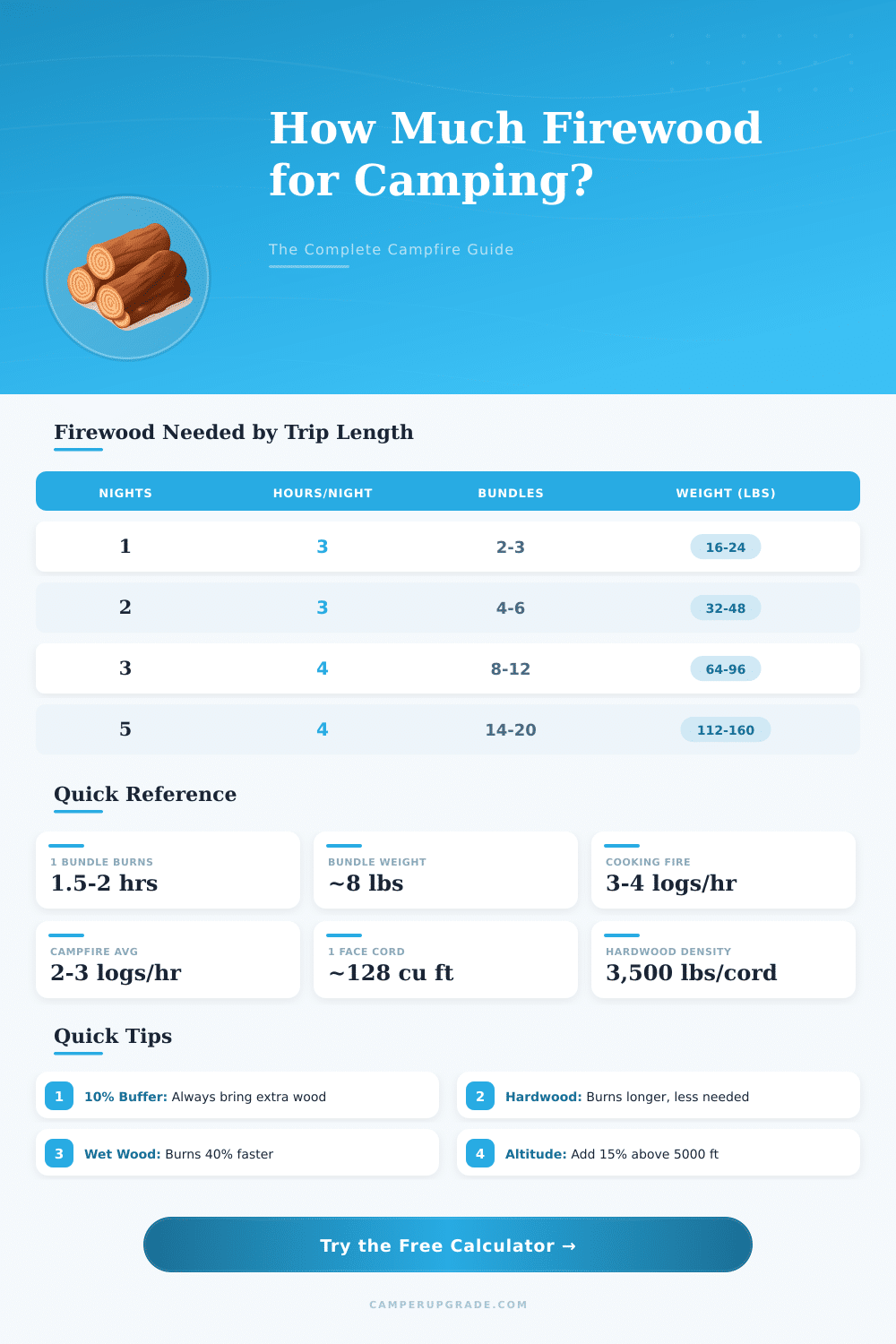
| Solo overnight, small campfire | 1 | 2 – 3 | 16 – 24 |
| Weekend family trip, campfire | 2 | 4 – 6 | 32 – 48 |
| 3-night cooking camp | 3 | 9 – 12 | 72 – 96 |
| 5-night RV campsite | 5 | 10 – 15 | 80 – 120 |
| Week-long trip, nightly fire | 7 | 14 – 21 | 112 – 168 |
| 2-night bonfire party | 2 | 8 – 12 | 64 – 96 |
Hardwoods like oak and hickory burn about 40–50% longer per log than softwoods like pine and cedar. This means you need fewer hardwood bundles for the same amount of burn time. A single oak bundle can last up to 2 hours in a standard campfire, while pine burns through in about 1–1.5 hours.
A 10–15% buffer is smart for any camping trip. Wet or windy conditions can increase burn rate by 20–40%. At elevations above 5,000 feet, fires burn roughly 15% faster due to lower oxygen density. If you are cooking over fire, plan for 3–4 logs per hour rather than the standard campfire rate of 2–3 logs per hour.
A standard campfire bundle weighs around 6 to 10 pounds and burns for roughly 1.5 to 2 hours, so a typical 2-night trip with 3 hours of fire each evening chews through about 4 to 6 bundles. Hardwoods like oak burn 40 to 50 percent longer than softwoods like pine, which means youre hauling fewer bundles for the same warmth. Above 5,000 feet Ive noticed fires eat through wood about 15 percent faster, and wet conditions can bump consumption up another 20 to 40 percent.
The information below does not come from some calculator or another converter tool online. It is based on actual user feedback, forum chats and experiences of camping communities gathered through the net.
Firewood Basics
Firewood is any wooden material usable as fuel. Most commonly by that word one means wood not factory processed, rather than wooden pellets. It usually appears as easily recognizable log or branch.
Firewood can be heat-treated and seasoned, so dry; or it can be unseasoned so fresh and a bit wet. Almost every wood works as Firewood, and widely it stays untreated. One burns it in fires, outdoor homes, campfires or wood-burning boilers.
Oak and pecan are looked at as between the best Firewoods. The cellulose in their structure carries more hydrogen atoms than in many other wood types, and exactly the hydrogen gives the most heat. White oak also is good, but oak damaged by fungus loses a bit of its quality.
Choosing Firewood, it is useful to think about some things: how much heat it gives, how long it will burn, and how easily it is possible to light it.
For recently cut Firewood, the drying time is around six months, and already seasoned wood commonly costs more. Good way to check the wood is ready for burning is to use a moisture meter. The target is approximately twenty percent of moisture or less.
Growing hardwood trees requires eighty to hundred years. After one drops it and cuts it in easily handled lengths, it must season in a dry place during one or two years before one splits it with an axe and stacks it for use. One year of drying can give big dry logs even form difficult species as oak.
Some Firewood is sold already cut in triangular bits, which helps it burn more effectively. Packed Firewood is very useful to carry and works well for indoor fires or outdoor homes. Another option is oven-dried oak Firewood sent in compact boxes.
It lights quickly and works for almost smokeless fires. Such arrangement well fits with living in an apartment, where storage is limited.
Moving Firewood is an important cause, especially for campers. Carrying whole truckloads from very far is a bad idea. Insects can crawl out from the wood, infest nearby trees and start to destroy forests.
That means fewer enjoyment for future campers and fewer trees four all. The risk of invasive species is very high in campgrounds. Florida, for instance, does not want that Firewood be moved inside the state, even more brought from another state.
One recommends to buy Firewood inside fifty miles of the place where it will be burned. At one border crossing between British Columbia and Washington, campers with Firewood received order to return to Canada and leave it be taken before one allowed them to enter.
The most common way is to buy Firewood at or beside the camping. The camp itself commonly sells it. Some state parks have own production of Firewood and separate selling spots.
Also side tracks close to campings can be a good place to search. Amish farms and private properties occasionally sell half-truckload burden for around twenty-five dollars. Local sources like Facebook Marketplace, Craigslist and Nextdoor also are useful to find Firewood or cord wood nearby.
For those that hardly start a campfire with real wood, fire-starter logs are a simple option that works well. Firewood is a renewable natural resource, although it risks to be wasted. Meanwhile other fuel sources come with own problems, for example oil spills and earthquakes because of fracking.
Split, stack and burn Firewood can become a kind of hobby. When the habit starts, gathering wood becomes an entirely real cause. Handling Firewood in more older age becomes more hard.
One person at seventy-four years found that handling almost thirty-inch blocks of red fir with a machete was very tough work, and considered to limit himself totrees under twenty inches in diameter.
Firewood does not serve only for heat. One uses it to grill, to smoke meat and for pizza ovens. Oven-dried ash splits, for instance, work as gentle smoking wood with little smoke and easy lighting.
Dense hardwood is a popular choice for all these uses.