🚛 25 Foot Camper Weight Calculator
Calculate dry weight, GVWR, cargo capacity, tongue weight, and loaded weight for any 25-foot camper or travel trailer
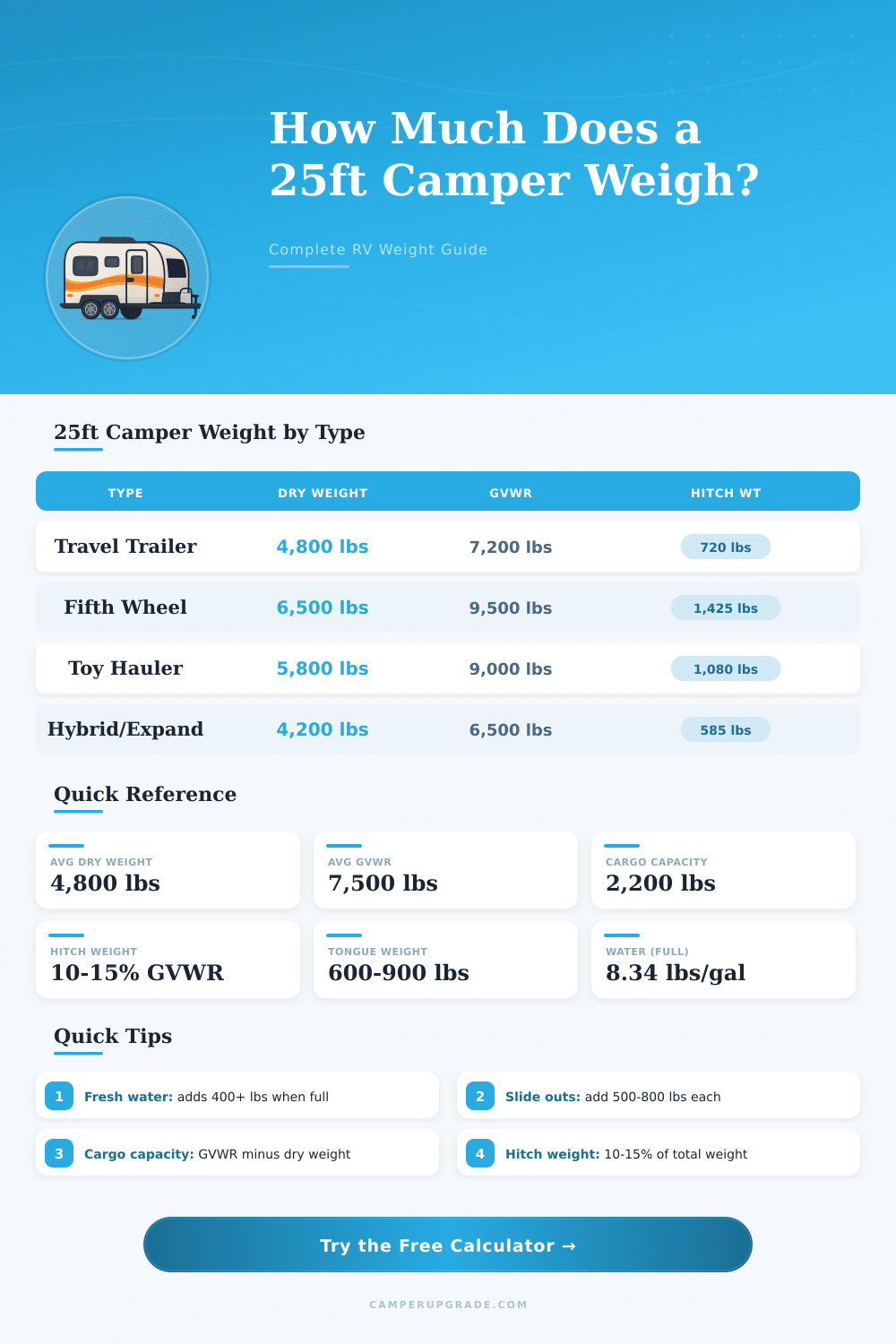
| Camper Type (25ft) | Dry Weight (lbs) | GVWR (lbs) | Cargo Capacity (lbs) |
|---|---|---|---|
| Travel Trailer (Lightweight) | 3,800 | 5,500 | 1,700 |
| Travel Trailer (Standard) | 4,800 | 7,200 | 2,400 |
| Travel Trailer (Luxury) | 5,800 | 8,500 | 2,700 |
| Fifth Wheel (Standard) | 6,500 | 9,500 | 3,000 |
| Fifth Wheel (Luxury) | 7,800 | 11,000 | 3,200 |
| Toy Hauler | 5,800 | 9,000 | 3,200 |
| Hybrid / Expandable | 4,200 | 6,500 | 2,300 |
| Airstream / Aluminum | 5,200 | 7,500 | 2,300 |
| Bunkhouse Travel Trailer | 5,500 | 8,000 | 2,500 |
| Large Teardrop | 3,200 | 5,000 | 1,800 |
| Fluid Type | Weight per Gallon | Typical Tank Size (25ft) | Full Tank Weight |
|---|---|---|---|
| Fresh Water | 8.34 lbs (3.78 kg) | 40–60 gallons | 334–500 lbs |
| Gray Water | 8.34 lbs (3.78 kg) | 30–50 gallons | 250–417 lbs |
| Black Water | 8.5 lbs (3.86 kg) | 25–40 gallons | 213–340 lbs |
| Propane (liquid) | 4.2 lbs (1.9 kg) | Two 20 lb tanks | 40–80 lbs |
| Fuel (Generator) | 6.3 lbs (2.86 kg) | 3–5 gallons | 19–32 lbs |
| Slide-Out Count | Added Weight (lbs) | Added Weight (kg) | Typical GVWR Impact |
|---|---|---|---|
| 0 (No Slides) | 0 | 0 | Base weight |
| 1 Slide-Out | 500–800 | 227–363 | +6–10% |
| 2 Slide-Outs | 1,000–1,600 | 454–726 | +12–20% |
| 3 Slide-Outs | 1,500–2,400 | 680–1,089 | +18–30% |
| 4 Slide-Outs | 2,000–3,200 | 907–1,452 | +25–40% |
| Loaded Camper Weight | Min Tow Rating Needed | Tongue/Hitch Weight | Example Vehicles |
|---|---|---|---|
| Under 5,000 lbs | 6,000 lbs | 500–750 lbs | Mid-size SUV, Half-ton |
| 5,000–7,000 lbs | 8,000 lbs | 700–1,050 lbs | Half-ton truck, Full-size SUV |
| 7,000–9,000 lbs | 10,500 lbs | 1,050–1,350 lbs | 3/4-ton truck |
| 9,000–11,000 lbs | 13,000 lbs | 1,350–1,650 lbs | 3/4-ton or 1-ton truck |
| Over 11,000 lbs | 15,000+ lbs | 1,650+ lbs | 1-ton truck (dually) |
For travel trailers, tongue weight should be 10–15% of the total loaded trailer weight. For fifth wheels, pin weight runs 15–25% of loaded weight. Always verify your tow vehicle’s payload capacity can handle the tongue/pin weight plus passengers and gear in the truck.
GVWR (Gross Vehicle Weight Rating) is the maximum the camper can safely weigh when fully loaded. Dry weight is the base camper with no fluids, cargo, or options. The difference between GVWR and dry weight is your Cargo Carrying Capacity (CCC). Never exceed your GVWR — weigh your rig at a truck scale (CAT scale) to know for sure.
Camper simply is folk that camps. Even so, that word commonly relates to kind of cars or places that works for journeys and nights under the sky. The camper sometimes called a small caravan, works as transport and home at the same time.
Inside one finds normal setups, for instance kitchen, bathroom with shower and zone for rest.
What Is a Camper and How People Live in It
Various kinds of campers exist. Between them are travel trucks, motor homes, fifth-wheel trailers, toy haulers and pop-up campers, that all belong to the same group. Class A motor homes are the biggest.
Class B van campers are more small and more nimble. Class C motor homes sit between the two. Also, truck campers are made up of sleep cabins, that sit on the cargo bed of a pickup.
They most commonly are the simplest, less comfortable, less fancy and chiefly good for cheap journeys.
Fully set up truck campers weigh a lot. They commonly pass 1500 pounds, what passes the maximum load limit of average pickups. The most many pickups sold in United States belong to half ton, as the Ford F-150, Chevy 1500 or Ram 1500.
Truck campers on the road cause also worse gasoline use because of wind drag. Water tanks and waste tanks usually are much more small because of limited place.
Pop-up campers present a fresh choice. Some companies offer adjustable pop-up models, that work for truck beds and allow flexibility during outdoor trips or camping trips. Also exist overland trucks with special camping covers for sleeping in the wild.
In summary, two normal modes of camp living happen all along journeys. The tourer moves during weeks until months or even more, and usually stays at one place no more then four nights before going further. The settler follows the opposite way.
None of them is better or worse.
Living in a van seems nice, but with two folks it becomes very hard. The second folk always is around. Even talks can become stuffy.
Travel by means of camper is not this cheap, although it could seem. It costs lot of gasoline, and even staying at one place adds expenses. With three folks a van would be very narrow.
A possible fix is to adapt the van by means of temporary storage, hammocks or sleeping pads. When the car does not look like a camper, options for sudden nights or pauses almost donot have limits.
Known marks of RVs include Winnebago, Coachmen, Forest River, Jayco, Keystone, Thor Motor Coach and Tiffin Motorhomes. The life in an RV can feel scary at first, but many groups help to share travel stories and tips about camping.