🚛 16 Foot Camper Weight Calculator
Calculate total weight including cargo, water, propane & gear for your 16ft camper
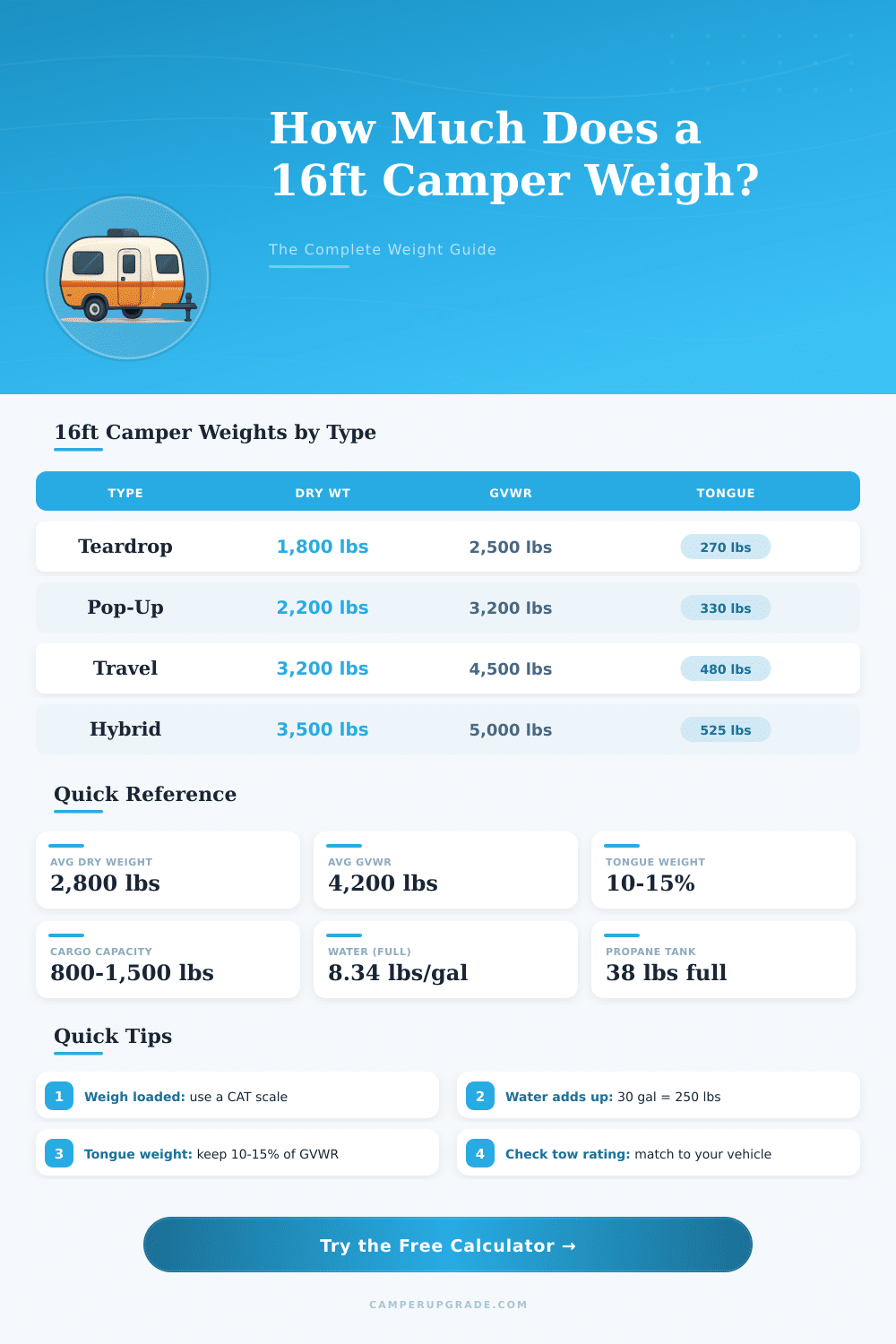
| Camper Type | Dry Weight (lbs) | GVWR (lbs) | Cargo Capacity (lbs) |
|---|---|---|---|
| Teardrop | 1,500 – 2,100 | 2,200 – 2,800 | 500 – 800 |
| Pop-Up / Folding | 1,800 – 2,600 | 2,800 – 3,500 | 700 – 1,100 |
| A-Frame | 2,100 – 2,900 | 3,000 – 3,800 | 700 – 1,000 |
| Travel Trailer | 2,800 – 3,600 | 3,800 – 5,200 | 800 – 1,600 |
| Hybrid Trailer | 3,200 – 3,800 | 4,500 – 5,500 | 1,000 – 1,700 |
| Toy Hauler (16ft) | 3,400 – 4,200 | 5,000 – 6,000 | 1,200 – 2,000 |
| Truck Camper | 1,500 – 2,500 | N/A (truck payload) | 400 – 800 |
| Tank Size | 25% Full | 50% Full | 100% Full |
|---|---|---|---|
| 10 gal (38 L) | 21 lbs (10 kg) | 42 lbs (19 kg) | 83 lbs (38 kg) |
| 20 gal (76 L) | 42 lbs (19 kg) | 83 lbs (38 kg) | 167 lbs (76 kg) |
| 30 gal (114 L) | 63 lbs (29 kg) | 125 lbs (57 kg) | 250 lbs (114 kg) |
| 40 gal (151 L) | 83 lbs (38 kg) | 167 lbs (76 kg) | 334 lbs (151 kg) |
| 50 gal (189 L) | 104 lbs (47 kg) | 209 lbs (95 kg) | 417 lbs (189 kg) |
| Component | Weight (lbs) | Weight (kg) | Notes |
|---|---|---|---|
| 20 lb Propane Tank (full) | 38 lbs | 17 kg | 20 lbs propane + 18 lbs tank |
| 30 lb Propane Tank (full) | 55 lbs | 25 kg | 30 lbs propane + 25 lbs tank |
| Lead-Acid Battery (12V) | 65 lbs | 29 kg | Group 27 deep cycle |
| Lithium Battery (12V 100Ah) | 28 lbs | 13 kg | LiFePO4 type |
| Generator (2000W portable) | 48 lbs | 22 kg | Inverter style |
| Average Person | 180 lbs | 82 kg | US adult average |
| Leveling Blocks (set) | 12 lbs | 5 kg | Set of 10 blocks |
| Sewer Hose Kit | 8 lbs | 4 kg | 20 ft with fittings |
| Total Loaded Weight | Min Tow Rating | Vehicle Class Examples | Hitch Type |
|---|---|---|---|
| 2,000 – 3,000 lbs | 3,500 lbs | Compact SUV, Midsize Car | Class II |
| 3,000 – 4,000 lbs | 5,000 lbs | Midsize SUV, V6 Truck | Class III |
| 4,000 – 5,500 lbs | 7,000 lbs | Full-Size SUV, Half-Ton Truck | Class III |
| 5,500 – 7,000 lbs | 8,500 lbs | Half-Ton Truck, 3/4 Ton | Class IV |
Tongue weight should be between 10% and 15% of total loaded trailer weight for safe towing. Too little tongue weight causes trailer sway; too much overloads your vehicles rear axle. A bathroom scale with a 2x4 lever or a dedicated tongue weight scale at a truck stop can give you an accurate reading.
Certified Automated Truck (CAT) scales at truck stops can weigh your tow vehicle and loaded camper for a small fee. Weigh each axle separately to verify tongue weight, tow vehicle payload, and total combined weight. This is the most reliable way to make sure youre within safe limits.
At the base, camper simply is folk that lives in tent. However the word also points to a kind of cars that became very popular during the last years. A camper van (sometimes simply called camper or little caravan) in short is a car that serves at the same time as travel and a place to stay.
It combines travel with home comfort in one package. Inside one finds usually a kitchen, bathroom with shower, and enough space for rest or watching television.
Living and Traveling in Camper Vans
Most many camper vans start from average vans, that one adapts by means of involved home setups. Batteries for keeping everything working, solar panels for energy, a small base, a kind of toilet, sink and storage places everywhere. Also there is the truck camper option, that is made up of a sleeping cabin installed in the bed area of a pickup.
When one chooses the pickup camper mode, one finds the most little less fully equipped and widely most cheap solution on the market.
Here where things become interesting: fully equipped camper vans mean heavy loads. Such will weigh at least 1500 pounds, what commonly passes the skill of a standard pickup in its bed area. Many pickups on American roads are half-ton versions, for example Ford F-150, Chevy 1500 or Ram 1500.
When one lays a camper flat, the fuel use drops a lot because of the air resistance. Also, the water tank and waste tanks must stay little, because there simply lacks space for bigger.
Folks usually live in two different modes. The travelers always move, staying somewhere from a week until a month or even more, but never more then four nights at same place before go. The spot lovers, the other way, follow the opposite plan.
No style beats the other, it simply depends on your choice.
Living in a camper or van seems nice until one truly tries. The gasoline spends itself quickly, and even if one parks pretty fixed, yet happen costs. When two folks share a van, it becomes good cause.
The second folk always attends. Chats can feel too dense. Three folks?
That becomes truly narrow. A van with swappable bins, hammocks or sleeping pads surely can serve as a tent system. The secret is that if it does not look like a camper, one wins more freedom, because it is possible to park sharply or pause somewhere.
That is a whole other world than camping. If one loves camping, tents can save money in comparison. The RV lifestyle can feel too strong at first, even so.
There is truly a lot of camper kinds that deserve attention, Class A motor homes, Class B camper vans, Class C motor homes, travel trailers, fifth wheels and toy haulers. Brands like Grand Design RV, Coachmen RV, Forest River RV, Jayco, Keystone RV, Thor Motor Coach and Tiffin Motorhomes got strong fame. Pop-up camper units that fit in pickup bed areas form another choice, trading freedom for outdoor fun.
Overlanding trailers with special rooftop tents showadditional ways to reach nature and explore.