🚛 30-Foot Camper Weight Calculator
Estimate dry weight, loaded weight, tongue weight & towing requirements for your camper
| Length | Travel Trailer | Fifth Wheel | Toy Hauler | Metric (TT) |
|---|---|---|---|---|
| 20 ft (6.1 m) | 3,500 lbs | N/A | 4,800 lbs | 1,588 kg |
| 24 ft (7.3 m) | 4,200 lbs | 6,000 lbs | 5,500 lbs | 1,905 kg |
| 26 ft (7.9 m) | 4,800 lbs | 7,000 lbs | 6,200 lbs | 2,177 kg |
| 28 ft (8.5 m) | 5,300 lbs | 7,800 lbs | 6,700 lbs | 2,404 kg |
| 30 ft (9.1 m) | 5,800 lbs | 8,500 lbs | 7,200 lbs | 2,631 kg |
| 32 ft (9.8 m) | 6,400 lbs | 9,200 lbs | 7,800 lbs | 2,903 kg |
| 35 ft (10.7 m) | 7,200 lbs | 10,500 lbs | 8,500 lbs | 3,266 kg |
| 40 ft (12.2 m) | 8,500 lbs | 12,500 lbs | 10,000 lbs | 3,856 kg |
| Fluid | Weight per Gallon | Typical Tank Size | Full Tank Weight |
|---|---|---|---|
| Fresh Water | 8.34 lbs (3.78 kg) | 40–60 gal (151–227 L) | 334–500 lbs |
| Gray Water | 8.34 lbs (3.78 kg) | 30–50 gal (114–189 L) | 250–417 lbs |
| Black Water | 8.5 lbs (3.86 kg) | 30–40 gal (114–151 L) | 255–340 lbs |
| Propane (20 lb tank) | 4.2 lbs/gal (1.9 kg) | 4.7 gal (17.8 L) | ~37 lbs (16.8 kg) |
| Fuel (Gas Generator) | 6.3 lbs (2.86 kg) | 3–7 gal (11–26 L) | 19–44 lbs |
| Number of Slides | Added Weight (lbs) | Added Weight (kg) | Notes |
|---|---|---|---|
| 0 Slides | 0 lbs | 0 kg | Base weight, no slide mechanisms |
| 1 Slide-Out | 600–1,000 lbs | 272–454 kg | Includes motor, frame & contents |
| 2 Slide-Outs | 1,200–2,000 lbs | 544–907 kg | Common on 30 ft fifth wheels |
| 3 Slide-Outs | 1,800–3,000 lbs | 816–1,361 kg | Typical on 32–40 ft models |
| 4+ Slide-Outs | 2,400–4,000 lbs | 1,089–1,814 kg | Large fifth wheels & park models |
| Camper Type | Tongue/Pin % of GTW | 30 ft Estimate (lbs) | 30 ft Estimate (kg) |
|---|---|---|---|
| Travel Trailer | 10–15% | 580–870 lbs | 263–395 kg |
| Fifth Wheel | 15–25% | 1,275–2,125 lbs | 578–964 kg |
| Toy Hauler | 10–15% | 720–1,080 lbs | 327–490 kg |
| Hybrid Trailer | 10–15% | 480–720 lbs | 218–327 kg |
| Ultra-Lite | 10–12% | 450–540 lbs | 204–245 kg |
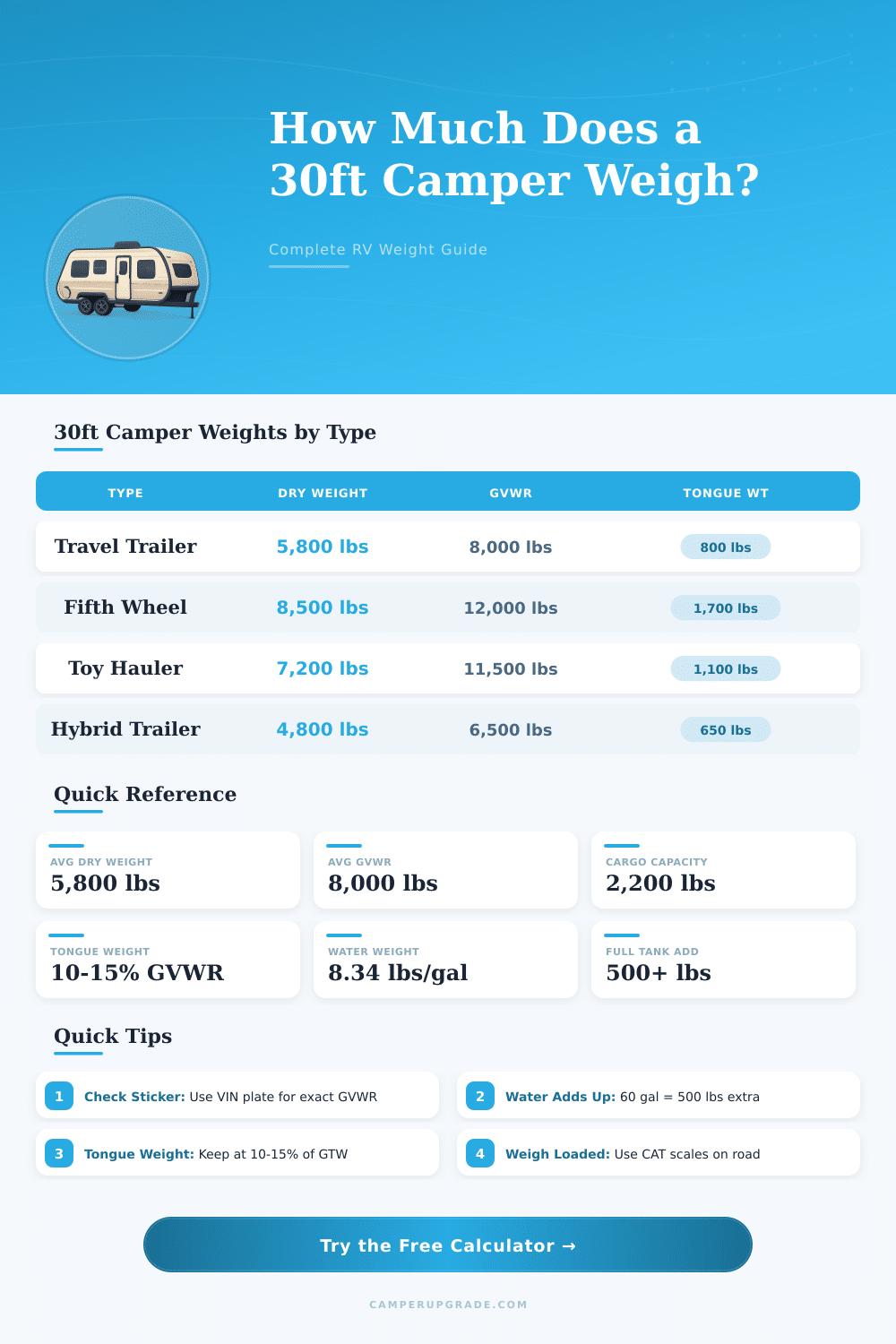
A 30 foot travel trailer runs about 5,800 lbs dry, which jumps to around 8,000 lbs loaded. Fifth wheels at that length? Way heavier, closer to 8,500 lbs dry and 12,000 fully loaded.
Each slide-out tacks on 600 to 1,000 pounds (I had to double check that). Fill a 60 gallon fresh water tank and thats another 500 lbs just sloshing around. Tongue weight should sit between 10 and 15 percent of gross trailer weight for travel trailers, so figure 800 to 1,200 pounds on the hitch for a loaded 30 footer.
Types of campers and how heavy they are
The word camper can mean different things according to the situation. Usually it relates to folk that likes the outdoors under the sky in tent. However the word covers also many kinds of trips that serve for travel and staying, from simple truck camper until fully equipped motorhome of Class A.
Truck campers form the simplest and cheap option. They give sleeping space in the back of truck. Although they have downsides: the wind drag of the camper a lot reduces the use of gasoline, and the tanks for water and waste stay small because of the limited place.
Fully equipped campers on the other hand weigh a lot, sometimes passing 1500 pounds. That can pass the maximum load limit even of big tow-rated trucks, like the Ford F-150 or the Chevy 1500. Becuase of that the weight becomes important problem during the choice of right camper.
Van campers, that one adapted for camping, usually carry common elements like house batteries, solar panels, bed platform, toilet, sink and enough storage. The advantage of life in van is clear: only expense for fuel, and you have home with shower, electricity and kitchen everything ready. But it does not cost like this little, although one could believe, because the gas use and repair expenses add up.
Sharing van with some other can be difficult. The closeness forces you always share the spaces of the other, and even average chatters feel themselves stressed. So that life in van succeed for too folks, you need special type of love and patience.
Enclose three people in such setup would be truly tight.
For simpler camping life, the camping self are great budget solution. Exists whole group of fun campers, that bless the tent and hammock style instead of camper vehicles. The world of campers self are huge, full of fancy motorhomes of Class A until compact tear-drop trailers and folding sheds.
One brand of camper vehicles, that commonly gets mentioned, are Forest River. It offers wide series of products, of the Wolf Pup until the line Surveyor. However the experiences with some models of Forest River not always pleased: especially the Wolf Pup have heavy name because of fast wear, and even the line Surveyor had its portion of problems.
Camp fires form natural part of the camping life. But the constant use of wood in same place can damage the local nature. Compact unit for camp fire from rust-proof steel can serve as more nature-friendly option, especially in the limits of camper of Class B.
Websites about camper vehicles form great sources of knowledge, where expert campers share tips about fixes, gear, add-ons, reviews of campsite and trip planning. Care of pets in camper is other popular theme in talks, for instance about the disposal of cat litter or safety of dog beside the campsite.
In the end of the day, the charm of camping rests in the freedom ofthe vast nature, whether in big motorhome, mobile van or modest tent. The experiences and memories, that one creates during the way, is that, what truly matters.