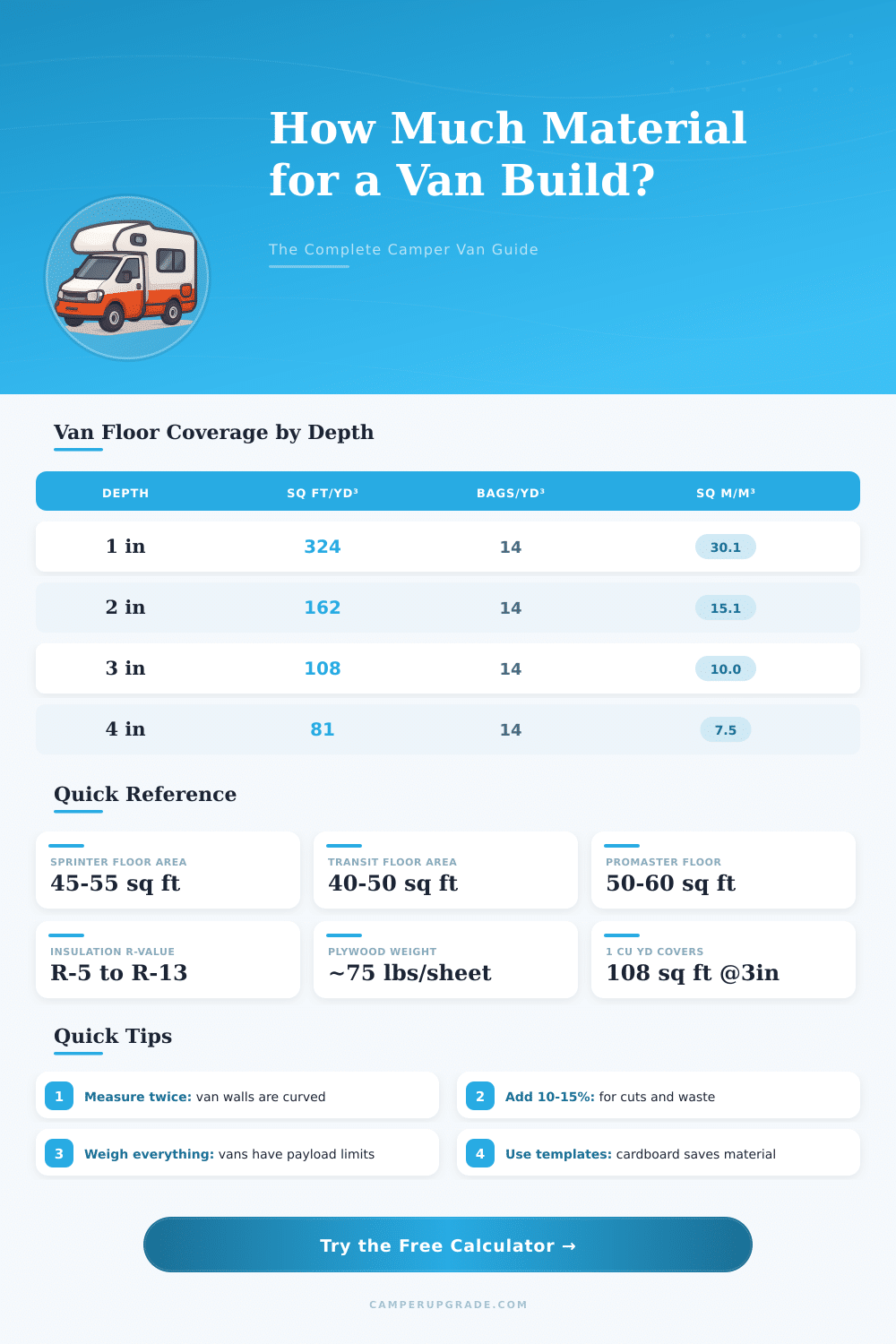
🚚 Camper Van Renovation Material Calculator
Calculate exactly how much flooring, insulation, wall panel, or subfloor material you need for your van build
| Thickness | Sq Ft per Cu Yd | Sq M per Cu M | Sheets (4×8) per Cu Yd |
|---|---|---|---|
| 3/16 in (4.8 mm) | 1,728 | 211.3 | 54 |
| 1/4 in (6.4 mm) | 1,296 | 158.5 | 40.5 |
| 3/8 in (9.5 mm) | 864 | 105.6 | 27 |
| 1/2 in (12.7 mm) | 648 | 79.2 | 20.3 |
| 3/4 in (19 mm) | 432 | 52.8 | 13.5 |
| 1 in (25.4 mm) | 324 | 39.6 | 10.1 |
| 1.5 in (38 mm) | 216 | 26.4 | 6.8 |
| 3 in (76 mm) | 108 | 13.2 | 3.4 |
| Material Format | Sheet Size | Area per Sheet | Typical Thickness |
|---|---|---|---|
| Plywood (standard) | 4 ft × 8 ft | 32 sq ft (2.97 m²) | 3/4 in (19 mm) |
| Luan Panel | 4 ft × 8 ft | 32 sq ft (2.97 m²) | 3/16 in (4.8 mm) |
| Rigid Foam (XPS) | 4 ft × 8 ft | 32 sq ft (2.97 m²) | 1–2 in (25–51 mm) |
| Vinyl Plank | 48 in × 7 in | 2.33 sq ft (0.22 m²) | 1/4 in (6 mm) |
| Cedar T&G | 96 in × 3.5 in | 2.33 sq ft (0.22 m²) | 3/8 in (9.5 mm) |
| Cork Tiles | 12 in × 24 in | 2 sq ft (0.19 m²) | 1/4 in (6 mm) |
| MDF Panel | 4 ft × 8 ft | 32 sq ft (2.97 m²) | 1/2 in (12.7 mm) |
| Van Model / Project | Floor Area | Plywood Sheets (3/4 in) | Insulation Sheets (1.5 in) |
|---|---|---|---|
| Sprinter 144 WB Floor | 50 sq ft (4.6 m²) | 2 sheets | 2 sheets |
| Sprinter 170 WB Floor | 66 sq ft (6.1 m²) | 3 sheets | 3 sheets |
| Transit High Roof Floor | 50 sq ft (4.6 m²) | 2 sheets | 2 sheets |
| ProMaster 159 WB Floor | 84 sq ft (7.8 m²) | 3 sheets | 3 sheets |
| Sprinter Ceiling | 55 sq ft (5.1 m²) | N/A | 2 sheets |
| Sprinter Walls (both sides) | 110 sq ft (10.2 m²) | N/A | 4 sheets |
| Full Sprinter 144 Interior | 215 sq ft (20 m²) | 3 sheets | 8 sheets |
| Full ProMaster 159 Interior | 250 sq ft (23.2 m²) | 4 sheets | 9 sheets |
Van walls and ceilings are curved, meaning flat sheet goods need extra cuts and produce more waste. For walls and ceilings, use a 15–20% overage buffer instead of the standard 10%. Floor areas are mostly flat and 10% overage is usually enough.
Most cargo vans have a payload capacity between 2,500 and 3,500 lbs. A full Sprinter 144 build with plywood subfloor (3/4 in), rigid foam insulation, cedar ceiling, vinyl flooring, and cabinetry can weigh 800–1,200 lbs in materials alone before adding water tanks, batteries, and gear. Weigh everything as you go.
Camper Van, known also as camper, motorhome, caravan or recreation vehicle, form a moving device that delivers both motion and retreat. It commonly carries cooking resources. That word one uses to describe a truck adapted for life during journeys.
In average Camper Vans find one domestic batteries, sun panels, light base, some kind of toilet, sink and storage place. Some models include even kitchen, bathroom with shower and tiny living space.
All About Camper Vans
Camper Vans rank between the most small motorhomes. They most commonly stretch until 20 feet and weigh until 8 000 pounds. Some has slide-outs for expand the living space, even so they do not pass 30 feet.
One finds everything from efficient little Camper Van until bigger version according to your demand. They drive easily and stay quite a lot small for reach abandoned ways, while they give enouhg space for good overnight rest.
Fully furnished versions come with kitchens, bathrooms and comfortable seat and sleeping spots. Pop-up beds, exterior awning and other features ease the enjoyment of camping life by means of extra space. They call also Class B motorhomes and attract many fun enthusiasts, that requires adventure, comfort ore simply various everyday vehicle.
Vans are built commonly a lot more flat than big recreation vehicles, with fewer risk for damages. The base forms solid metal frame of the vehicle. Big campers and recreation cars most often are built on weak frames and can split or tip.
Their interiors are built cheap and on average do not last full use.
Extending normal van to Camper Van results in popular solution. Conversion sets are available, that converts any usual truck in full camper with working kitchen, storage and sleeping spots. Some companies or self builders have ready sets installed in bought van, or deliver them for own building.
For simple base, Ford truck with high roof shows reliable option. Parts easily present, and any workshop can fix them. They usually bear strong alternator, heavy tyres and strong batteries, everything helps when one adds mass.
Live in Camper Van together gets harder compared to privacy. The space fills up soon. Even chat sometimes feel pressed.
Drive by means of van do not cost as little, although it seems, because fuel costs add up. However the van life gives freedom. Payments for fuel, accommodation, showers, electricity and food making simplify everything.
One favours diesel in Camper Vans, because its use during pause is almost half less than ata gasoline engine.