🏕 Camper Van Pad Material Calculator
Calculate gravel, stone & fill material for your camper van pad, campsite, or RV parking area
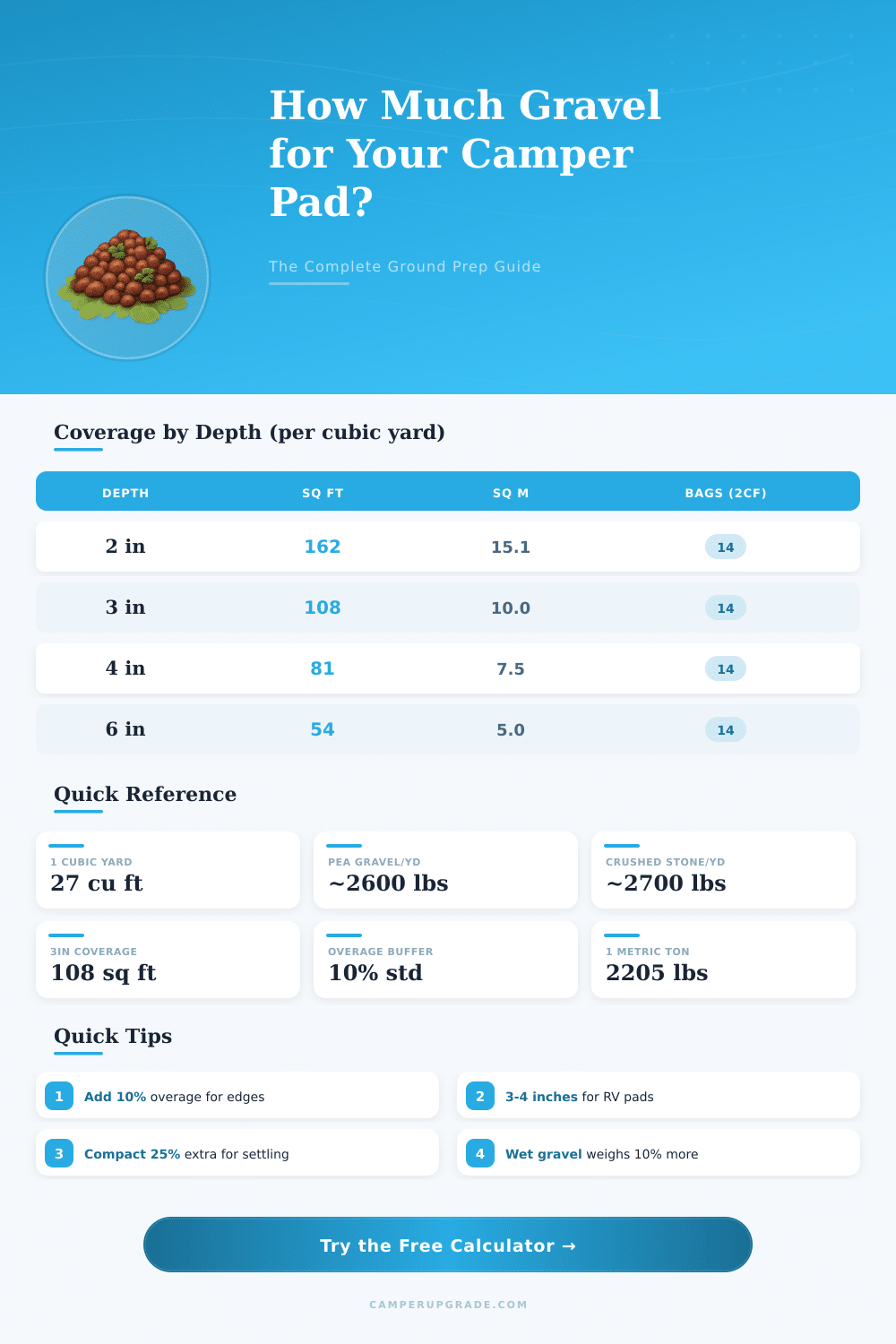
| Depth | Sq Ft / Yard | Sq M / Yard | Cu Ft / Yard |
|---|---|---|---|
| 1 in (2.5 cm) | 324 | 30.1 | 27 |
| 2 in (5 cm) | 162 | 15.1 | 27 |
| 3 in (7.6 cm) | 108 | 10.0 | 27 |
| 4 in (10 cm) | 81 | 7.5 | 27 |
| 6 in (15 cm) | 54 | 5.0 | 27 |
| Bag Size | Volume / Bag | Bags / Yard | Coverage @ 3 in |
|---|---|---|---|
| Small Bag | 0.5 cu ft | 54 | 2 sq ft |
| Standard Bag | 2 cu ft | 13.5 | 8 sq ft |
| Large Bag | 3 cu ft | 9 | 12 sq ft |
| Super Sack | 1 cu yd (27 cu ft) | 1 | 108 sq ft |
| Project | Area (sq ft) | Cu Yards @ 3 in | Bags (2 cu ft) |
|---|---|---|---|
| Van Pad (10×30) | 300 | 2.8 | 38 |
| RV Pad (12×40) | 480 | 4.4 | 60 |
| Campsite (20×20) | 400 | 3.7 | 50 |
| Full RV Site (25×50) | 1,250 | 11.6 | 156 |
| Fire Pit Circle (10 ft ⌀) | 79 | 0.7 | 10 |
| Awning Zone (8×20) | 160 | 1.5 | 20 |
| Walkway (4×30) | 120 | 1.1 | 15 |
A single cubic yard only covers about 108 square feet at 3 inches deep, and that caught me off guard the first time I prepped a van pad. Bump to 4 inches and youre down to 81 square feet per yard. Crushed stone runs somewhere around 2700 pounds a yard, so a 300 square foot van pad at 3 inches needs roughly 2.8 yards and thats already over 7,000 pounds of material.
I always add 10% overage because edges and settling eat up more than you expect.
How to Prepare the Ground for Pads, Pools and Gardens
The information below does not come from calculator or any automatic translator. It bases on real users reviews, forum changes and collective cooking experiences from various websites.
Preparation of ground means various tasks according to the kind of work. For instance, one can have to get spaces fit for garden, for level ground meant for pool or shed, or for arrange place under concrete plate. However the main ideas stay same.
The soil must be cleared of debris leveled and sometimes packed before start the next works.
When deal about concrete plate, first find and arrange the place. Count the sizes of the plate, together with its depth. The plate must rest level with the surrounding soil, then dig in the ground for pack it and well pose the foundation.
Use flat packers or manual tampers for pack the soil and form solid base. Control the evenness of the surface by means of spirit level, during rakes spread and level the extra materials.
Arranging the space similar to laying of paving stones, one finds good method. For instance, start by means of stakes, string, measuring tape and level. Mark carefully the zone where will happen teh construction.
Use square tool for ensure, that the corners reach precise 90 degrees.
In areas with gravel, the leveling is the first cause. Form the space by means of shovel or tractor with front blade and eventual scraping box for reach the wanted form. The existing soil or fit fill material must pack to between 80 and 95 percent according to proctor test.
For upper pools, as those of Intex, the soil requires to be fully flat. Differences under half inch is real, because filling the pool, it starts to lean, and the error grows upward. Paving stones lay under the feat, so that the tops stay also level where the pool will rest.
All stones should be flat inside one inch between themselves, but ideally inside quarter inch. A mat or protective pad under the pool stops grasses grow up under it.
Preparation of garden soil is fully other history. If the ground is dense and rich in clay, tilling it well help the drainage. In dry regions with too much alkaline and clay soil, dig deep holes or cavities around one and half until two feet deep, later fill them by means of kitchen compost, old manure, old straw and coffee ground.
Compost correct more than water-soluble nutrients, because watering only washes those costly nutrients away, what causes focused pollution.
Dig the whole area by means of shovel, turning the soil so that the upper layer goes down. Remove big weeds and gather them for maybe burn. Cold of cold winter naturally breaks the soil over time.
In places where the upper soil washed and the ground seems packed, gently add any extras to the soil until cover plants set their roots. Falling needles and leaves well reduce the erosion. Except that, lay cardboard above the ground without tilling it.
It chokes the weeds and roots, during good upper soil builds up, keeping water right while it yet drains well.
Working big lands, tilling by means of garden tiller or tractor rotary tiller are efficient. One can buy or rent them. Remove rocks and other dirt for have smooth growing surface.
For uneven meadows where one will add several inches of upper soil, one can skip the tilling here.
Because one lays sod, preparation of ground bed matters. Spray the old meadow and expect eight until ten days, later pull it and till. The best mode is isolate the old sod, extract it, later repeatedly level the free ground, grade it and roll by means of heavy roller correctly in front lay the new sod.
After placing, water it deeply and roll repeatedly for help root inside two weeks. Slow nutrient with iron and pre-treatment against fungus are good extra step. Level by means of sand or soil, later lay the sod during cleverly add organic material up by means of compost, is other useful method.
Design the backyard plan on paper before help to estimate the involved materials and tools. It includes to think, whether sprinkler system will enter or whethertrees or bushes need add or remove.