🚛 Camper Bumper Weight Calculator
Calculate safe load capacity for your RV or camper bumper based on bumper specs and accessory weight
| Accessory | Weight (lbs) | Weight (kg) | Notes |
|---|---|---|---|
| Bike rack (empty, 2-bike) | 25–35 | 11–16 | Hitch-mount style |
| Bike rack (empty, 4-bike) | 40–55 | 18–25 | Platform style heavier |
| 2 adult bikes | 50–70 | 23–32 | Road bikes lighter, MTB heavier |
| 4 adult bikes | 100–140 | 45–64 | E-bikes can be 50+ lbs each |
| Cargo tray / carrier | 15–30 | 7–14 | Steel heavier than aluminum |
| Grill (portable) | 25–40 | 11–18 | Plus fuel weight |
| Propane tank (20 lb, full) | 37–40 | 17–18 | Tank + fuel combined |
| Spare tire (trailer) | 35–60 | 16–27 | Varies by size significantly |
| Portable generator | 45–120 | 20–54 | 2000W–3500W range |
| Storage box (empty) | 15–30 | 7–14 | Plus contents weight |
| Load Position | Capacity Modifier | Effective on 300 lb Bumper | Why It Matters |
|---|---|---|---|
| Centered | 100% | 300 lbs (136 kg) | Even stress distribution |
| Slightly off-center | 90% | 270 lbs (122 kg) | Minor uneven stress |
| Heavily off-center | 75% | 225 lbs (102 kg) | Concentrated stress on fewer mounts |
| End-mounted (one side) | 60% | 180 lbs (82 kg) | Torque and leverage amplified |
| Extension Distance | Leverage Multiplier | Effective Capacity (%) | Effective on 300 lb Rating |
|---|---|---|---|
| Flush (0 in / 0 cm) | 1.0x | 100% | 300 lbs (136 kg) |
| 6 in (15 cm) | 1.15x | 87% | 261 lbs (118 kg) |
| 12 in (30 cm) | 1.3x | 77% | 231 lbs (105 kg) |
| 18 in (46 cm) | 1.5x | 67% | 201 lbs (91 kg) |
| 24 in (61 cm) | 1.75x | 57% | 171 lbs (78 kg) |
| Tube Size | Wall Thickness | Weight per Foot | Typical Rating |
|---|---|---|---|
| 4″ x 4″ Square | 1/8″ (3.2 mm) | 3.4 lbs (1.5 kg) | 150–200 lbs |
| 4″ x 4″ Square | 3/16″ (4.8 mm) | 4.9 lbs (2.2 kg) | 250–350 lbs |
| 4″ x 4″ Square | 1/4″ (6.4 mm) | 6.3 lbs (2.9 kg) | 350–450 lbs |
| 4″ x 6″ Rect | 1/4″ (6.4 mm) | 8.2 lbs (3.7 kg) | 450–550 lbs |
| 4″ x 6″ Rect | 5/16″ (7.9 mm) | 10.0 lbs (4.5 kg) | 550–650 lbs |
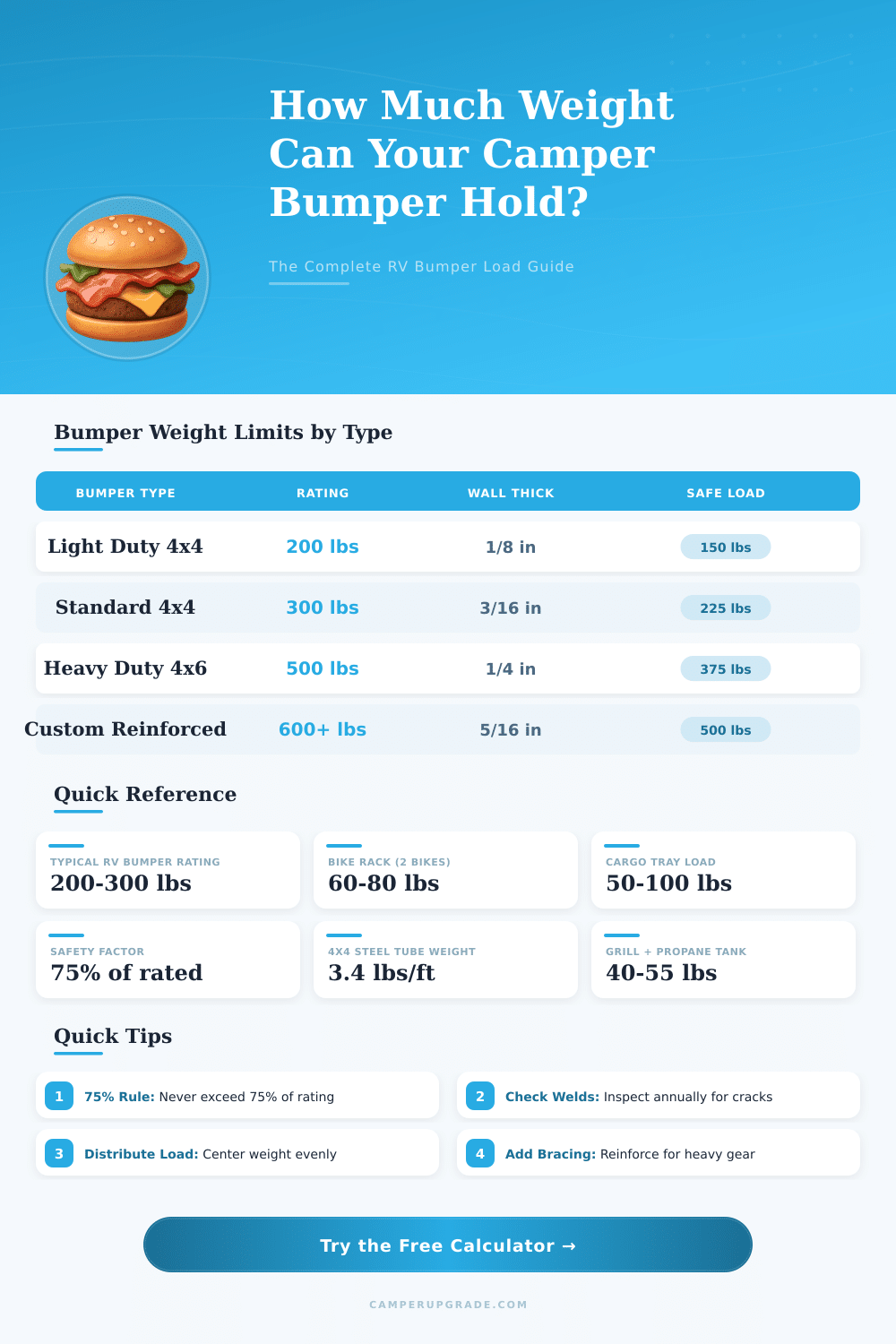
Most factory camper bumpers are 4×4 inch square steel tube with 1/8 inch walls, and those top out around 200 pounds. Bump to 3/16 inch wall thickness and youre looking at roughly 300 lbs. Thats the number I kept running into.
A 2 bike rack with loaded bikes weighs somewhere around 90 pounds total, which eats almost half a light duty bumpers capacity before you add anything else. Overhang matters too, 12 inches of extension cuts effective capacity by about 23%. Four mount points versus two changes everything.
Rear Camper Bumpers: Strength, Weight Limits and Extras
Two bolts drops your safe load by 30%. Ive seen bumpers rated at 300 lbs that realistically hold maybe 160 after factoring in 75% safety margin, a 6 inch extension, and fair condition with some rust. Road vibration multiplies static weight by 1.5x to 3x during travel so that 75% rule isnt just conservative, its necessary.
The back bumper of a camper or travel vehicle goes beyond simply being a decoration (it forms a key part of safety gear). This strong metal tube defends first in a crash at the back end absorbing the hits to save the body of the car. It also protects the parts of the travel system, that matters for every camping trip.
Almost all bumpers installed by the factory in campers are made of standard 4-inch square hollow metal tube. This standard matters, because many aftermarket parts and extras are designed to fit it (for example replacement bumpers), coverings, racks and fixtures. Racks especially commonly include practical features like vents and clamps, that eases the setup and removal.
Naturally, not every camper receives a back bumper directly from the factory. Here steps in the aftermarket. Bumper parts for truck campers come with all kinds of useful features, from storage boxes to LED lights and built-in stairs for simpler access.
Some even adapt to precise models of campers and arrive with guarantees for whole life.
bumper parts built to order for truck campers offer even more options, like combined step platforms, storage boxes and hitch receivers. For instance, the Camper bumper System stores a pair of rubber bumpers and cargo space, that fits every camper, helping neatly restore the look while keeping both the camper itself and the towed vehicles.
weight plays a big role regarding bumpers of campers. A simple 2-inch adapter hitch receiver can clamp itself to the 4-inch square pipe without drilling, and one estimates it widely at around 200 pounds of tongue weight. However the main limit comes from the skill of the bumper itself, not from the hitch, they are designed for good absorbing, not for heavy outside loads.
Showing bike racks on the back bumper happens commonly, but one must mind the forces in action. A stand for a 150-pound bike will seem much more heavy, when one bounces down the road, which can stress a dangerously week bumper frame. I heard too many stories about bumpers, that almost broke under such moving load.
For serious biking, a more rugged hitch receiver system or front mounted stand likely is the safer option, especially if the tongue weight already passes.
A common complaint against modern bumpers of trucks is, that they feel a bit soft and spongy, which hurts the trust of hitch points. Adding some support braces or clamp mounts on the bumper can fix those weaknesses. For the biggest loads, some owners even dump the factory bumper fully and weld on a more rugged custom steel version.
Grills form another common add-on for bumpers, with an outer swing mount, that allows extending the cooking stone when needed and tuck it for trips. Simply mind the risks of heat and fat… Setting the grill directly to the camper can cause ugly (and maybe dangerous) marks.
Widely the swing out variant stays the safer andfinal choice.
Spare tire carriers, that fit those standard 4-inch bumpers, give a handy removable mount point. One can swing them down for fast access to the back storage area, later tuck upward by means of a safety pin, when one is ready to go. Only recall, that extra weight can force use of more rugged mounts to bear the load.
In the end, the back bumper forms a critical, but commonly overlooked part of any camper or travel vehicle. With the right extras and little effort, it delivers basic protection, extra storage and full hosting of handy features to improve your camping trips. Simply make sure to mind the mount points and links; you do not want surprises, when you rush down the highway.