🔥 Camp Stove BTU Calculator
Find the right BTU output for your camping needs — adjust for pot size, altitude, temperature & group size
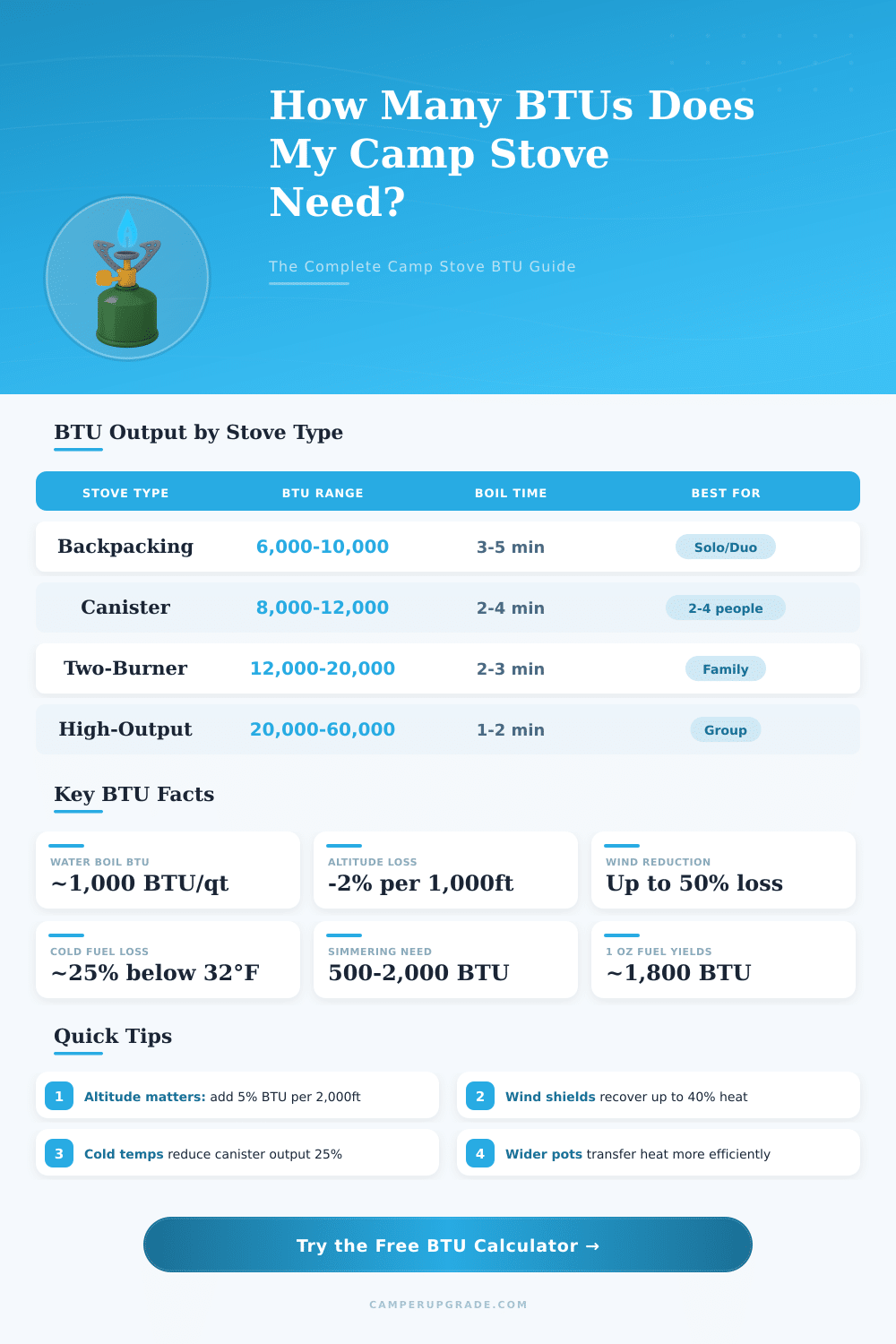
| Stove Type | BTU Range | Avg Boil Time (1 qt) | Best Group Size | Fuel Type |
|---|---|---|---|---|
| Backpacking Stove | 6,000 – 10,000 | 3–5 min | 1–2 people | Canister / liquid |
| Canister Stove | 8,000 – 12,000 | 2–4 min | 2–4 people | Isobutane canister |
| Single-Burner Propane | 10,000 – 14,000 | 2–3 min | 2–4 people | Propane canister |
| Two-Burner Propane | 12,000 – 20,000 | 2–3 min | 4–8 people | Propane tank |
| High-Output Burner | 20,000 – 60,000 | 1–2 min | 8+ people | Propane / butane |
| Wood Gasifier | 5,000 – 15,000 | 3–6 min | 1–4 people | Wood / biomass |
| Alcohol Stove | 1,000 – 3,000 | 8–15 min | 1 person | Denatured alcohol |
| Altitude (ft) | Altitude (m) | Boiling Point (°F) | Boiling Point (°C) | Extra BTU Needed |
|---|---|---|---|---|
| Sea Level (0) | 0 m | 212°F | 100°C | Baseline |
| 2,000 ft | 610 m | 208°F | 98°C | +2% |
| 4,000 ft | 1,220 m | 204°F | 96°C | +4% |
| 6,000 ft | 1,830 m | 201°F | 94°C | +6% |
| 8,000 ft | 2,440 m | 197°F | 92°C | +8% |
| 10,000 ft | 3,050 m | 194°F | 90°C | +10% |
| 12,000 ft | 3,660 m | 190°F | 88°C | +12% |
| 14,000 ft | 4,270 m | 187°F | 86°C | +14% |
| Water Volume | Volume (mL) | BTU to Boil (from 60°F) | kJ to Boil (from 15°C) |
|---|---|---|---|
| 8 oz (1 cup) | 237 mL | ~250 BTU | ~264 kJ |
| 16 oz (1 pint) | 473 mL | ~500 BTU | ~528 kJ |
| 32 oz (1 quart) | 946 mL | ~1,000 BTU | ~1,055 kJ |
| 64 oz (1/2 gal) | 1,893 mL | ~2,000 BTU | ~2,110 kJ |
| 128 oz (1 gal) | 3,785 mL | ~4,000 BTU | ~4,220 kJ |
| 2 gallons | 7,571 mL | ~8,000 BTU | ~8,440 kJ |
| Canister Size | Fuel Weight | Total BTU | Total kJ | Boils of Water (1 qt) |
|---|---|---|---|---|
| Small (100g) | 3.5 oz | ~5,500 BTU | ~5,800 kJ | ~5–6 boils |
| Medium (230g) | 8 oz | ~12,600 BTU | ~13,300 kJ | ~12–14 boils |
| Large (450g) | 16 oz | ~24,700 BTU | ~26,000 kJ | ~24–28 boils |
| 1 lb Propane | 16.4 oz | ~21,600 BTU | ~22,800 kJ | ~20–22 boils |
| 1 gal Propane | 4.2 lb | ~91,500 BTU | ~96,500 kJ | ~85–90 boils |
A camp stove can make or break the experience of cooking under the sky. One finds propane models for camping in portable, compact and multi-burner types, which makes them a reliable choice for any trip. Propane camp stoves are popular because of their ease, safety and efficiency.
They give strong and steady flame that lights easy and burns clean, even during wind or humidity.
Pick a Camp Stove and Use It Safely
The two-burner Coleman camp stove is most commonly used for car camping. It works well thanks to the regular changes of burners, so one can truly cook, not only boil water as on a little backpacking camp stove. Both dual-fuel and propane versions are available for purchase.
Basically, the Coleman two-burner is a simple but good enough solution for most of your needs, for many folks. Some install it in their van with a closing cover, that serves also as extra counter space when not in use.
For cooking in an RV, there are combos of camp stove and oven. For instance, a 2-in-1 model with three burners and an oven, all in a little package. Brands like Furrion offer RV ovens and cooktops, designed for home style of cooking in travel-friendly forms.
There are both electric induction and gas types, so the choice depends on your liking for the speed and accuracy of induction or the classic feel of open flame with gas. There is even an RV induction cooktop with two burners, that runs on 1800 watts and plugs into a regular 120V outlet.
RV ovens require a bit of practice, but they cook well after you master them. Some models have stainless steel with a cover, witch helps in small camps. Even so, some stainless types can be hard to set up well.
An important thing to know is that propane camp stoves can work with small 16-ounce disposable bottles. The downside of such tiny cans is the limited fuel supply. Some folks use an adapter to quickly attach to the built-in propane tank of their RV and thus run their camp stove without limits.
A propane camp stove with a 5-pound tank costs only a few dollars to refill.
Wood camp stoves are another option, and some companies sell small wood models for RV use. One can install a wood camp stove in a van, if it is small enough and has a proper chimney. The challenges include getting rid of smoke, space for wood, removal of ash and control of heat.
Safety is also key. Each camping truck should have a carbon monoxide detector. Using a propane camp stove to heat your RV or running it inside needs full attention against fire andhealth risks.
Camp stoves should mostly be used only outside.