⚓ Boat Trailer Tongue Weight Calculator
Calculate safe tongue weight, hitch class requirements & towing compatibility for your boat trailer
Max TW (lbs)
Max TW (lbs)
Max TW (lbs)
Max TW (lbs)
Max TW (lbs)
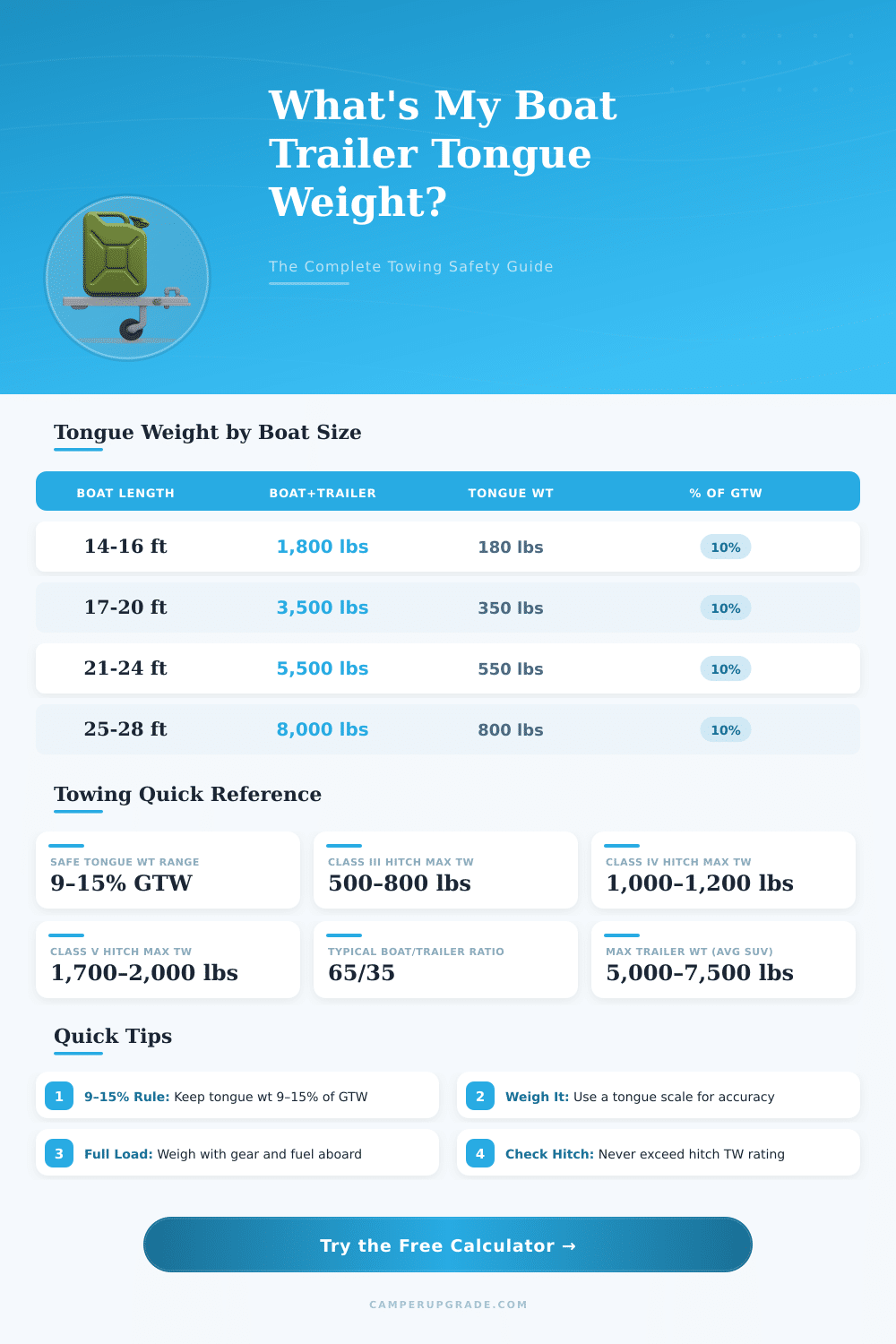
| Boat Length | Typical GTW (lbs) | Target TW 10% (lbs) | Target TW 12% (lbs) | Suggested Hitch |
|---|---|---|---|---|
| 10–14 ft (Jon/Canoe) | 800–1,500 | 80–150 | 96–180 | Class I or II |
| 15–17 ft (Bass/Fishing) | 1,500–2,800 | 150–280 | 180–336 | Class II or III |
| 18–20 ft (Runabout/Center) | 2,800–4,500 | 280–450 | 336–540 | Class III |
| 21–24 ft (Pontoon/Ski) | 4,500–7,000 | 450–700 | 540–840 | Class III or IV |
| 25–28 ft (Cabin/Cruiser) | 7,000–12,000 | 700–1,200 | 840–1,440 | Class IV or V |
| PWC / Jet Ski | 900–1,800 | 90–180 | 108–216 | Class I or II |
| Trailer Type | Typical TW % | Notes | Adjustment |
|---|---|---|---|
| Bunk Trailer | 10–12% | Boat sits fully on bunks | Slide boat forward to increase TW |
| Roller Trailer | 9–11% | Boat can shift slightly forward | Adjust boat position on rollers |
| PWC / Jet Ski | 8–12% | Lighter overall load | Center PWC on cradle |
| Pontoon Trailer | 10–15% | Long boat, axles centered | Distribute gear toward bow |
| Sailboat (keel) | 12–15% | Heavy keel shifts weight forward | Adjust mast step position |
| Hitch Class | Max GTW (lbs) | Max TW (lbs) | Receiver Size | Common Vehicle Types |
|---|---|---|---|---|
| Class I | 2,000 | 200 | 1-1/4 in | Compact cars, sedans |
| Class II | 3,500 | 350 | 1-1/4 in | Minivans, small SUVs, crossovers |
| Class III | 8,000 | 500–800 | 2 in | Full-size SUVs, mid-size trucks |
| Class IV | 10,000 | 1,000–1,200 | 2 in | Heavy-duty SUVs, full-size trucks |
| Class V | 20,000 | 1,700–2,000 | 2-1/2 in | Heavy-duty trucks, commercial |
| Pounds (lbs) | Kilograms (kg) | Pounds (lbs) | Kilograms (kg) |
|---|---|---|---|
| 100 lbs | 45.4 kg | 600 lbs | 272.2 kg |
| 200 lbs | 90.7 kg | 800 lbs | 362.9 kg |
| 300 lbs | 136.1 kg | 1,000 lbs | 453.6 kg |
| 400 lbs | 181.4 kg | 1,500 lbs | 680.4 kg |
| 500 lbs | 226.8 kg | 2,000 lbs | 907.2 kg |
tongue weight simply said is the pressure down, that loaded trailer puts on the ball of the hitch of your vehicle for towing. It matters a lot. If the weight is badly spread you get unstable and rough travel.
So controlling this weight is key for safe towing.
Why Tongue Weight Matters for Safe Towing
If the tongue weight is too little, the trailer starts to swing; that is that shaking and swaying nightmare. If it is too heavy, it pushes down the back part of the vehicle, what slows the steering response. Like this any change in the direction becomes a problem on the road.
For boat trailers, the ideal sits a bit between 5 and 15 percent of the whole loaded weight, and that includes everything: the trailer, the boat, the engine, the gasoline and all gear that you pull. Models with one axle best work at around 6 percent. For dual axles?
They usually favor 7 to 10 percent, depending on the situation. A quikc way to guess it is to split the whole weight by 10. So, if your boat with trailer and stuff weighs 3,200 pounds, aim for around 320 pounds for the tongue weight.
For something like a 2,000-pound loaded trailer, you would want the tongue weight to reach between 200 and 240 pounds at the hitch. Reaching this is hard, because boats do not move freely on trailers like normal goods on the road.
You have several ways to adjust the tongue weight. Open the winch and move it backwards, so that the boat slides more forward on the trailer when loaded. Also moving the axle can quickly shift the wait…
One boat owner shared, that 14 inches of backwards motion of the axle changed everything, from only 50 pounds to 160 pounds for an 18-foot boat.
Want to guess the tongue weight at home, without going to a store? Take a bathroom scale and set a vertical tube under the tongue of the trailer. Lower the front until the hitch rests on that tube, read the scale, then multiply by three.
That gives your real tongue weight.
Unloaded trailers for boats weigh somewhere from around 1,100 pounds to 4,400 pounds, depending on the quality of build. The average is around 2,200 pounds. When you load a big boat up, the weight grows fast, depending on the size of your trailer.
The height of the hitch on your tow vehicle also matters, adjust it, so that the tongue stays level during the trip. A little downward angle is fine, but too much tilt on the trailer messes up the weight spread on the tongue. Here is the reason: a low hitch does not truly lower the tongue weight.
It only spreads the load differently through your vehicle. And remember that batteries, propane tanks and extra gear all add to the tongue weight; thatyou must count.
Long trailers help for better stability and simpler control. If you shorten the real length by moving the axle forward? That truly hurts the overall stability.