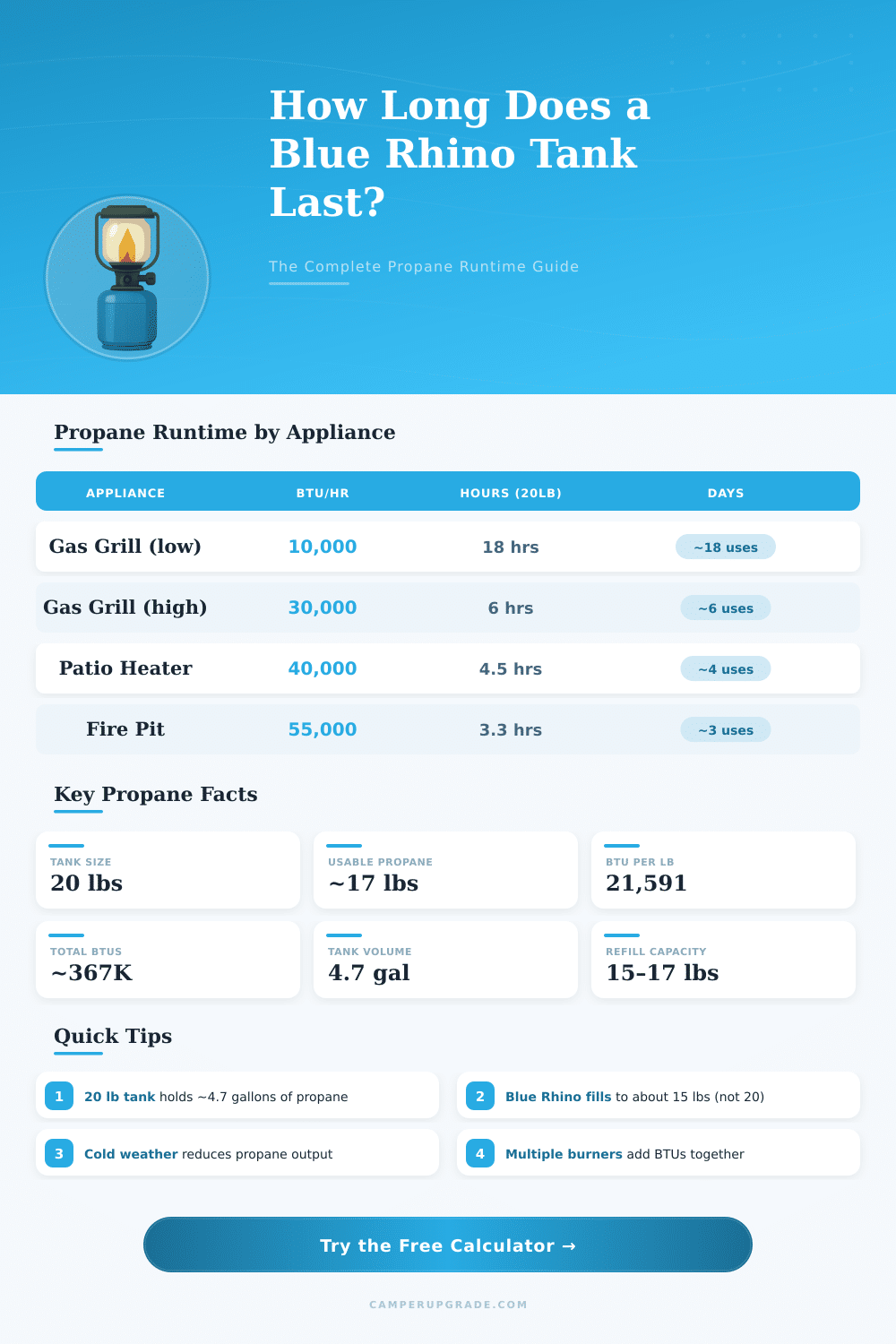
🔥 Blue Rhino Propane Tank Runtime Calculator
Find out exactly how long your 20 lb or 15 lb Blue Rhino propane tank will last for any appliance
| Appliance | BTU/hr | Total Hours | Sessions (1hr each) |
|---|---|---|---|
| Camp Stove (1 burner) | 7,500 | ~43 hrs | ~43 uses |
| Gas Grill (Low, 10K) | 10,000 | ~32 hrs | ~32 uses |
| Propane Smoker | 15,000 | ~21 hrs | ~21 uses |
| Gas Grill (Medium, 20K) | 20,000 | ~16 hrs | ~16 uses |
| Flat Top Griddle | 25,000 | ~13 hrs | ~13 uses |
| Gas Grill (High, 30K) | 30,000 | ~10.6 hrs | ~11 uses |
| Pizza Oven | 35,000 | ~9.1 hrs | ~9 uses |
| Patio Heater | 40,000 | ~8 hrs | ~8 uses |
| Propane Fire Pit | 55,000 | ~5.8 hrs | ~6 uses |
| Torpedo Heater | 60,000 | ~5.3 hrs | ~5 uses |
| Turkey Fryer | 65,000 | ~4.9 hrs | ~5 uses |
| Specification | Exchange Tank | Full 20 lb Tank | Unit |
|---|---|---|---|
| Propane Weight | ~15 lbs | ~20 lbs | pounds |
| Propane Weight (metric) | ~6.8 kg | ~9.1 kg | kilograms |
| Liquid Volume | ~3.5 gal | ~4.7 gal | gallons |
| Total BTU Content | ~323,865 | ~431,820 | BTU |
| Total kWh Equivalent | ~94.9 | ~126.5 | kWh |
| BTU per lb of propane | 21,591 | BTU/lb | |
| Tank Tare Weight (empty) | ~17 lbs | pounds | |
| BTU/hr | Kilowatts (kW) | Hours (15 lb tank) | Hours (20 lb tank) |
|---|---|---|---|
| 5,000 | 1.46 kW | 64.8 hrs | 86.4 hrs |
| 10,000 | 2.93 kW | 32.4 hrs | 43.2 hrs |
| 20,000 | 5.86 kW | 16.2 hrs | 21.6 hrs |
| 30,000 | 8.79 kW | 10.8 hrs | 14.4 hrs |
| 40,000 | 11.72 kW | 8.1 hrs | 10.8 hrs |
| 50,000 | 14.65 kW | 6.5 hrs | 8.6 hrs |
| 60,000 | 17.58 kW | 5.4 hrs | 7.2 hrs |
| 80,000 | 23.44 kW | 4.1 hrs | 5.4 hrs |
| 100,000 | 29.30 kW | 3.2 hrs | 4.3 hrs |
Propane Tank come in many different sizes. At the smallest end, there are portable tanks that weigh only 20 pounds. On the other end of the range, we find huge tanks that store more than 2,000 gallons.
The right size depends on the layout of your home and the number of devices that run on propane. For those with very large setups, tanks of around 30,000 gallons usually are the most popular option, although some sites go even up to 120,000 gallons.
How to Choose a Propane Tank
The most many grills for gas use the usual tank of 20 pounds, that carries around 4.7 gallons of propane. Also, makers offer sizes of 5, 10, 33 and 40 pounds. One also finds choices of 45.6 gallons and 120 gallons on the market.
The materials range according to your needs, steel and aluminum both are common, and you can choose vertical or horizontal setups. Horizontal tanks commonly show up on vans and sometimes carry liquid propane. Also, there are undermount tanks, designed specially for RVs, that receive full approval.
Those tanks work well for camping, grilling, homes and home heating. A tank of 5 pounds works great for a portable home. With a tank of 20 pounds at average heat on a grill, you can expect around one weak of everyday use.
So maybe two hours each evening. The Flame King tanks of 10 pounds fit flat in a truck bed, what makes them very handy for camping trips. Some prefer 11-pound tanks for portable grills and camping fires, too.
Refill beats exchange in cost. If you stop somewhere at a place like U-Haul to refill, it costs around 17 to 20 dollars for almost 4 gallons of propane. Programs for exchange at big box stores?
They are more expensive, and honestly, they usually fill only up to 75% of capacity because of safety. A new tank of 20 pounds costs between 50 and 65 dollars, before adding the propane. After you have the tank, refilling it comes to around 4 dollars per gallon.
Overall, propane averages around 40 to 50 cents each pound.
The expiration date really matters here. Many stations for refill do not accept a tank that expired. When recertification must happen, sometimes it is better to simply buy a new one than pay for the papers and process of recertification.
The point is that propane itself does not go bad, it stays stable almost forever. What needs attention is painting the tank and swapping the valve every few years. Because propane is very flammable and explosive under pressure, safety is not something optional.
It also expands and shrinks a bit with temperature changes. Every tank that you buy must have a seal from CSA or UL laboratories and meet federal approval. Quick note: tanks for propane and for air are not the same.
They work with totally different pressures and have mismatched connections.
While camping, many folks keep little tanks of 1 pound of propane in their car. Opening the windows for fresh air is worth the effort. Some leave them outside during the winter.
Even so, using portable camping fires on tanks of 1 pound is not really recommended. The flow differs from that of tanks of 5 pounds and bigger, what can cause flames thatburn unevenly or even worse.