🚴 Bike Trail Distance Calculator
Calculate surface material needed for bike trail construction — gravel, crushed stone, and more
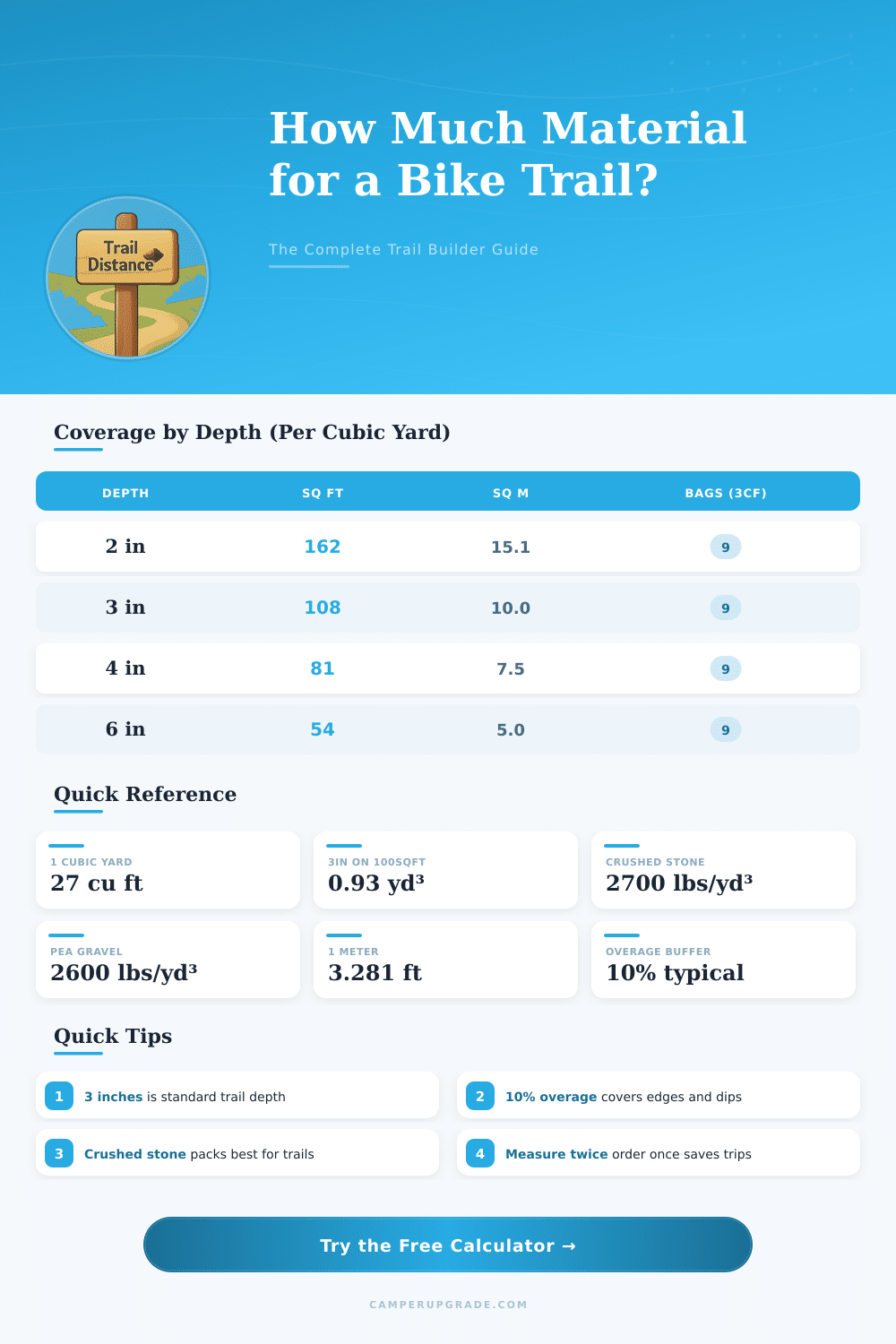
| Depth | Sq Ft Covered | Sq M Covered | Trail Length at 6ft Wide |
|---|---|---|---|
| 1 in (2.5 cm) | 324 | 30.1 | 54 ft (16.5 m) |
| 2 in (5 cm) | 162 | 15.1 | 27 ft (8.2 m) |
| 3 in (7.6 cm) | 108 | 10.0 | 18 ft (5.5 m) |
| 4 in (10 cm) | 81 | 7.5 | 13.5 ft (4.1 m) |
| 6 in (15 cm) | 54 | 5.0 | 9 ft (2.7 m) |
| Bag Size | Volume per Bag | Bags per Cubic Yard | Coverage at 3in Deep |
|---|---|---|---|
| Small (0.5 cu ft) | 0.5 cu ft (14.2 L) | 54 bags | 2 sq ft (0.19 m²) |
| Standard (1 cu ft) | 1 cu ft (28.3 L) | 27 bags | 4 sq ft (0.37 m²) |
| Medium (2 cu ft) | 2 cu ft (56.6 L) | 13.5 bags | 8 sq ft (0.74 m²) |
| Large (3 cu ft) | 3 cu ft (85 L) | 9 bags | 12 sq ft (1.11 m²) |
| Project Type | Area | Cubic Yards (3 in) | Bags Needed (2 cu ft) |
|---|---|---|---|
| Singletrack 200×4 ft | 800 sq ft | 7.4 yd³ | 100 |
| Standard Trail 500×6 ft | 3,000 sq ft | 27.8 yd³ | 375 |
| Wide Bikeway 300×10 ft | 3,000 sq ft | 27.8 yd³ | 375 |
| Skills Area 50×50 ft | 2,500 sq ft | 23.1 yd³ | 313 |
| Connector Path 100×5 ft | 500 sq ft | 4.6 yd³ | 63 |
| Trailhead Pad 30×30 ft | 900 sq ft | 8.3 yd³ | 113 |
| Long Gravel Path 1000×6 ft | 6,000 sq ft | 55.6 yd³ | 750 |
A single cubic yard of crushed stone only covers about 108 square feet at 3 inches deep, and for a 6 foot wide bike trail thats barely 18 feet of length. Thats nothing. A 500 foot singletrack section at 4 inches chews through roughly 12 yards which can weigh over 33,000 pounds depending on the aggregate.
Compacted gravel (ABC mix) runs close to 2800 pounds a yard, way heavier than recycled asphalt at around 2400. I keep adding 10 to 15 percent overage on every trail project because compaction alone eats 12 percent of loose depth.
How to Choose a Bike and How Much Gravel You Need
The information below does not come from any calculator or tool used on that page. It is based on actual exploration, discussions in forums and experiences of cyclists from various websites.
Bikes have many different kinds. One finds mountain bikes, road bikes, hybrid bikes, cross bikes, electrical bikes, tandem bikes, gravel bikes, city bikes and even repair tools together with unique fast models. Also used bikes are available for those that want to spare money.
Because of that wealth of options, choosing the right one can seem a bit overwhelming at first.
One of the main points during buying of a bike is the suitability. Suitability means various things at different levels. Usually it means that the frame of the bike has the right size and that all adjustments are done according to proper principles.
Moreover, the cost of the bike and its accessories must suit your budget for cycling. Think about that as about buying costly handmade Italian shoes. If you pay a lot, you expect perfect adjustments.
The size of a bike is made up of several measures that decide how well it suits the rider. It covers the frame size, the length of the seat tube and the diameter of the wheels. That ensures proper performance, extension of the legs and general handling.
While sitting on the bike, the inner leg length extends between the chair and the pedal. Because the leg length and the physical height commonly match at many folks, one can attach precise frame sizes to particular physical heights.
To find the ideal size, measure your height and the inner leg length. Stand directly against the wall and mark the line at the top of your head by means of a pencil. Charts for sizes are available for road, mountain, hybrid and kids bikes.
There is no unique chart for every brand or kind because they use slightly different measures. Those guides work as a starting point, and checking with the official chart of the brand ensures the most accurate suitability.
When your measures fall between two frame sizes, the usual advice is choose the smaller one. Many things can be adjusted easily after purchase, like the height of the chair, the position of the chair and the height of the stem. Every maker of bikes has his own opinions about good frame shape.
Not all of them are entirely right. They can be alike, but knowing what suitability works four you helps to remove bikes that never will feel comfortable.
A hybrid bike works well for someone that travels by means of it on pavements in a small city, takes the bus for short distances and sometimes rides on nice trails in a near national park. Hybrid bikes combine parts of various kinds, without being too specialized.
The best moment to buy a bike is not in summer. Then the season sales are in full activity. Visiting a local bike store in autumn or winter allows you to receive full service, have right size, sort the wanted model without risk of absence of stocks and maybe haggle about the price.
Cycling often is useful for heart health. It strengthens the legs and quite a lot helps the core muscle. Even so, the upper body force can drop over time.
National Bike Month happens since 1956. It gives a chance to stress the many benefits of cycling and inspire folks to try it. Communities of cyclists are present everywhere, from online forums about road, mountain and electrical bikes, to local groups in cities like Los Angeles, Pittsburgh, Colorado, Washington D.C.
And New York. Podcasts about bike support honor rides, groups, activists, sportsmen, commuters and the bike itself as an earth-friendly, human-powered form of transportation. The world meetings of cyclists accept riders of all levels of fitness, including those that do nothave a bike.
For folks that travel long distance by means of a bike, cooking really does require a plan. Bearing lightweight kitchen gear, big jars or even tiny wood-burning stoves works well. Heating water for bag cooking of dried foods is an easy mode.
Dry foods from stores along the way mix in a bag with warm water for a fast meal. Big gear is the most lightweight, but for most riders it matters to cook safely more than the weight of the jar.