🎒 Backpacking Gear Weight Calculator
Add your gear items by category, calculate total pack weight, and see your base weight vs. consumable weight breakdown
| Item | Ultralight | Lightweight | Traditional |
|---|
| Classification | Base Weight (lbs) | Base Weight (kg) | Typical For |
|---|
| Item | Weight per Unit | Metric | Notes |
|---|
| Trip Type | Duration | Total Weight (lbs) | Total Weight (kg) |
|---|
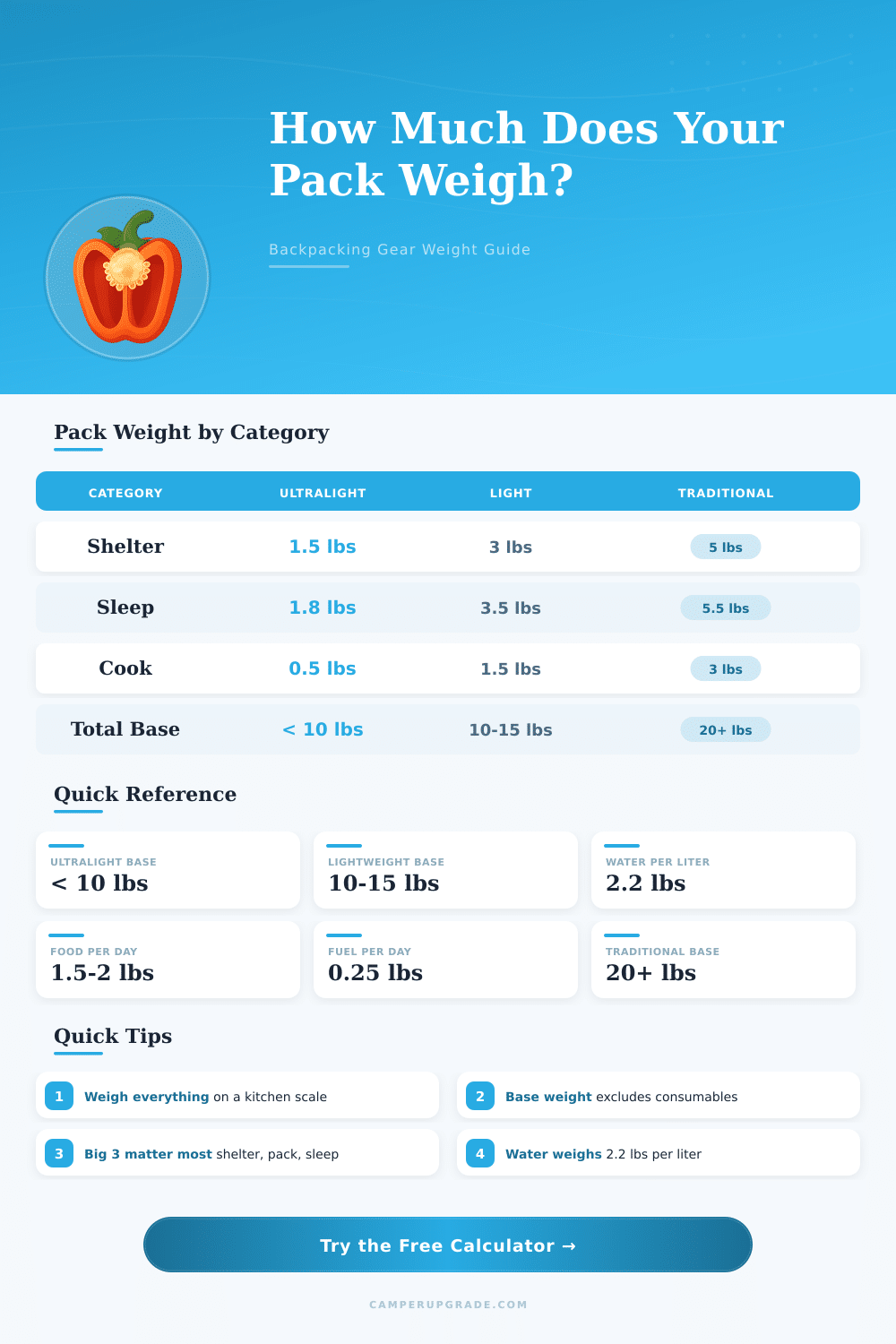
A single liter of water adds 2.2 pounds to your pack and most people carry 2 to 4 liters, so thats anywhere from 4.4 to 8.8 pounds just in water. Food runs about 1.5 to 2 pounds per day if youre packing calorie dense stuff around 100 to 125 calories per ounce. On a 5 day trip consumables alone can hit 18 pounds easy.
Shelter, sleep system, and pack make up roughly 60 to 70 percent of base weight for most hikers I know. An ultralight base sits under 10 pounds while traditional setups often land between 15 and 25 pounds which is a huge range.
Mountain Hiking: What to Pack and How Much It Weighs
Well, we dive in this summary about gear for mountain hiking. Stories from the real life of hikers and campers from the net help us judge clearly the needed stuff.
Mountain hiking is not simple cause, the list of gear can seem scary at the first look. Even so some main parts form the base of the “Big Three” around that everything other builds: the rucksack, the tent and the sleeping bag. Choosing them well can change entirely your journey.
The size of rucksack depends much on the length of your trip and amount of food, that you must carry. For 5-6 days, rucksack of 30-50 liters will suffice for the basic stuff, during fast trips maybe require only 40 liters. While longer journeys, 50-70 liters are the best, although some real light packers succeed with even less.
Day packs range of 15 until 35 liters; the little answer for half days in the hills, while bigger help for full day or winter trips.
One must recall, that the capacity of rucksacks ranges a lot between makers. 40 liters at one brand can feel entirely differently than 40 liters at another. Important is the whole internal space together with the outside pockets.
And those narrow, high 45-liter mountain packs is something entirely other than your usual everyday rucksack.
There are some reliable brands for rucksacks, that one consider, Osprey, Gregory, Hyperlite and Zpacks offer good options. The Hyperlite Southwest 55 is real solid value. Gregory packs also commonly please, especially during discounts.
And do not overlook the cheap no-brand packs on Amazon (here one truly saves money).
When dealing about tents, the mid-range models commonly are the best choice. No need to spend for the most expensive, to have something, that will serve years. The Nemo Hornet 2P and Big Agnes Tiger Wall 2P both anwser well.
The X-Dome 1+ gives a lot of space above the head for one person; that 50-inch beam at the top helps to hide the contents of your rucksack.
About pads for sleep, the line Therm-a-Rest NeoAir (XLite, Uberlite, Xtherm) are hardly beat. Combine one from them with cheap foam pad below, and you will be comfortable. You stay warm and happy, regardless of the season.
For cooking in tent, main is weight, size and fuel savings. If you mostly use dried foods, simple stove and long spoon will suffice. Something in the size of a card deck, that fits to a butane candle, is ideal.
And cook gear, that fits together, saves place in the rucksack.
Some others give tips four the way: Use a trash bag as liner for the rucksack, to stop stuff dry. Swap heavy bottles against throwaway plastic ones. Have precise weight at home, to well count your base.
And always prepare for cold or wet sky, puffy coat is absolutely needed. And a little camp chair like the Yizi Lite changes the game for long days of hiking.
Many things to think, I know. But build the main “Big Three” gear and later add the right extras is the key to comfortable and practical mountain hiking. It all deals aboutfinding what most works for your own journeys.