🏟 Backpacking Base Weight Calculator
Enter your gear items by category — get your total base weight and see where you stand against ultralight benchmarks
| Item Name | Category | Weight (oz) | Qty | Remove |
|---|
| Item Name | Category | Weight (oz) | Qty | Remove |
|---|
| Item Name | Category | Weight (oz) | Qty | Remove |
|---|
| Item Name | Category | Weight (oz) | Qty | Remove |
|---|
| Item Name | Category | Weight (oz) | Qty | Remove |
|---|
| Item | Ultralight Target | Lightweight Target | Traditional Avg | Metric (UL target) |
|---|---|---|---|---|
| Tent / Shelter | 14–24 oz | 24–48 oz | 48–96 oz | 400–680 g |
| Sleeping Bag / Quilt | 10–18 oz | 18–32 oz | 32–64 oz | 280–510 g |
| Sleeping Pad | 8–14 oz | 14–20 oz | 20–36 oz | 225–400 g |
| Backpack (empty) | 16–32 oz | 32–48 oz | 48–80 oz | 450–900 g |
| Rain Jacket | 4–8 oz | 8–14 oz | 14–24 oz | 115–225 g |
| Footwear (trail runners) | 6–10 oz | 10–16 oz | 16–32 oz | 170–285 g |
| Cook System (pot+stove) | 3–6 oz | 6–12 oz | 12–24 oz | 85–170 g |
| Water Filter | 2–4 oz | 4–8 oz | 8–16 oz | 57–115 g |
| Navigation (GPS/compass) | 2–4 oz | 4–8 oz | 8–14 oz | 57–115 g |
| First Aid Kit | 3–5 oz | 5–10 oz | 10–16 oz | 85–140 g |
| Body Weight | 10% Rule (Max Total) | 20% Rule (Comfortable) | Ideal Base Weight | Max Base Weight |
|---|---|---|---|---|
| 120 lbs (54 kg) | 12 lbs / 5.4 kg | 24 lbs / 10.9 kg | 8–12 lbs | 15 lbs |
| 140 lbs (64 kg) | 14 lbs / 6.4 kg | 28 lbs / 12.7 kg | 9–14 lbs | 18 lbs |
| 160 lbs (73 kg) | 16 lbs / 7.3 kg | 32 lbs / 14.5 kg | 10–16 lbs | 20 lbs |
| 180 lbs (82 kg) | 18 lbs / 8.2 kg | 36 lbs / 16.3 kg | 11–18 lbs | 22 lbs |
| 200 lbs (91 kg) | 20 lbs / 9.1 kg | 40 lbs / 18.1 kg | 12–20 lbs | 25 lbs |
| 220 lbs (100 kg) | 22 lbs / 10 kg | 44 lbs / 20 kg | 13–22 lbs | 27 lbs |
| Gear Category | Item | Light Range (oz/g) | Average Range (oz/g) | Counts Toward Base? |
|---|---|---|---|---|
| Shelter | Single-wall tent | 28–40 oz / 800–1130g | 56–80 oz / 1600–2270g | Yes |
| Shelter | Tarp/bivy combo | 10–18 oz / 285–510g | 18–32 oz / 510–910g | Yes |
| Sleep | Down quilt (30°F) | 12–18 oz / 340–510g | 24–36 oz / 680–1020g | Yes |
| Sleep | Inflatable pad (R3) | 10–14 oz / 285–400g | 16–24 oz / 450–680g | Yes |
| Pack | Frameless pack 40L | 10–18 oz / 285–510g | 28–48 oz / 795–1360g | Yes |
| Pack | Framed pack 65L | 40–56 oz / 1135–1590g | 64–96 oz / 1815–2720g | Yes |
| Kitchen | Canister stove system | 3–5 oz / 85–140g | 8–14 oz / 225–400g | Yes (no fuel/food) |
| Kitchen | Water bottle 1L | 2–4 oz / 57–115g | 4–8 oz / 115–225g | Yes (empty) |
| Navigation | Smartphone + case | 6–8 oz / 170–225g | 8–12 oz / 225–340g | Yes |
| Clothing | Down jacket | 8–12 oz / 225–340g | 16–24 oz / 450–680g | Yes (packed) |
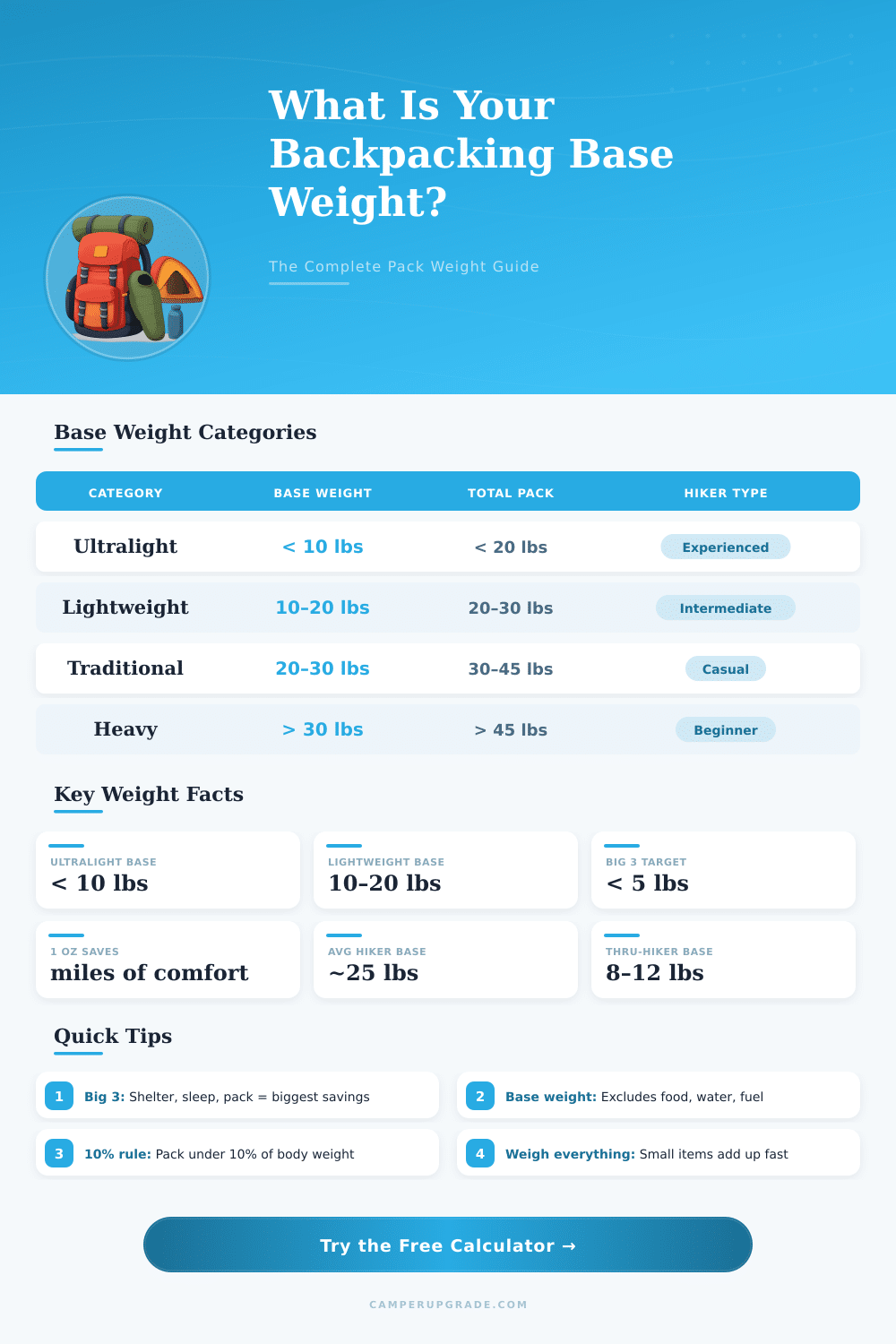
The base weight is made up of the whole mass of every gear that one carries in a backpack during a journey, but without the supplies. Among those supplies is something like food, drink and fuel. That change of weight when one uses them during the march, does not count.
So, basically, the base weight is everything that one measures at the start, before using any supply.
What Is Backpack Base Weight and How to Make It Lighter
To estimate the base weight, one fills the backpack with every gear except food and drink. Later one uses a hanging scale to estimate the whole weight. Another way is stand on a floor scale, note the weight, later lay the backpack on the back and weigh yourself again.
One subtracts the first value from teh second.
To estimate the base weight, one finds three main kinds of backpackers. The ultralight group aims for weight under 10 pounds. Lightweight backpackers fall between 10 and 20 pounds.
Usual or standard backpackers have 20 pounds or more, commonly under 30 pounds. Some hikers that aim for ultralight style, press their base weight even to 7 to 10 pounds, depending on there choices for sleeping bag, tent, tarp and ground pads.
For most folks, a good base weight falls between 10 and 20 pounds. Carrying around 10 to 15 percent of your body mass helps to protect the joints and stay comfortable. The climate plays a big role also.
During warmer season with lows around 50 to 60 degrees, the base weight can stay around 12 pounds. In cold weather down to about 10 degrees, it can rise to 20 pounds. Winter backpacking requires more food for extra calories, and possibly a stove for warm meals, which adds fuel weight to everything else.
The biggest savings of weight come from the “Big Four“. Backpack, shelter, sleeping bag and sleeping pad. A sample shows how one dropped the base weight from more than 25 pounds to around 12.75 pounds, only by paying attention to backpack, sleeping bag and tent.
Even so, choosing more lightweight gear costs money. One sometimes describes ultralight gear as easy, if the budget allows.
Many long-range hikers start in the range of 15 to 20 pounds and leave some stuff along the way that they did not use at all. In the end, they commonly reach around 15 pounds. Keeping the whole weight with food and drink under 40 pounds forms a good starting point.
There is also the idea of base camp style trips, where hikers walk to a place, set up camp and do day trips from here. That helps to reduce the weight of water, because one does not have to drag everything at once.
Almost each backpacker carries at least one or two luxury items during trips, even when one tries to lower the base weight. Getting tips for cutting weight while keepingthose extra items can make the whole trip more pleasant.