🛻 RV Length Calculator & Size Guide
Find the average length of any RV type and compare sizes in feet or meters
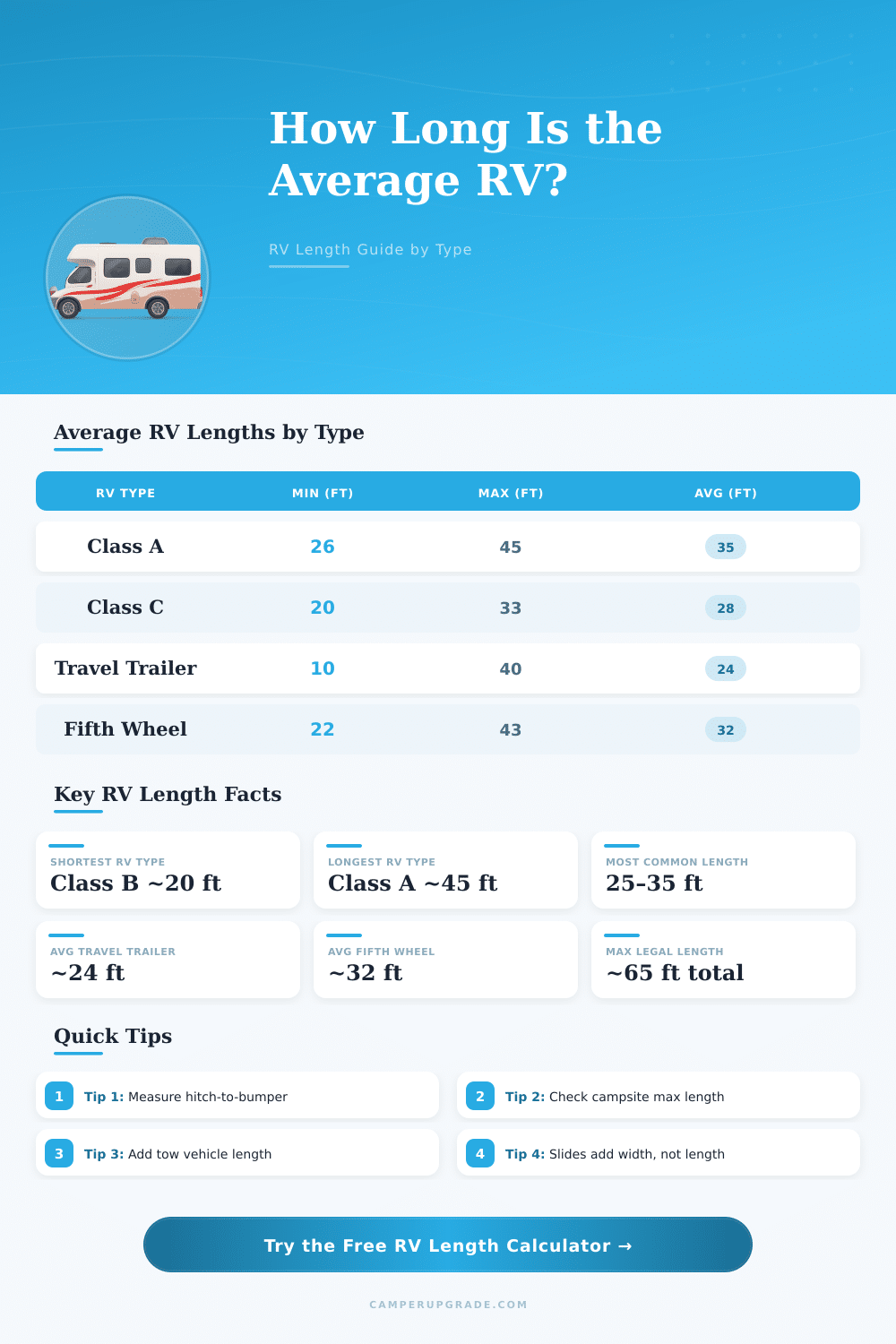
| RV Type | Min Length | Max Length | Average Length | Avg Width | Avg Height |
|---|---|---|---|---|---|
| Class A Motorhome | 26 ft (7.9 m) | 45 ft (13.7 m) | 35 ft (10.7 m) | 8.5 ft (2.6 m) | 12.5 ft (3.8 m) |
| Class B Van Camper | 17 ft (5.2 m) | 24 ft (7.3 m) | 20 ft (6.1 m) | 7 ft (2.1 m) | 8 ft (2.4 m) |
| Class C Motorhome | 20 ft (6.1 m) | 33 ft (10.1 m) | 28 ft (8.5 m) | 8.5 ft (2.6 m) | 11 ft (3.4 m) |
| Travel Trailer | 10 ft (3.0 m) | 40 ft (12.2 m) | 24 ft (7.3 m) | 8 ft (2.4 m) | 10 ft (3.0 m) |
| Fifth Wheel | 22 ft (6.7 m) | 43 ft (13.1 m) | 32 ft (9.8 m) | 8.5 ft (2.6 m) | 13 ft (4.0 m) |
| Toy Hauler | 24 ft (7.3 m) | 42 ft (12.8 m) | 30 ft (9.1 m) | 8.5 ft (2.6 m) | 12 ft (3.7 m) |
| Pop-Up Camper | 8 ft (2.4 m) | 20 ft (6.1 m) | 14 ft (4.3 m) | 7.5 ft (2.3 m) | 4 ft (1.2 m) closed |
| Truck Camper | 6 ft (1.8 m) | 14 ft (4.3 m) | 10 ft (3.0 m) | 7 ft (2.1 m) | 8 ft (2.4 m) |
| Campsite Size | Max RV Length | Suitable For | Metric Equivalent |
|---|---|---|---|
| Small Site (20 ft) | up to 20 ft | Class B, Pop-Up, Truck Camper | up to 6.1 m |
| Standard Site (30 ft) | up to 30 ft | Class C, Travel Trailer, Small Class A | up to 9.1 m |
| Large Site (40 ft) | up to 40 ft | Fifth Wheel, Class A, Toy Hauler | up to 12.2 m |
| Pull-Through (50 ft) | up to 50 ft | Class A + tow car, large combos | up to 15.2 m |
| Big Rig Site (65 ft) | up to 65 ft | Super C + toad, large Class A combos | up to 19.8 m |
| Feet | Inches | Meters | Centimeters |
|---|---|---|---|
| 10 ft | 120 in | 3.05 m | 304.8 cm |
| 20 ft | 240 in | 6.10 m | 609.6 cm |
| 24 ft | 288 in | 7.32 m | 731.5 cm |
| 28 ft | 336 in | 8.53 m | 853.4 cm |
| 32 ft | 384 in | 9.75 m | 975.4 cm |
| 35 ft | 420 in | 10.67 m | 1066.8 cm |
| 40 ft | 480 in | 12.19 m | 1219.2 cm |
| 45 ft | 540 in | 13.72 m | 1371.6 cm |
Always measure from the front bumper (or hitch ball) to the rear bumper. Do NOT include bike racks, spare tires, or air conditioner units that extend beyond the body — but do include them when checking campsite clearance.
For towable RVs (travel trailers, fifth wheels), always add the tow vehicle length plus the hitch/tongue distance (typically 3–5 ft) to get total combo length. Most states limit total combo length to 65 ft.
When talking about buying RV vehicles, big details matter more than many folks think. The typical RV has length between 20 and 40 feet, height of 10 to 14 feet and width around 8 feet. Class A motorhomes, the heaviest, reach 26 to 45 feet.
The Class B, which are smaller, have maximum of 17 to 23 feet outside. RV trailers range a lot, from only 6 to 40 feet long, with widths between 4 and around 8.5 feet.
How RV Length Affects Where You Can Park
The length that you choose depends mostly on the places where you plan to park. Here what I noticed: RV vehicles under 19 feet fit in almost 98% of the camping spots in national parks. When you reach 25 feet or less, that drops to around 93 percent.
If you go to 29 feet, only 84% of parks will accept you. For 35 feet, only 73% of camping spots in parks will have space big enough. The average length in United States is 27 feet, which shows that the best range for national parks sits between 25 and 30 feet.
Everything above 30 feet can cause problems. For instance, the Mather campground beside the Grand Canyon has around 300 places with maximum length of 31 feet. But actually, only 7 or 8 of them truly accept such big ones.
I found the same situation other places: some campgrounds say that they take 35-footers, but after deeper research, only two places work for that size. Most places limit too 27 or 30 feet. Both campgrounds in Canyonlands National Park cap at 28 feet for everything.
Various parks hit you with different limits. Joshua Tree National Park keeps many of its roads to 22 feet maximum. At the Grand Bank, the limits are even stricter, around 24 to 25 feet.
Yosemite and parks alike do not allow RV vehicles above 34 feet on some roads. Yellowstone and Yosemite however have some spots for 40-footers, although truly, in Yosemite Valley many hundresd of places work well for 35-foot RV vehicles.
State laws add extra problems. Most states set the limits for motorhomes between 40 and 45 feet. California is different, here the whole length limits to 65 feet, sometimes even 75 feet depending on conditions.
Trailers limit to 28 feet and 6 inches, while motorhomes to 40 feet. In Alberta, the rules are different, with maximum of 13 metres for motorhomes and 20 metres for the whole combination.
Here is where folks commonly mess up: the listed size commonly points to the basic length, not the whole reality. When you book a campground, they want to know your whole need for space. From my experience, around 30 feet works well for a family of four.
Above 40 feet, your choices sharplydrop, even in private parks. The longest RV apparently was a fifth wheel of 57 feet, weighing 37 000 pounds and with 7 sliding sections, that is extreme.