🔋 AGM Battery Life Calculator
Estimate how long your AGM battery will last based on capacity, load, and usage conditions
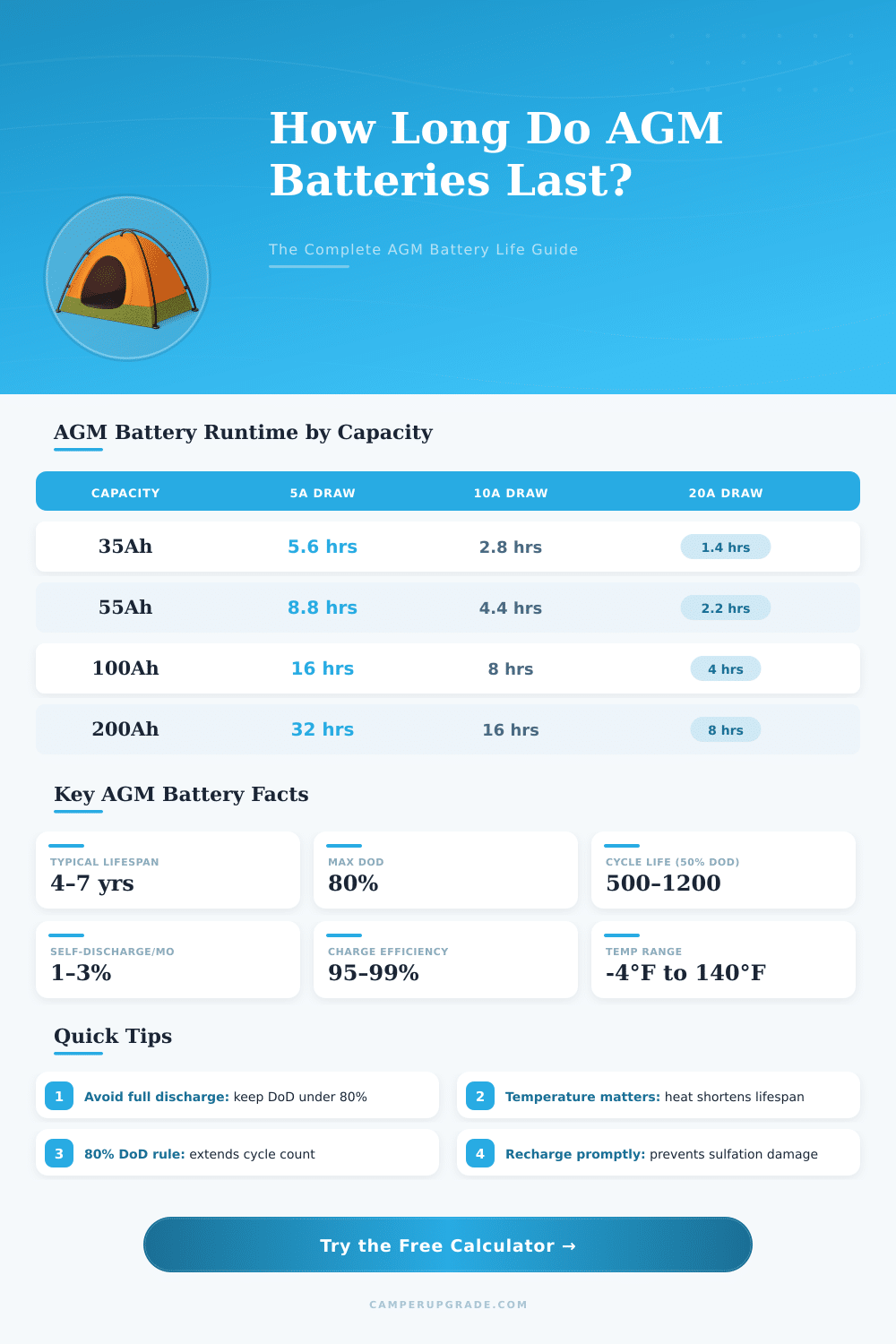
| Capacity (Ah) | 3A Load | 5A Load | 10A Load | 15A Load | 20A Load | 30A Load |
|---|---|---|---|---|---|---|
| 35 Ah | 9.3 hrs | 5.6 hrs | 2.8 hrs | 1.9 hrs | 1.4 hrs | 0.9 hrs |
| 55 Ah | 14.7 hrs | 8.8 hrs | 4.4 hrs | 2.9 hrs | 2.2 hrs | 1.5 hrs |
| 75 Ah | 20 hrs | 12 hrs | 6 hrs | 4 hrs | 3 hrs | 2 hrs |
| 100 Ah | 26.7 hrs | 16 hrs | 8 hrs | 5.3 hrs | 4 hrs | 2.7 hrs |
| 150 Ah | 40 hrs | 24 hrs | 12 hrs | 8 hrs | 6 hrs | 4 hrs |
| 200 Ah | 53 hrs | 32 hrs | 16 hrs | 10.7 hrs | 8 hrs | 5.3 hrs |
| DoD (%) | Float/Standby Cycles | Cyclic AGM Cycles | Deep Cycle AGM | Est. Calendar Life |
|---|---|---|---|---|
| 30% | 800–1500 | 1000–2000 | 1500–3000 | 6–10 years |
| 50% | 400–700 | 500–1200 | 800–1500 | 4–7 years |
| 80% | 200–400 | 300–600 | 400–800 | 3–5 years |
| 100% | 100–200 | 150–300 | 200–400 | 1–2 years |
| Temperature (°F) | Temperature (°C) | Capacity Factor | Example: 100Ah Battery | Impact |
|---|---|---|---|---|
| 32°F | 0°C | 80% | 80 Ah effective | Significant loss |
| 50°F | 10°C | 88% | 88 Ah effective | Moderate loss |
| 68°F | 20°C | 96% | 96 Ah effective | Minor loss |
| 77°F | 25°C | 100% | 100 Ah effective | Rated capacity |
| 95°F | 35°C | 103% | 103 Ah effective | Slight gain |
| 104°F | 40°C | 102% | 102 Ah (ages faster) | Lifespan reduced |
AGM Batteries are now a popular choice for owners of RVs, and it matters to understand them well. They represent the acronym for absorbent glass mat the newest member in the family of lead-acid batteries, that includes also gel-type and flooded variants. Truly surprising is, that some of those AGM Batteries are made manually according to combat standards, what truly shows everything about the high quality of their build.
The technology itself existed since 1985, and one developed it specially for military planes, where efficiency, weight, safety and reliability could not be risked. Later that same idea entered the market of consumer batteries, for instance in the range of Lifeline for maintenance-free deep-cycles. Makers of RVs and ships use AGM Batteries for years, trust in them to hold up in real situations.
All About AGM Batteries for Your RV
Here where AGM Batteries truly shine… They will not drain everything above your frame. Compared to average lead-acid models, they much better keep their charge.
Rather than flooded batteries, AGM Batteries will not sulfate, if your RV stands unused during months. So, when you are ready to travel after a long pause, the battery should work mostly well. Moreover, they handle vibrations very well, what is useful during roads with stonse or when you park on rough soil.
Other good point of AGM Batteries? They are fully maintenance-free. No need to mix with water, as with wet cells.
You get also longer cycle life than with flooded RV batteries, that truly helps. But hear the main limit: most AGM Batteries reach only around 500 charge cycles, while lithium can go almost to 3000. Honestly, that is quite a big gap over long time.
Talking about real power, the patterns become clear. A lithium battery rated at 100 Ah allows to use up to 80 or 90 percent of its power. For AGM Batteries at same 100 Ah?
You indeed only get around 50 Ah before charging again. So, if you use your RV only some months yearly, AGM Batteries maybe work perfectly. Full-time nomadic life though…
Here lithium truly shines. One important note: AGM Batteries need a charger, that is specially made for them, not just any available.
The size can create problems, because space limits commonly bother owners of RVs. Duracell, Trojan, Lifeline and Vmaxtanks are the brands, that you most commonly will meet. Funny is, that most batteries sold in United States come from only some makers in the background.
The same club sells Oriental Penn batteries under its own label, great option. Optima batteries, on the other hand, stand at the top level with strong energy and life. Deep-cycle AGM Batteries give steady energy regularly, what separates them from starter batteries, that only give short power bursts.
They handle partial discharge without losing power, so you can use them more long before connecting again. In addition, they work surprisingly well even in extremes of temperature, keepingyour energy steady when everything gets tough.