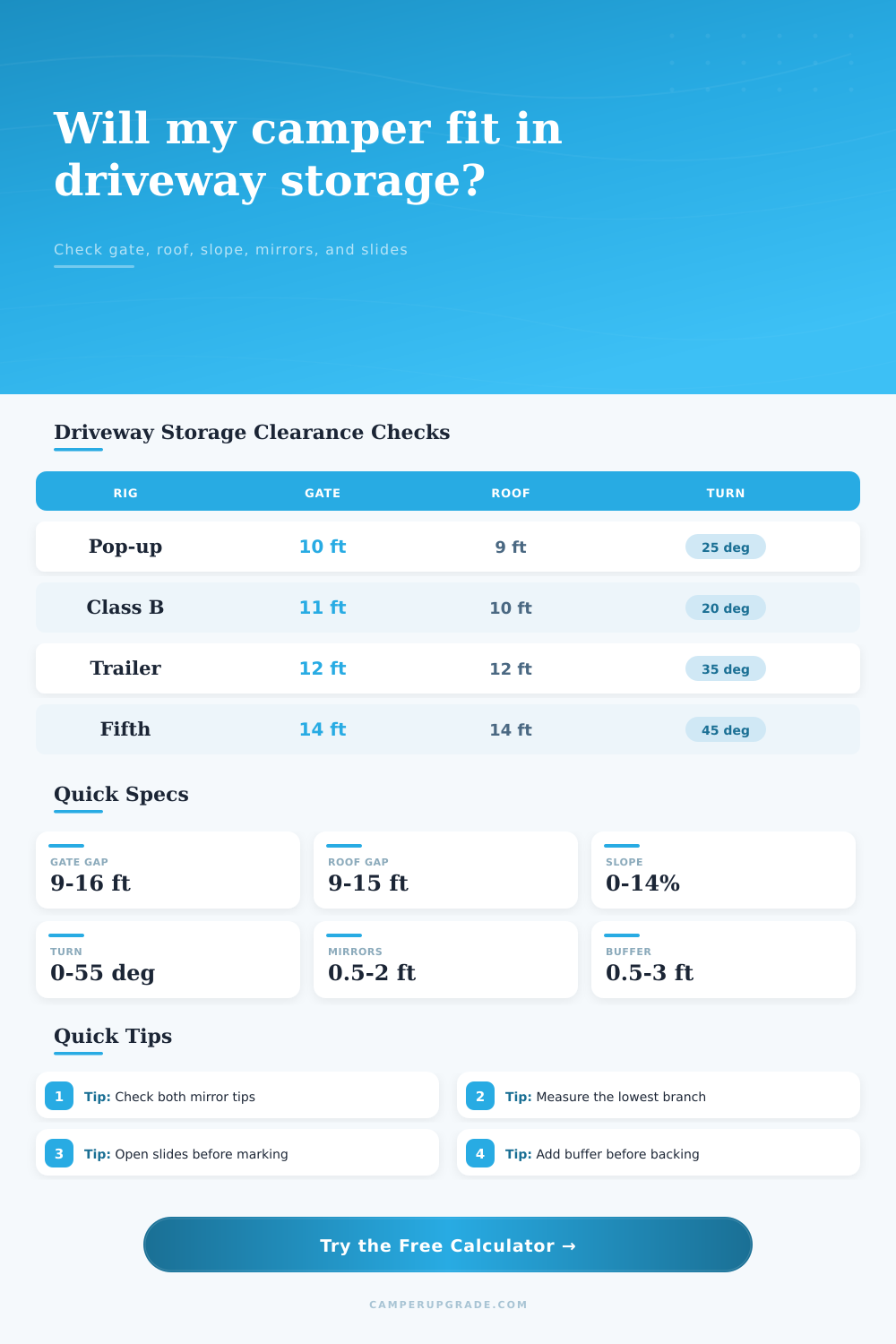
Driveway Camper Storage Clearance Calculator
Check whether a camper can fit into a driveway storage spot by comparing rig length, body width, height, driveway slope, gate opening, eave or tree clearance, turning angle, mirrors, jacks, slide-outs, and safety buffer.
🚙Driveway and rig presets
⚙Camper, driveway, and obstacle inputs
Clearance Breakdown
📊Clearance margin grid
📏Gate and turning angle reference
| Entry path | Turn angle | Width multiplier | Common driveway condition | What to measure |
|---|---|---|---|---|
| Straight backing | 0 to 10° | 1.00 to 1.02 | Wide apron with a square gate opening. | Post-to-post width and mirror tips. |
| Light angle | 11 to 25° | 1.02 to 1.10 | Street approach needs a small correction. | Inside fence corner and outside swing. |
| Side-yard turn | 26 to 45° | 1.10 to 1.30 | Camper enters beside a house or garage. | Gate post, gutter, fence, and tire path. |
| Sharp offset | 46 to 60° | 1.30 to 1.55 | Storage pad sits behind a narrow offset. | Corner clipping and tow vehicle swing. |
🌲Eave, branch, and slope clearance table
| Overhead margin | Storage call | Slope sensitivity | Branch or eave note | Best action before backing |
|---|---|---|---|---|
| Less than 0 in | Does not clear | Any grade can worsen it. | Roof hardware may contact first. | Do not enter until remeasured. |
| 0 to 6 in | Very tight | Small pavement breaks matter. | Branches can sag with rain or wind. | Use a spotter and recheck height. |
| 7 to 18 in | Usable with care | Watch curb aprons and crowns. | Eaves still need gutter clearance. | Mark the lowest overhead point. |
| More than 18 in | Comfortable | Slope allowance is usually enough. | Still inspect seasonal tree growth. | Keep a permanent height marker. |
🛠Mirror, jack, and slide clearance table
| Side projection | Typical amount | When active | Storage risk | Calculator input |
|---|---|---|---|---|
| Folded mirrors | 0.3 to 0.8 ft each side | Backing through a narrow gate. | Posts and hinges sit at mirror height. | Mirror clearance each side. |
| Fixed mirrors | 0.8 to 1.5 ft each side | Motorhomes and tow vehicles. | Side brush can hide hard limbs. | Mirror clearance each side. |
| Stabilizer jacks | 0.3 to 1.0 ft each side | Parked storage or leveling. | Fence lines and lawn edging. | Jack and slide clearance. |
| Slide-outs | 2.0 to 3.5 ft each side | Stored with slides opened for access. | House walls, trees, and gates. | Jack and slide clearance. |
🗺Driveway storage comparison grid
Gate pass
Moving widthGate clearance uses camper body width, mirrors, the selected safety buffer, and a turning-angle multiplier for diagonal entry.
Roof pass
Travel heightOverhead clearance compares the lowest eave or branch against camper height, safety buffer, and a slope transition allowance.
Parked pass
Stored widthParked clearance adds jack or slide projection after the rig is in place, so a camper can pass a gate but still not open safely.
Length pass
Bay depthStorage length compares the camper end-to-end dimension plus buffer to the measured driveway bay or side-yard pocket.
💡Two driveway storage tips
This calculator is a planning tool for driveway storage fit. Confirm local setback rules, utility clearances, road sight lines, and exact measurements before moving the camper.
You stand at the end of your driveway, key in hand, heart rate climbing. You’ve got the key in your hand standing at the end of your driveway. Your heart start to race. The gate is wide enough. The eaves seem high enough. But there is something between the pavement and post that is off. In the pit of your stomach, you know it. The RV owners’ nightmare occurs. It happen just before the first dent in the eave. It is the first scratch on the mirror.
Parking a big box in a small space isn’t simply a question of driving into a space. It is a mathematical equation. It is a geometry problem hiding behind parking lot. People will measure the gate but they will overlook the mirrors. Overlook the slope. Forget that a camper are not a stiff rectangle. A camper is a collection of moving parts. Moving parts that act differently when backing up.
How to Avoid Damaging Your RV
Plug into the calculator above and it will do the math for you based off the dimensions of your rig and the oddities of your entry path. Enter the length of your camper (including bumper and spare tire rack if you have that). That final foot is what makes or breaks it many times.
Next, enter the width of the body. Then add on the mirrors. Yep, mirrors. It is the one thing that most people forget. Some fold in, which means they only extend outward by six inches. Others extends outward two feet. And if you’re trying to back into a gate with a small turn radius, those mirrors get swung out further than width of your body. To account for this, the tool adds a width multiplier depending on how sharp of a turn you make when backing in. So a straight back-in doesn’t require nearly as much room. But a sharp right angle require quite a bit more space on the interior corner. Until you actualy put the numbers in and see them change, it’s not all that obvious.
And then there’s height. If you’re towing a 10′ high camper you may think you know how high to go. But what about the low hanging limb over the entrance? What about the gutters above the garage as you pass by? You don’t measure the average roof line. You measure the lowest thing in your way. Then the calculator takes that clearance and compares it with your travel height. Then it backs off a little more for good luck. That’s called your safety buffer. That’s non negotiable. It’s for bouncing on that crown of the driveway. It is for lumpy pavement. And even just recognizing that your eye can’t see six inches from thirty feet away. So if your margin is less than six inches, you’re gambling. If you have more than eighteen inches, it is no problem.
The chart on the page will explain all of this. It will show you where the danger spikes up. More than eighteen inches, no problem. The chart on the page will explain all of this. Will show you where the danger spikes up.
Oh, did I mention slope? The way a drive inclines complicates everything. Is your drive dropping into the storage bay? That’s a dip at the front of the camper. Is it rising? Then the back will lift. This slope affects how high your rig sit above overhead obstructions. A 10 inch clearance may become an instant scrape when you encounter a steep grade. To calculate that vertical shift, the tool takes into account both the amount of slop and the length of transition.
Then there’s the parked situation. Maybe you’ve got the mirrors folded and slides tucked in, and you barely squeeze under the gate. No problem…until you park and extend the slides to live in. Drop those stabilizer jacks. Now, all those things you could of easily squeeze by while moving will catch on fence posts and the wall of your house. The calculator also looks at how wide the car is when parked. So you don’t just fit in, you fit when you’re settled.
Walk the path before backing up. Check the choke points. Stick mark the low branch. Inspect the gate hinges. And then test your instincts with the tool. Spend ten minutes measuring. It is not an afternoon of sanding fresh paint.
Clearance is confidence. Knowing the margins, you no longer guess. No more guessing. You go in there confident. And you never get that scratch. Because you stand there looking at that space through the gate. You finally see it for what it is. Not a tight squeeze. Just a driveway.