Camper Parking Pad Size Calculator
Size a camper parking pad from rig length, body width, slide-outs, door and awning clearance, tow vehicle access, turning apron, setbacks, material depth, and drainage buffer.
🚙Rig and pad presets
⚙Pad size inputs
Pad Size Breakdown
📊Material weight grid
📏Rig clearance sizing guide
| Camper setup | Body size to enter | Slide-out allowance | Door and awning clearance | Pad sizing note |
|---|---|---|---|---|
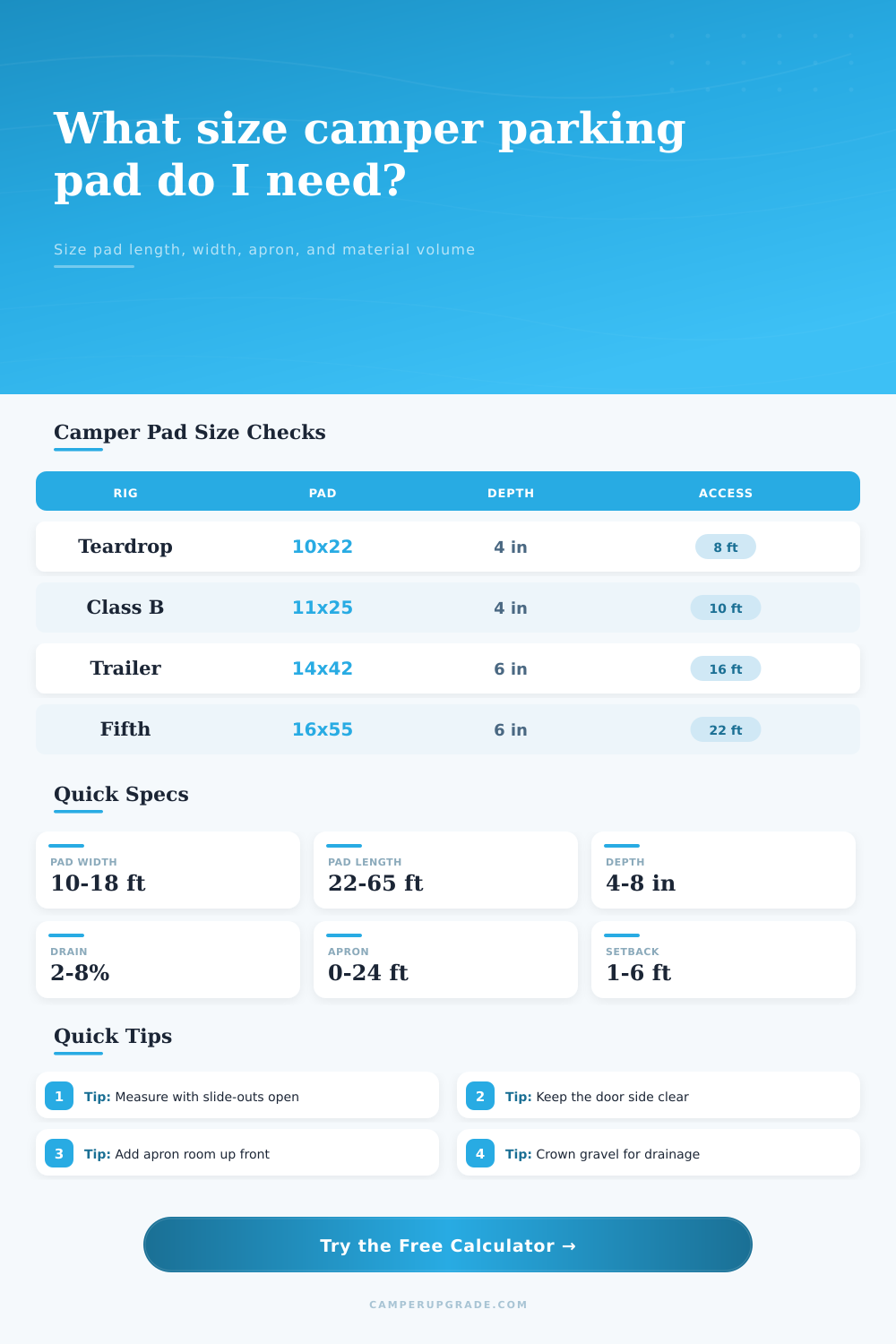
| Teardrop or tiny camper | 12 to 16 ft long, 6 to 7 ft wide | Usually none | 2 to 3 ft | Short pads still need enough apron to back in cleanly. |
| Class B van | 19 to 24 ft long, 7 to 8 ft wide | Usually none | 2 to 4 ft | Width is often driven by door use and storage access. |
| Travel trailer | 22 to 34 ft long, 8 to 8.5 ft wide | 2 to 3.5 ft on one side | 3 to 6 ft | Add tow vehicle access if the hitch remains in line. |
| Fifth wheel | 32 to 42 ft long, 8 to 8.5 ft wide | 2 to 3.5 ft each side | 4 to 8 ft | Long pads benefit from a wider apron and generous front clearance. |
🛣Tow access and turning apron reference
| Access condition | Tow access input | Turning apron input | Best for | What it protects |
|---|---|---|---|---|
| Straight driveway approach | 6 to 10 ft | 0 to 6 ft | Vans, truck campers, small trailers | Hitch space, rear rack, and bumper clearance. |
| Moderate backing angle | 10 to 16 ft | 6 to 12 ft | Travel trailers parked beside a house | Trailer tire tracking and tow vehicle swing. |
| Tight side-yard turn | 14 to 22 ft | 12 to 20 ft | Long trailers, fences, or narrow gates | Jackknife angle, corner clipping, and lawn edge rutting. |
| Pull-through storage pad | 18 to 28 ft | 16 to 24 ft | Large RVs and repeated moves | Entry taper, exit taper, and easier alignment. |
📦Material depth and bulk conversion
| Finished depth | Coverage per cubic yard | 2 cu ft bags per 100 sq ft | 3 cu ft bags per 100 sq ft | Typical pad use |
|---|---|---|---|---|
| 3 in | 108 sq ft | 13 bags | 9 bags | Light-duty topping over a firm base. |
| 4 in | 81 sq ft | 17 bags | 12 bags | Common small camper or van parking pad. |
| 6 in | 54 sq ft | 25 bags | 17 bags | Travel trailer and fifth wheel gravel pad planning. |
| 8 in | 40.5 sq ft | 34 bags | 23 bags | Soft subgrade, heavier rigs, or stronger base build-up. |
💧Slope and drainage buffer guide
| Drainage situation | Buffer input | Pad edge detail | Material effect | Use when |
|---|---|---|---|---|
| Flat firm driveway edge | 0 to 3% | Light shoulder taper | Small volume increase | Water already drains away from the pad. |
| Normal gravel pad crown | 4 to 6% | Raised center or slight cross slope | Typical planning allowance | The pad needs runoff without a high crown. |
| Low spots or soft edge | 7 to 12% | More taper and edge support | Moderate volume increase | Existing soil is uneven or holds shallow puddles. |
| Corrective grading area | 13 to 20% | Broader apron, ditch, or swale tie-in | Large volume increase | The pad must blend into a slope or redirect runoff. |
Local setbacks, drainage rules, utility clearances, and load-bearing base design can change the final pad size. Use this calculator for planning quantities before site-specific verification.
💡Two camper pad sizing tips
Until you attempt to back up in what seems like ample space on paper, you have no idea just how big of a camper you have. That sinking feeling when rear tire starts to roll onto lawn isn’t unique to RV ownership. Length isn’t usually the issue, but rather width, swing, and terrain underneath the rig make parking an issue.
Preparing for gravel pad means accounting for not only size of the camper itself, but also gear, doors, and movement of other vehicles around it. The way most folks begin is with the pad size for their trailer. That’s great, but it isn’t complete. Your camper will live with its slide-outs all the way out, so if you have a slide-out on one end then your pad must be wider to fit extra couple feet of living area.
How to Plan Your Campsite
Next is the door side. Every time you go outside to get your coffee, you don’t want to step into muddy grass or something else uneven. Having just a few feet of clearance on the door side can make difference between having an outdoor space you use and a tripping hazard.
Once you know those measurements, plugging them in to the calculator does the math so no guessing about whether it’s worth spending more materials for that additional foot of width. Usually, it is.
The other tricky variable, length… Is really one that has to be thought backward. It’s not only about parking the camper but also about getting the tow vehicle into place. You have to leave room for loading and unloading gear, hitching, unhitching, and avoid driving on grass. Enter the turning apron, that additional hunk of pavement or gravel up front which lets the truck swing in (or out) at an angle, or swing wide, without rutting the edges. Otherwise, the pad becomes a tight squeeze that puts stress on both lawn and drivetrain.
How big does the apron need to be? That depends on your truck’s approach angle (see reference table). You can picture the swing radius ahead of time before buying stone.
After the size is determined, then it’s time for the material. Not all gravel are created equal. Angular edged crushed stone locks together, creating a firm surface that doesn’t move under your heavy axle. Round pea gravel acts more like marbles, rolling about nicely on a garden path but totally unsuitable for a 5 ton fifth wheel.
Also consider how deep you want it. Four inches of packed stone is completely different than four inches of loose gravel. It must be thick enough to provide solid foundation. But remember, it’ll compress under the combined weight of vehicle plus engine vibration. Expect this compaction by building in some margin, that way when the rains come and the pad settles slightly, it doesn’t end up sitting in a hole.
The quiet killer on parking pads is drainage. You need a bit of a cross-slope or crown so water runs off the sides instead of pooling up and softening the underlying pad. Without it, you’ll have a hard time. This is even more important if you live in a wet area. A few inches difference in input keeps the pad solid and the bottom dry. The calculator builds in a bit of drainage buffer to cover extra material used for creating those slopes. Often a flat pad means a muddy pad. A little tweak in the inputs saves a big headache come springtime.
But at the end of the day, a good sized pad will pay off in peace of mind. You will no longer worry each day about parking. Just let go and enjoy it without having to think about hows and wheres.
Account for every extra long door and swinging bumper by measuring twice and cutting once. Pick the proper stone to do the work, create a base that lasts. You should of never have to worry about where the tires go ever again.
Hook it up, walk away. Pull in and know the ground’s just as ready as the rig.