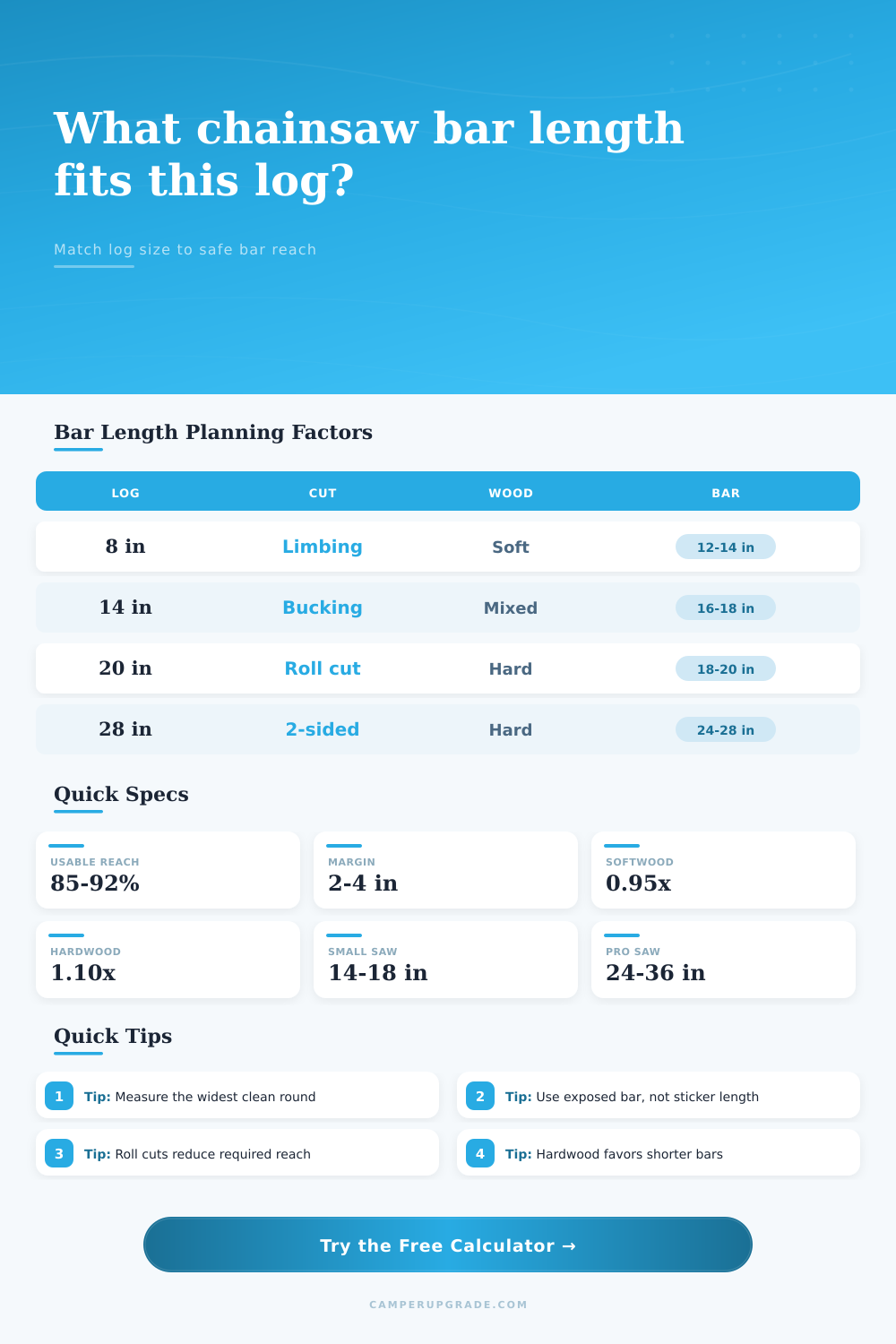
Chainsaw Bar Length By Log Calculator
Estimate the usable chainsaw bar reach needed for a log from diameter, cut type, bucking or limbing mode, actual exposed bar length, saw power class, wood factor, safety margin, and maximum recommended bar.
🪵Log and saw presets
⚙Log, bar, saw, and safety inputs
📊Live spec grid
📐Reference tables
Cut type reach factors
| Cut type | Factor | What it means | Best use |
|---|---|---|---|
| Straight bucking, one side | 1.00x | Bar must reach through the full round plus margin. | Simple firewood bucking on accessible logs |
| Roll bucking | 0.64x | Cut partway, rotate the log, and finish from a new side. | Round logs that can safely roll or be turned |
| Two-sided bucking | 0.55x | Reach from opposite sides, keeping the cuts aligned. | Oversize rounds when both sides are accessible |
| Limb or branch flush cut | 0.78x | Less full-depth reach, but awkward angles need clearance. | Limbing and trail clearing |
| Felling notch and backcut | 1.08x | Extra control reach for hinge, notch, and backcut geometry. | Felling cuts handled by trained operators |
| Bore or plunge cut | 1.15x | Extra nose clearance because the tip is part of the cut. | Advanced cuts with low-kickback awareness |
| Ripping or noodling | 1.22x | Longer exposed reach helps keep chips clearing. | Splitting, milling prep, and long-grain cuts |
Saw power class and common maximum bar ranges
| Saw class | Typical engine or motor | Common bar range | Planning note |
|---|---|---|---|
| Battery or electric | 40-80 V or corded | 10-16 in | Best with small logs, limbing, and low chain load. |
| Small gas | 30-40 cc | 12-18 in | Keep the chain sharp and avoid oversize hardwood bars. |
| Mid gas | 40-55 cc | 16-20 in | Good all-around firewood and campground cleanup size. |
| Ranch saw | 55-65 cc | 18-24 in | Handles larger rounds with better chain speed reserve. |
| Pro saw | 65-80 cc | 20-32 in | Useful when reach and torque both matter. |
| Large pro | 80 cc plus | 28-42 in | Specialty work; balance, oiler output, and chain setup matter. |
Usable bar reach by nominal bar length
| Nominal bar | 86% usable | 90% usable | Example log use |
|---|---|---|---|
| 12 in | 10.3 in | 10.8 in | Limbing and small campfire rounds |
| 14 in | 12.0 in | 12.6 in | Small firewood and trail clearing |
| 16 in | 13.8 in | 14.4 in | Common homeowner bucking size |
| 18 in | 15.5 in | 16.2 in | Mixed campground and firewood logs |
| 20 in | 17.2 in | 18.0 in | Medium hardwood rounds |
| 24 in | 20.6 in | 21.6 in | Larger rounds or roll-cut work |
| 28 in | 24.1 in | 25.2 in | Oversize bucking with suitable power |
| 32 in | 27.5 in | 28.8 in | Large pro saw reach work |
Wood factor and margin guidance
| Wood condition | Factor | Margin range | Why it changes reach |
|---|---|---|---|
| Softwood, green pine or fir | 0.95x | 1-3 in | Usually cuts faster, so slightly less excess reach is workable. |
| Mixed wood, normal chain | 1.00x | 2-4 in | Baseline for ordinary campground, farm, or property cleanup cuts. |
| Hardwood, oak or maple | 1.10x | 3-5 in | Favors more control clearance and a bar that does not bury constantly. |
| Dry dirty hardwood | 1.16x | 4-6 in | Dirt, bark, and dry fibers slow the chain and raise heat. |
| Frozen or very knotty wood | 1.22x | 4-7 in | Extra resistance means less benefit from running a fully buried bar. |
💡Calculation tips
It’s there, that log is bigger around than my bar is long and there I am standing above it on a downed oak limb. So you fire up the beast and get the nose digging and begin to cut across the log. I pray you have enough chain out to make it to the end before shutting down or getting thrown backwards. That split second pause illustrates why bar size is important relative to the wood being felled.
You need enough chain to extend past the far end, and you also need to consider how much of that chain will actualy be working. The saw comes with a bar marked “twenty-inches,” so everyone assumes they’re getting twenty inches of cut. That’s not what happens. Because part of the bar must be tucked away in the engine housing and covered by the clutch cover, the working bar has to do all of its work with just the part that sticks out. Use the calculator above. It’ll crunch the numbers for you and turn that nominal bar size into an actual cutting length. That’s the single largest cause of error among weekend woodcutters.
How to Pick the Right Bar Size
You need to decide how you will cut when you get down to usable length. Are you just bucking firewood where log lays flat and you make a straight cut? Or did you limb it after a mess of a storm cleanup, so there’s angle and shift in leverage? Those differences is accounted for in the tool; it applies factors depending on what kind of cut you’re making. Roll cuts use a much shorter bar length compared to a straight pass. Slice half way around, turn log over, then finish from opposite side. It is a simple trick that saves time and helps save saws. Move the wood, don’t need big bar.
The other factor is hardness of the wood. Pine (softwood) will cut quickly, while hardwoods such as maple or oak will drag on the chain and slow down the engine. In that case you would of prefer a shorter bar in relation to the log size as it allows the engine to keep up with the chain. Trying to feed a small engine with a long bar into green oak is a recipe for dissapointment. So the system takes account of this and suggests a safety margin. An additional inch of clearance makes the difference between a stalled motor and a smooth cut.
Another thing that confuses people is saw power class. That battery-powered tool may appear to have the same torque as a gas saw. But it doesn’t. Depending on what type of saw you’re running, say, a compact electric versus a heavy-duty gas engine, you can use a shorter bar and must goes easy on it. Does it have sufficient headroom? Are you forcing the machine beyond its capabilities? The calculator will compare your saw’s class to the requirements of your cut and let you know.
But there’s more than just theory with safety margins. In reality, logs aren’t uniform cylinders; they have knobby ends, dip down in the middle, and twist weirdly. A couple inches of added margin when you think about what length you need allows for all this. It gives the chain enough room so that it doesn’t fully embed into the wood, decreasing the chances of kickback and ensuring a clean cut. You don’t want it scraping along the wood; you want the bar tip to clear it comfortabley.
So what’s the bottom line? The bottom line is: A bar is a mix of various factors. You want the shortest bar that will work well. So how long is short enough? It must be long enough to get the job done well. But longer means it gets heavier; it’s more difficult to control; it’s also more likely to kick back on you at the end. When you factor out the kind of cut and kind of wood used to make the bar shorter or longer, you eliminate the guessing game. You go from reading a label on a box to looking at the metal in your hands. And that’s when cutting becomes a confidence move instead of a stressful guess.