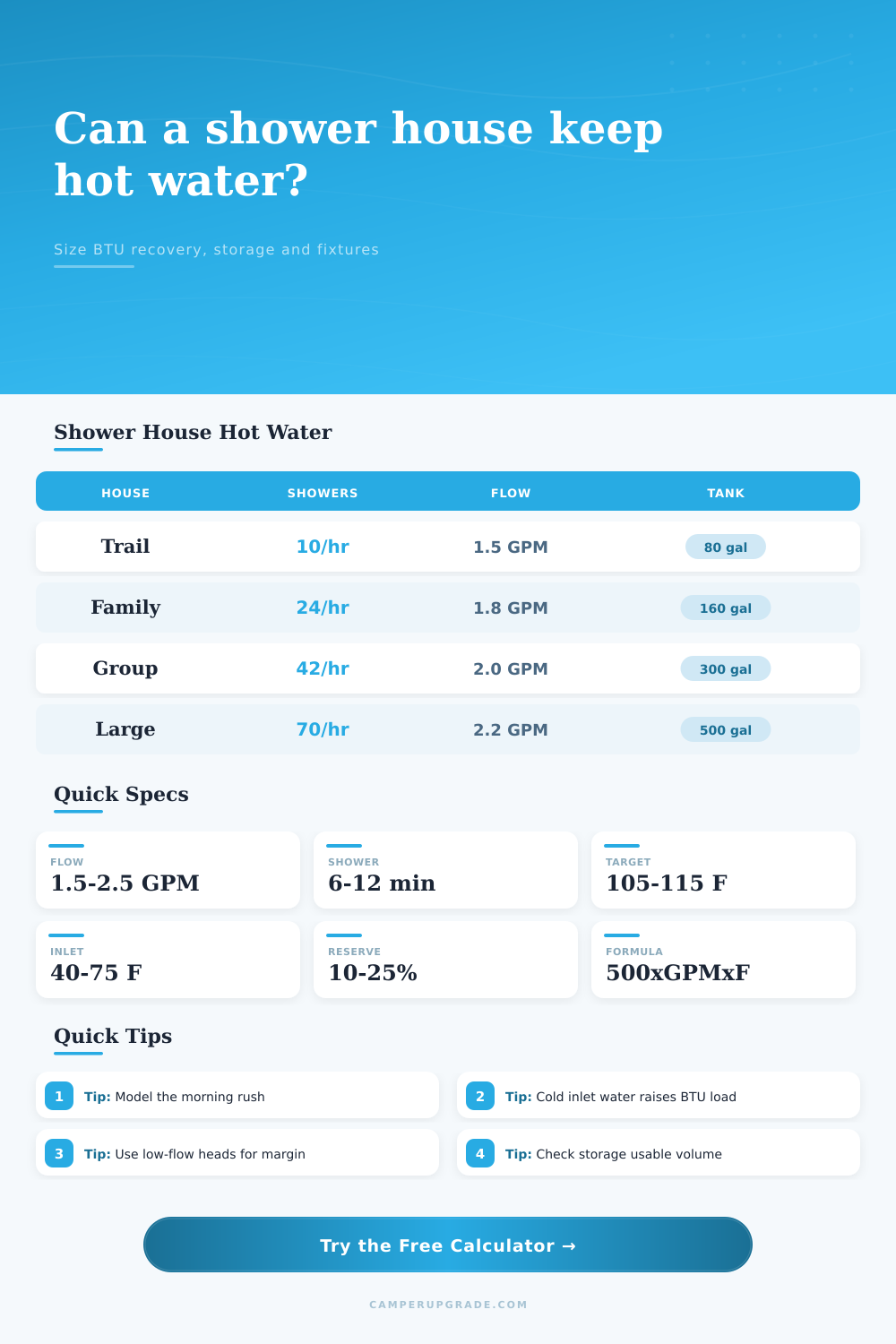
Campground Shower House Hot Water Calculator
Estimate shower-house hot water demand, usable tank storage, BTU recovery, recovery rate, fixture throughput, peak window drawdown, and reserve margin.
| Shower House Setting | Peak Showers/Hour | Typical Flow | Common Hot-Water Strategy |
|---|---|---|---|
| Small trail or primitive loop | 6 to 14 | 1.3 to 1.6 GPM | Small tank with modest recovery. |
| Family tent loop bathhouse | 18 to 32 | 1.5 to 2.0 GPM | Storage tank plus high-input recovery. |
| Lake, beach, or rinse-heavy park | 30 to 55 | 1.8 to 2.3 GPM | Short peak window with extra storage. |
| Youth group camp | 36 to 70 | 1.7 to 2.1 GPM | Large storage and staged shower times. |
| Large campground core | 55 to 90 | 1.8 to 2.5 GPM | Multiple heaters and storage tanks. |
| Heater Input At 86% | 40°F Rise | 55°F Rise | 70°F Rise |
|---|---|---|---|
| 100,000 BTU/hr | 258 GPH | 188 GPH | 147 GPH |
| 150,000 BTU/hr | 387 GPH | 282 GPH | 221 GPH |
| 199,000 BTU/hr | 514 GPH | 374 GPH | 293 GPH |
| 300,000 BTU/hr | 774 GPH | 563 GPH | 442 GPH |
| 500,000 BTU/hr | 1289 GPH | 938 GPH | 737 GPH |
| Fixture Count | 6 Min Shower | 8 Min Shower | 10 Min Shower |
|---|---|---|---|
| 2 showerheads | 20 showers/hr | 15 showers/hr | 12 showers/hr |
| 4 showerheads | 40 showers/hr | 30 showers/hr | 24 showers/hr |
| 6 showerheads | 60 showers/hr | 45 showers/hr | 36 showers/hr |
| 8 showerheads | 80 showers/hr | 60 showers/hr | 48 showers/hr |
| 12 showerheads | 120 showers/hr | 90 showers/hr | 72 showers/hr |
| Usable Storage | 45-Min Rush | 60-Min Rush | Planning Note |
|---|---|---|---|
| 60 gallons | 4 to 6 showers | 3 to 5 showers | Small remote building only. |
| 120 gallons | 8 to 12 showers | 7 to 10 showers | Good buffer for light loops. |
| 240 gallons | 16 to 24 showers | 13 to 20 showers | Common family-loop storage range. |
| 400 gallons | 27 to 40 showers | 22 to 33 showers | Useful for group or beach peaks. |
| 650 gallons | 43 to 65 showers | 36 to 54 showers | Large core bathhouse planning range. |
Nothing ruins a camping trip like lukewarm water. You have spent four nights reconnecting with nature, but you return to a cold shower house. Camp plumbing physics is usually the cause; not the campers.
In a commercial environment, there’s a balance between recovering water quickly and storing enough for the morning rush. While some people takes showers, your water heater needs burner power to replenish that tank. The calculator will help you know what’s missing.
How to Choose the Right Water Heater for Camping
The first step is to set your peak window. Demand isn’t constant during the day. Families gets up and go during the morning rush. Afternoon spikes happen often due to lake activity. Define the busiest one-hour block. How many people will use the shower in that hour? Assume they all take a shower.
Now multiply that number times the number of gallons it takes to fill the shower (flow rate). For example, an average low-flow head use 1.8 gallons per minute. Assuming each person shower for eight minutes, that’s almost fifteen gallons of hot water. Multiply this by twenty and now we has three hundred gallons of demand within one hour.
Tank size isn’t as important than recovery rate. A larger tank seems safer, but that is not always true. Even if a large tank get filled fast enough, it empties faster then a smaller one if incoming cold water isn’t warmed up rapidly by the heater.
The ability to recover depends based off the efficiency and BTU input of the heater. An atmospheric standard unit will likely have an efficiency rating of about seventy-eight percent. A high-efficiency condensing unit can reaches as high as ninety-six percent. That makes a difference in how many gallons of hot water you can produce per hour for the same amount of fuel cost. You’re paying for the energy; you’d better get it.
The other key issue is temperature rise. Well water coming into the house may be a balmy fifty-five degrees in the summer time. That mean moderately high energy to heat it up to one hundred ten degrees. In the dead of winter it can sink to forty degrees or even colder. The difference is huge. Because you are heating from a much higher starting point, the heater has to work twice as hard to produce the same amount of heat. A heater sized for July isn’t going to survive January. Model your system for the coldest possible inlet temperature and then it’ll work all year.
Recovery and storage aren’t competing roles, but rather complementary ones: storage takes the brunt of the initial hit, while recovery maintains the ongoing flow. At a small, remote trail shelter, there’s minimal recovery and storage: only enough for the occasional user. On a busy family loop or a rinsing station on a popular beach, you need significant storage capacity for the first hit and a high-input heater to match the ongoing demand.
When all six shower head are running simultaneously, you’re pulling more than gallons per minute. Far above average residential recovery rates. Examine the fixture counts closely. Six shower heads doesn’t equal six bodies showering at once. That’s staggered use in the real world. Some showers will be vacant. Some folks is washing hair. Others will just get rinsed off. Even though the tool factors in that staggered use, it’s best to factor in worst case overlap. Fifteen to twenty percent more capacity as a buffer is inexpensive insurance against no hot water while someone is shampooing on the far end of things.
Typical strategies are laid out in the reference table. An RV resort isn’t the same as a youth group camp. One is scheduled users in blocks. The other involve random high-intensity bursts. Adjusting the inputs to match your usage pattern helps you understand what you need. Don’t guess. Understand how many fixtures you have, know your heater specs, and plug in your expected peak hour. The numbers will tell you if there is a bottleneck.
But then again, that’s just one little detail. And details matter. A happy guest is a warm guest. And nothing makes guests happier than a comfortable shower. No complaining. You can predict utility bills because there is no need to run the heater all day to catch up.
Plan for the rush. Size for the cold. Keep the water hot. Turn a chore into a comfort.