Campground Water Demand Calculator
Estimate campground daily water demand, peak-day storage, bathhouse use, laundry loads, irrigation, reserve tank volume, and pump gallons per minute.
| Campground Setting | Typical Gal/Guest/Day | Bathhouse Add-On | Planning Note |
|---|---|---|---|
| Dry tent loop with vault toilets | 10 to 18 gal | 0 to 4 gal | Low wash and no shower demand. |
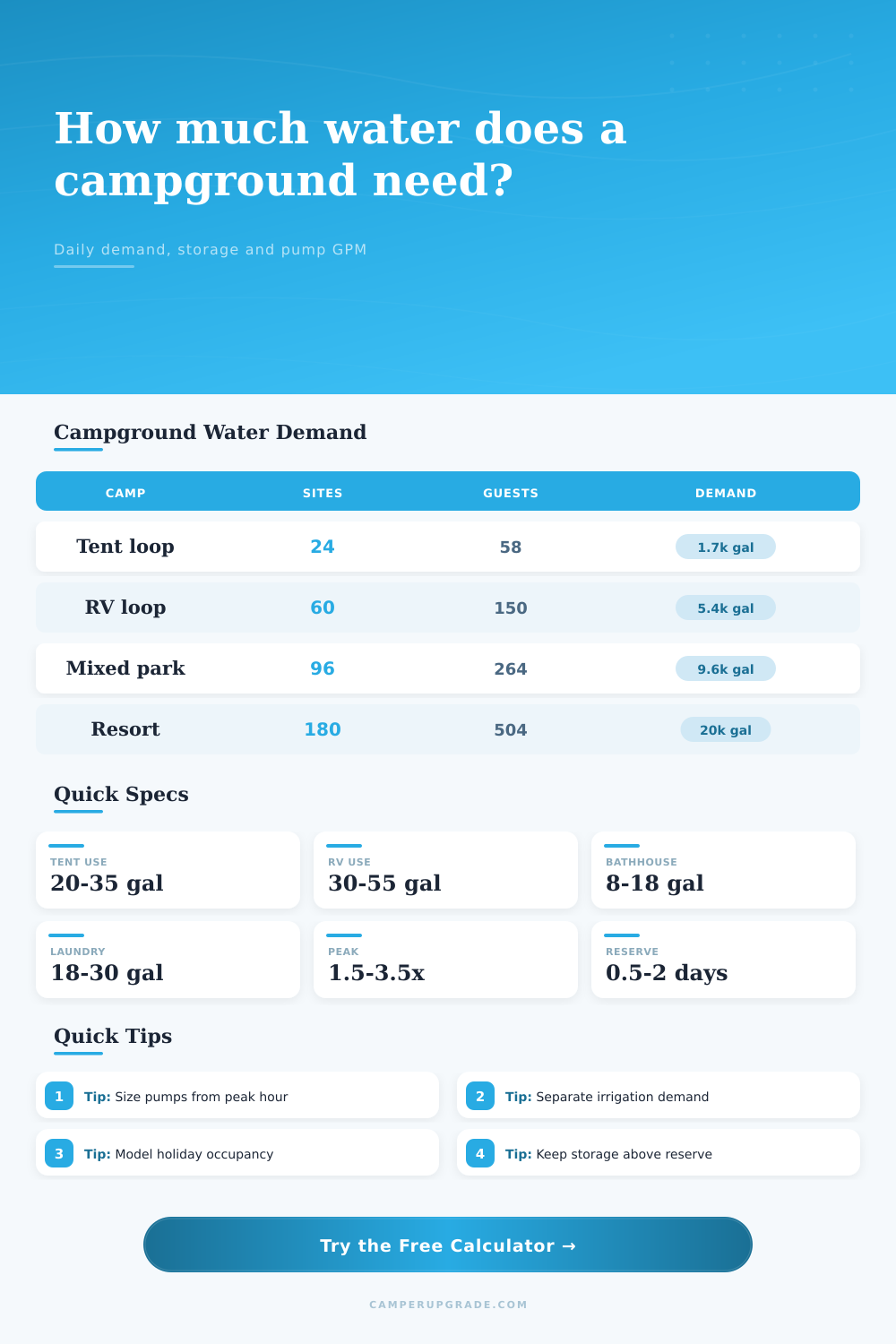
| Tent campground with showers | 20 to 35 gal | 8 to 18 gal | Shared bathhouse drives the peak hour. |
| Mixed RV and tent campground | 30 to 45 gal | 8 to 16 gal | Good default for family weekend parks. |
| Full-hookup RV park | 35 to 60 gal | 4 to 12 gal | Onboard fixtures shift demand to sites. |
| Resort campground or long stay park | 50 to 80 gal | 6 to 18 gal | Higher laundry, cleanup, and comfort use. |
| Use Pattern | Peak Day Factor | Peak-Hour Share | Pump Sizing Use |
|---|---|---|---|
| Small steady campground | 1.25x to 1.50x | 8% to 10% | Daily refill often governs. |
| Busy family weekend | 1.50x to 2.00x | 10% to 14% | Morning bathhouse use can govern. |
| Holiday full occupancy | 2.00x to 2.75x | 12% to 18% | Check both pump and storage reserve. |
| Beach, event, or group camp surge | 2.75x to 3.50x | 16% to 25% | Short peak flows can dominate. |
| Demand Item | Planning Value | Example Daily Demand | Calculator Input |
|---|---|---|---|
| Landscape irrigation | 0.623 gal per sq ft per inch | 6000 sq ft at 0.15 in, 3 days/week = 240 gal/day | Area, depth, days/week |
| High-efficiency laundry | 12 to 18 gal per load | 10 loads = 120 to 180 gal/day | Loads/day, gal/load |
| Commercial washer | 20 to 30 gal per load | 10 loads = 200 to 300 gal/day | Loads/day, gal/load |
| Maintenance washdown | 100 to 500 gal per day | Set by facility schedule | Other daily demand |
| Reserve Target | Use Case | Tank Volume Basis | Planning Note |
|---|---|---|---|
| 0.5 day | Connected municipal supply | Half of average day | Operational buffer only. |
| 1.0 day | Typical campground tank | One average day | Good first planning target. |
| 1.5 to 2.0 days | Well recovery or remote fill delay | Average day times reserve days | Helps ride through refill limits. |
| 3.0 days | Emergency or hauled water | Average day times 3 | Large tank with strict turnover checks. |
You might think, “I’ll bring the water line to my site and hook up the water, but I’ll figure out the rest later.” That works fine until summer comes. When several RVs at your site fill their tanks, the shower pressure go down and your extra capacity vanishes. Water needs to be sized properly, because proper water sizing isn’t just about plumbing codes, it’s about managing the chaotic reality of how people actualy use water.
You put in your estimate of guests plus site count into the calculator, and the calculator figures out the rest. Most planners just use total number of sites and assume they all fill up evenly each day. That’s wrong. The average daily demand might be right for billing purposes, but it doesn’t indicate if the pump will meets peak demand. Peak times are typically in the evenings when RVs refill or mornings when everyone takes showers. Those brief periods of heavy demand require higher pump capacity and storage than simply dividing by days implies.
Plan for Peak Water Use
Why? Because some sites requires more water then others. For example, an RV site may have twice as much water used compared to a tent site (if someone fills their tank and runs their appliances). That’s why there is an option to value these inputs differently on the calculator.
Then there is the issue of bathhouses: they concentrate demand into one area while self-contained units distributes the load over multiple sites but at higher rates per site. Again, the tool breaks this down for you so you know where your pressure points are.
Then there’s irrigation. Even a little bit of lawn doesn’t look like it would take a lot of water, but watering landscapes can use as much water as the number of guest or even more. So you don’t want to oversize your drinking water system or undersize your tank for guest needs if you haven’t factored out irrigation demand from potable. How does the landscape volume figure into overall capacity? The table at right gives a sense. Don’t let it compete with toilet flushes when it’s hot outside. That’s just a different load altogether.
A surge is any spike in usage (like people showering at once) where the pump can absorbs. The storage tank compensates. It balances demand and supply. Surges are inevitable. If there is not enough surge volume, the system runs dry until the pump catches up.
What’s the surge? Use the calculator to find out how much bigger your current tank should of be to hold a “peak” day. Insufficient surge volume = system runs out until the pump catches up. What’s the surge? Use the calculator to find out how much bigger your current tank should be to hold a “peak” day. Big tanks are good; empty tanks is bad, especially when there’s company! Size your system for a busy weekend, not a quiet day.
Commercial washers also use a bunch of water. You’d be surprised how much water commercial washers uses. So I added in those loads too which paints a better picture of overall daily usage. All those little things add up to a final total.
It’s not rocket science: Water planning is all about understanding people. They tend to do things together, specifically, they wake up together, and they’re comfortabley together. That’s how they use water together. Plan to meet their needs by building a system that can handle them. Use numbers as a guide; then prove whether you got it right by seeing if the water turns on when needed. Build for the peak and store for the surge. Make it work, make it reliable.