Spare Fuel Storage Weight Calculator
Estimate spare fuel weight from fuel density, container count, container size, tare weight, mounting hardware, slosh allowance, payload limit, roof placement, rear axle leverage, and reserve range.
Fuel storage breakdown
Tank Equivalent
0% of 20 galShows how much spare fuel volume compares with a common 20 gallon vehicle tank baseline.
Single Container
0 lb eachSeparates one filled container weight before shared hardware so you can lift and mount realistically.
Roof Check
0 lb roofCompares roof share with remaining dynamic roof or rack limit entered in the placement section.
Rear Leverage
1.00x axleEstimates rear axle increase when a rear carrier or hitch basket places fuel behind the rear axle.
| Fuel type | Typical density | Weight per 5 gal | Planning note |
|---|---|---|---|
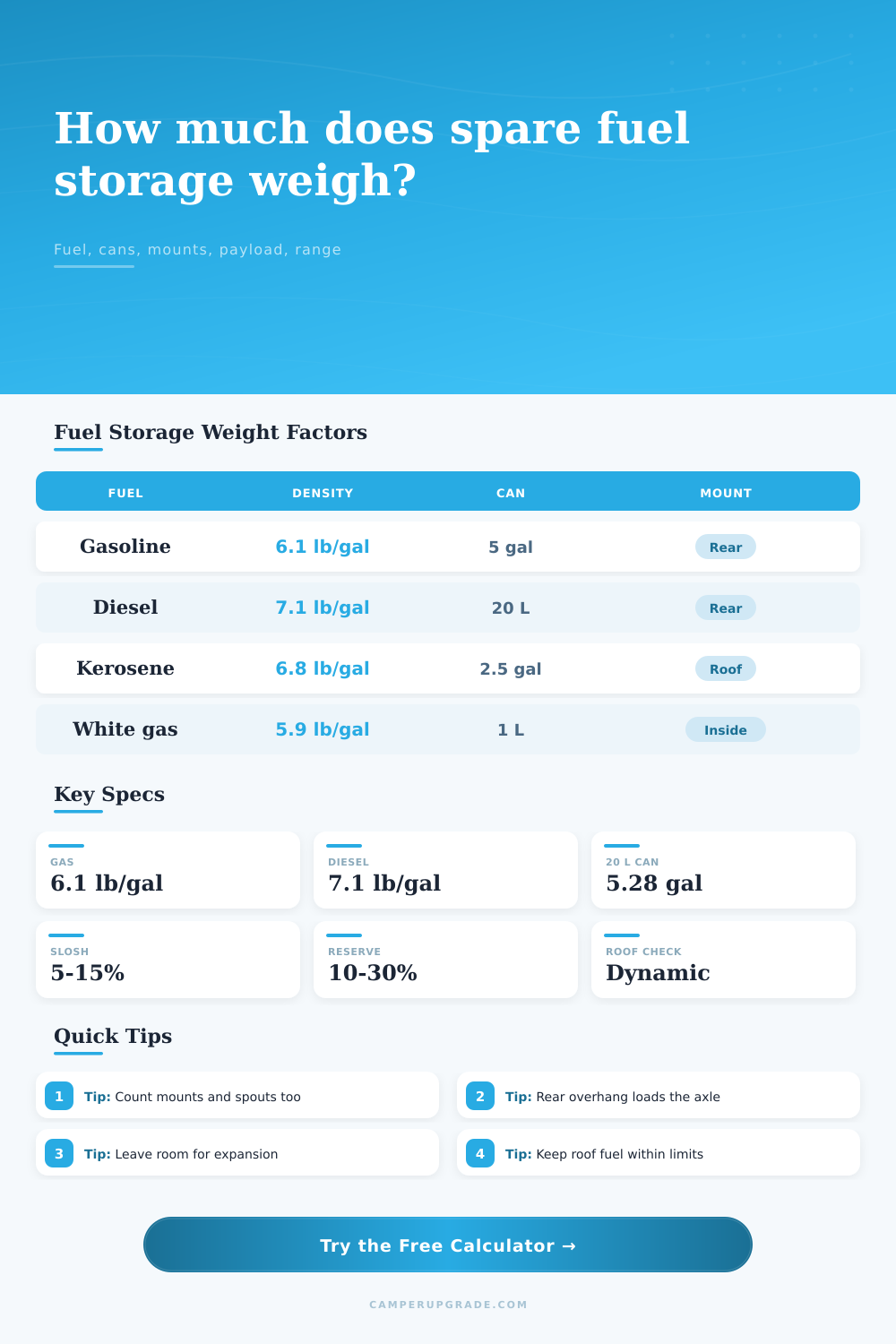
| Gasoline / petrol | 6.1 lb/gal, 0.73 kg/L | 30.5 lb before container | Good default for most gas trucks, SUVs, and generators. |
| Diesel | 7.1 lb/gal, 0.85 kg/L | 35.5 lb before container | Heavier per gallon, so diesel cans hit payload faster. |
| Kerosene | 6.8 lb/gal, 0.81 kg/L | 34.0 lb before container | Use for heaters or stove fuel stored in larger containers. |
| White gas / camp fuel | 5.9 lb/gal, 0.71 kg/L | 29.5 lb before container | Usually carried in small bottles, but density still matters. |
| Two-stroke premix | 6.1 lb/gal, 0.73 kg/L | 30.5 lb before container | Estimate near gasoline unless you have a measured blend weight. |
| Container style | Common size | Typical empty weight | Calculator entry |
|---|---|---|---|
| Plastic low-profile pod | 2 to 4 gal | 4 to 8 lb each | Use lower tare but include locking mount plates. |
| Steel NATO style jerry can | 20 L or 5.28 gal | 9 to 12 lb each | Use 10 lb when the exact can weight is unknown. |
| HDPE safety fuel can | 5 gal | 3 to 6 lb each | Good for interior cargo checks when allowed and sealed. |
| Aluminum auxiliary cell | 5 to 15 gal | 10 to 28 lb each | Add brackets, straps, skid plate, and filler neck weight. |
| Small fuel bottle kit | 1 L bottles | 0.4 to 0.8 lb each | Enter total bottles and size in liters under metric mode. |
| Placement | Roof share | Rear axle behavior | Best calculator check |
|---|---|---|---|
| Inside between axles | 0% | Usually split between front and rear axles. | Payload limit and secure containment. |
| Truck bed aft of axle | 0% | Most weight lands on rear axle, little lever effect. | Rear share plus payload remaining. |
| Roof rack over cabin | 100% | Axle split may be moderate, but center of gravity rises. | Dynamic roof limit and total payload. |
| Rear door or spare carrier | 0% | Overhang can increase rear axle load above carried weight. | Wheelbase, overhang, and hinge rating. |
| Hitch basket | 0% | Longest lever arm and strongest rear axle increase. | Receiver tongue limit and rear axle margin. |
| Reserve style | Keep unused | Use case | Range effect |
|---|---|---|---|
| Known fuel stops | 10% | Highway connector, mild weather, easy reroutes. | Spare range uses 90% of carried fuel. |
| Backcountry standard | 15% to 20% | Forest roads, mixed climbs, changing surface. | Spare range uses 80% to 85% of fuel. |
| Remote desert or winter | 25% to 30% | Sand, snow, recovery delays, limited exits. | Spare range uses 70% to 75% of fuel. |
| Group support reserve | 30% to 40% | Shared fuel or emergency transfer for another rig. | Range is lower, but support margin is higher. |
Fuel density varies with temperature, blend, and formulation. Use manufacturer ratings for containers, racks, hinges, rear carriers, and roof systems before travel.
You pull onto a remote road, the fuel gauge slips into the red, and you panic. That’s why people carry spare fuel.
Extra liquid in a vehicle are a physics problem. How much will it weigh? How do you balance weight of the liquid itself with the weight of its container(s)? What is the structural limits of your hitch/roof? The rear axle bear the burden of force created by a can of gas.
Why You Need a Fuel Weight Calculator
Enter the calculator above. Plug in the size of containers and where they sits in the vehicle. Save yourself from guessing at conversions and coefficients. Make a gut feeling turn to hard numbers.
They also forget about weight of fuel. Diesel has higher density then gasoline. Twenty liters or so make a big difference. Ten pounds per five gallons isn’t nothing; especially if you’re on a tight payload limit. And it’s cumulative. The tool includes an option to specify fuel type. For example, you could configure white gas or kerosene at a custom density.
Mounting hardware and tare weight matter too. An empty steel jerry can is still several pounds. Add in some spill pads, locking bolts, swing arms, and roof rack cross bars. There is bunch of dead weight before you drop a single drop.
That’s when placement matters. To get the fuel out of cargo area, you put it on the roof. That’s good for cargo room. But it move the Center Of Gravity up. And also creates more wind resistance. Dynamic weight limits apply to every pound you add to the roof. Your manual says your dynamic limit is less than your static limit. When the vehicle isn’t moving and you stand on the rack, it doesn’t feel heavy. But once you start down the bumpy road, it does. The calculator compares your roof share to your dynamic limit so you don’t go over.
And if you add fuel to a hitch basket, you now create Leverage. Anything behind the rear axle will multiply its load. An 18 inch can behind the axle at 50lbs adds far more than 50 pounds of force. The tool estimates this rear axle increase based off your wheelbase and the distance of the load center from the axle.
A slosh allowance of 10-15% is added. It doesn’t cost much in terms of safety. It means your brackets are rated to handle the real deal. Your vehicle structure and mounts sees these forces from shifting fuel and other liquids. When you turn, brake, fuel shifts. Moving forces develop that will test your vehicle structure and mounts. The amount of slosh vary based on container type and fuel.
And then there’s planning. Planning doesn’t mean burning up all your extra gas. That isn’t good. Twenty percent or more are your reserve. It is your buffer against delays and detours. The calculator takes away the reserve from the usable range. Now you have an idea of what distance you can realistically cover. If you do the math, running out of fuel is avoidable.
It is all about carrying fuel safely. Don’t compromise handling of your vehicle. Don’t exceed its structure. Check the numbers and weigh the options. Anxiety becomes preparation. The red zone on the gauge becomes a data point. It is part of a working plan. You should of checked the weight.