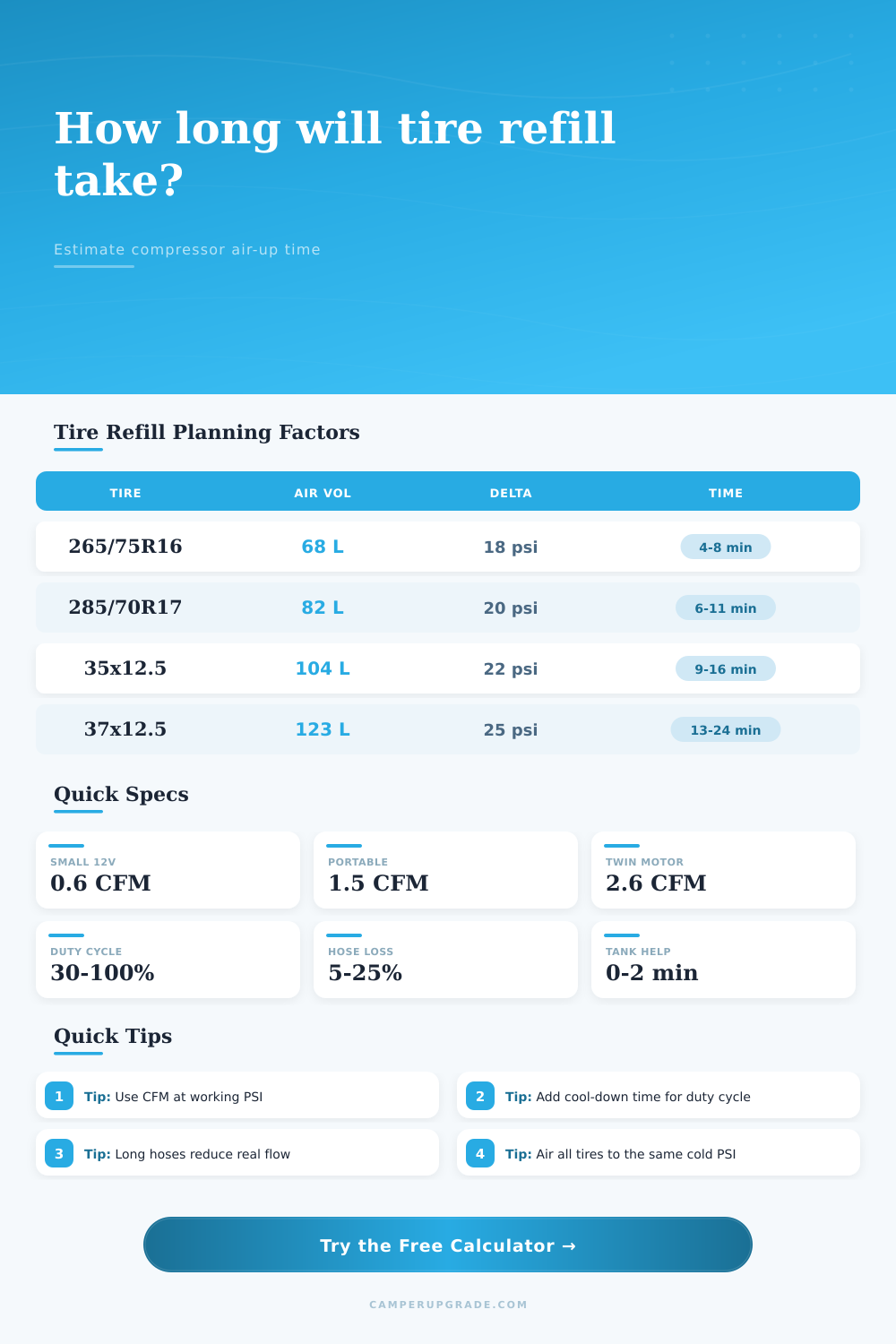
Air Compressor Tire Refill Time Calculator
Estimate how long it takes to air tires back up after sand, gravel, trail, or campsite use from tire size, starting PSI, target PSI, tire count, compressor CFM at pressure, duty cycle, hose loss, tank assist, altitude, and temperature.
🛞Compressor and tire presets
📋Tire, pressure, compressor, and environment inputs
⚙Live refill comparison grid
📊Current setup cards
📘Reference tables
Common tire air volume estimates
| Tire size | Approx internal air | Typical air-up range | Planning note |
|---|---|---|---|
| P205/55R16 compact tire | 36 L / 1.3 cu ft | 25 to 35 PSI | Small volume; pressure rises quickly with modest airflow. |
| P225/65R17 crossover tire | 52 L / 1.8 cu ft | 24 to 36 PSI | Common SUV top-off and gravel-road refill size. |
| LT265/75R16 all-terrain | 68 L / 2.4 cu ft | 18 to 45 PSI | Typical truck camper or overland baseline tire. |
| LT285/70R17 all-terrain | 82 L / 2.9 cu ft | 16 to 42 PSI | Popular 33-inch tire; small compressors slow noticeably. |
| 35x12.50R17 trail tire | 104 L / 3.7 cu ft | 12 to 35 PSI | Large volume rewards higher duty-cycle compressors. |
| 37x12.50R17 trail tire | 123 L / 4.3 cu ft | 10 to 32 PSI | Plan cool-down breaks unless using continuous-duty air. |
Compressor flow planning table
| Compressor class | Rated flow at pressure | Typical duty cycle | Best fit |
|---|---|---|---|
| Small emergency 12V inflator | 0.4 to 0.7 CFM at 30 PSI | 15% to 35% | Passenger tires, small top-offs, one or two tires at a time. |
| Portable single-motor compressor | 1.0 to 1.6 CFM at 30 PSI | 33% to 60% | Most SUV and light truck trail air-up sessions. |
| Portable twin-motor compressor | 2.0 to 2.8 CFM at 30 PSI | 50% to 100% | Four LT tires after beach or trail pressure drops. |
| Hard-mounted twin compressor | 2.8 to 3.5 CFM at 30 PSI | 100% | Frequent overland use, big tires, and manifold inflation. |
| Shop compressor with reserve tank | 3.5 to 6.0 CFM at 40 PSI | Varies | Fast driveway refills when tank recovery keeps up. |
Hose loss and connection factors
| Setup | Planning loss | Why it matters | Calculator entry |
|---|---|---|---|
| Short hose, locking chuck | 5% to 8% | Least restriction if fittings seal and the hose bore is adequate. | 5 to 8% |
| Coiled hose or small-bore line | 10% to 18% | Small passages and coils cut flow as pressure rises. | 10 to 18% |
| Four-tire manifold | 12% to 25% | Convenient but extra couplers and branches add restriction. | 12 to 25% |
| Long hose to trailer axle | 15% to 30% | Distance, fittings, and chuck leaks can dominate small compressors. | 15 to 30% |
| Poor seal or clip-on leak | 25% to 45% | Audible leaks turn compressor run time into wasted air. | 25% plus |
Altitude and temperature correction guide
| Condition | Factor | Use when | Practical effect |
|---|---|---|---|
| Hot lowland day | 0.96x | Warm air, low elevation, short hose run. | Slightly less free-air volume for the same gauge rise. |
| Sea level, 70°F | 1.00x | Baseline driveway or campground condition. | No correction beyond tire size and PSI delta. |
| 3,000 ft cool evening | 1.05x | Moderate mountain camp or desert after sunset. | Adds a small cushion for thinner, cooler air. |
| 6,000 ft mountain camp | 1.10x | High country air-up after trail driving. | Expect longer motor-on time and more heat. |
| 9,000 ft cold pass | 1.18x | Cold, high-altitude refill after airing down. | Plan extra runtime and compressor cooling pauses. |
📐Formula notes
PSI delta = target PSI - starting PSI.free air per tire = tire internal cu ft x PSI delta / 14.696 x altitude/temp factor.effective CFM = compressor CFM x pressure derate x (1 - hose loss).run minutes = total free air / effective CFM.elapsed minutes = run minutes / duty cycle - tank assist minutes.
💡Refill planning tips
This calculator estimates refill time only. Use tire placards, load tables, tire sidewall limits, and accurate gauges for final operating pressure decisions.
So after a fun day of beach driving or trail riding you’re back home on pavement with some seriously soft tires. Hook up the compressor and let the air gets pumped in until it’s full again.
Except that naturaly urge usually overlooks physics at work when pumping air around. The problem isn’t so much forcing air into the tire. It is about getting enough air in quickly enough to do the job without overheating the compressor before the tire reaches the right pressure.
Why It Takes So Long to Fill Your Tires
Most folks think they know how to answer those questions but most guess incorrectly because they look at psi gauge and not how many cubic feet of air it takes to change the number. After entering your compressor specs and your tire size, the calculator does math for you. So no need to try to wrap your head around cubic feet anymore.
Remember: air compressors don’t have a steady flow rate. You see a CFM rating on the box. That’s typically a free-flow rating, measured with zero pressure. Tires aren’t zero pressure. Back pressure increase as the tire fills and compressor slows way down. What may seem like beast of an air compressor on paper won’t be able to push much air into a sidewall under high pressure.
So the tool requests the CFM at working PSI. That is how fast it go when the tire is almost full, which is what you really care about.
The other hidden variable is tire volume. It doesn’t matter if your big off-road tire needs the same thirty-to-forty PSI as your little sedan tire. Because a big tire holds much greater volume, you’ll have to add far more molecules of air to get there. This isn’t simply a question of raising a pressure needle. This is filling a volume of physical space.
Underestimate that volume and what should of been a ten minute top-off becomes a forty-minute ordeal. That’s what the reference table on the page spells out: How internal air volume scales with tire width and diameter. Easy to understand why a thirty-five-inch tire takes forever to fill up. Not because of pressure. But because of all the sheer air required to do so.
Then there’s the thermal nature of the compressor itself. Duty cycle isn’t a “suggestion.” It’s a limit of how much heat it can handle. Run a small portable compressor too long and it will get hot and shut off to save itself, your tires remain flat and you’re stuck waiting for it to cool down. By forcing you to add cool-down time to your overall estimate, the tool makes you realize that a low-duty-cycle high-flow compressor may end up taking longer to do the job than a slower one that can run continuously. You gain speed at the expense of endurance and the sweet spot is going to depend on your setup.
But it’s not all about you. It’s also about the environment. At high altitudes, the air are thinner, so you have to run your compressor longer to fill a tire with same amount of air. The temperature is a factor as well. Cold weather affects the viscosity of your compressor oil as well as density of the air itself. These are not small changes. They make the difference between getting done before dark and spending an additional hour in your driveway.
Another factor is hose loss. Small bore fittings and a long coiled hose restrict flow dramatically. You may be running a great compressor but if the air can’t get out of the hose quickly, then the motor will fill slower and run hotter.
Instead, consider the fill-up a project, not a task. Before you do anything, check your hoses for leaks. Time one tire to see if the calculated speed matches what you find in the real world. Adjust the input for CFM or hose loss until your guess is in line with your experience. That’s better than any generic spec sheet.
When you grasp the relationship between heat, pressure, and volume, you’ll stop guessing. You’ll plan the refill as carefully as you did the trail ride. And finally, when the needle starts creeping, you won’t be frustrated while your patience wears thin.