Lift Kit Tire Clearance Calculator
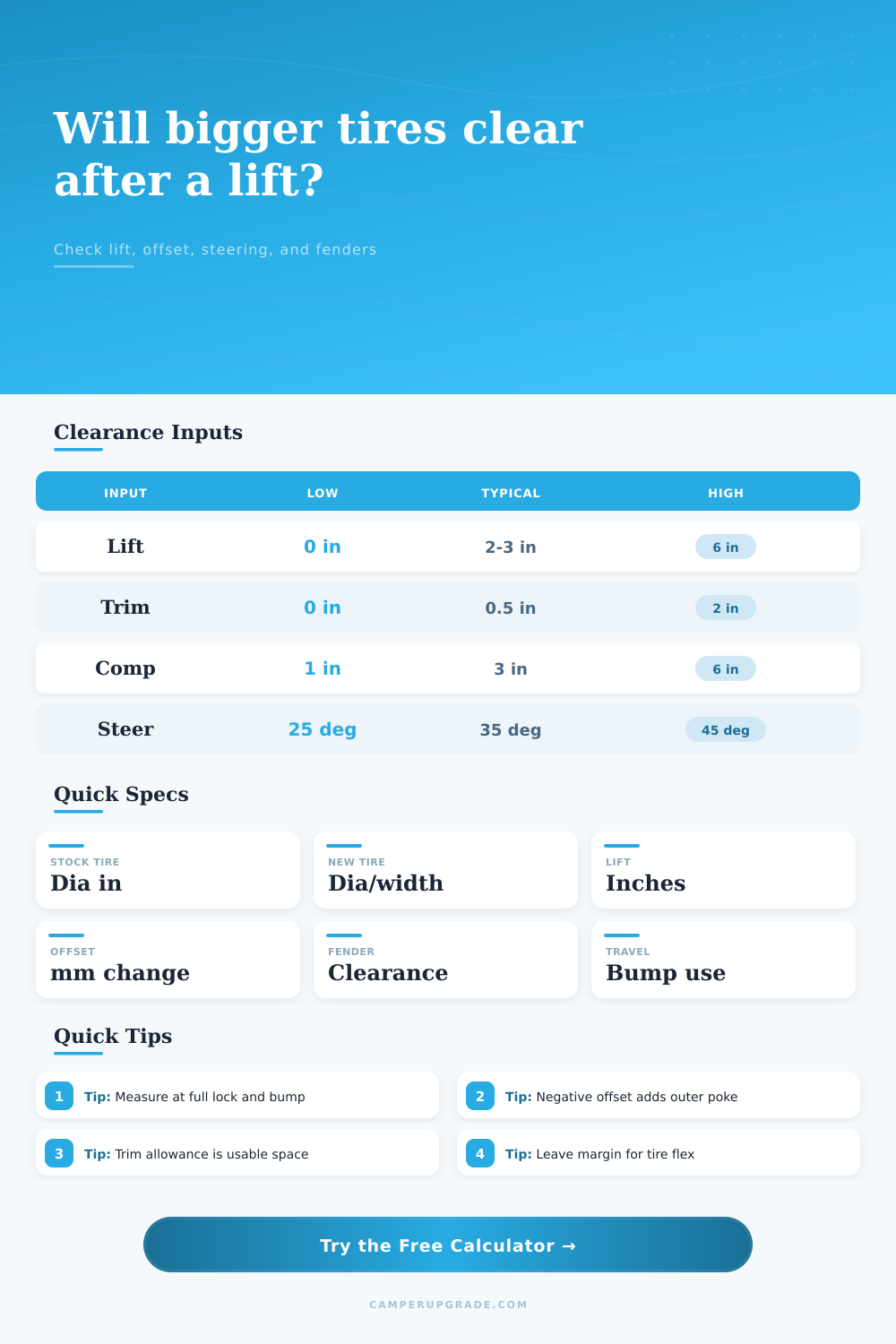
Estimate whether a larger tire clears the fender, inner liner, and turning sweep after lift height, wheel offset, compression travel, steering angle, and trimming allowance.
| Diameter change | Radius growth | Minimum lift to offset radius | Fitment note |
|---|---|---|---|
| 31 to 32 in | 0.5 in | 0.5 in plus bump margin | Usually minor liner checks |
| 31 to 33 in | 1.0 in | 1.0 in plus bump margin | Common mild lift change |
| 32 to 35 in | 1.5 in | 1.5 in plus bump margin | Often needs offset or trim tuning |
| 33 to 37 in | 2.0 in | 2.0 in plus bump margin | Cycle suspension before trail use |
| Offset change | Inner clearance effect | Outer poke effect | Typical reason |
|---|---|---|---|
| +12 mm | 0.47 in less inner room | 0.47 in tucked inward | Keep tire under flare |
| 0 mm | No offset change | No offset change | Stock wheel baseline |
| -12 mm | 0.47 in more inner room | 0.47 in more poke | Clear control arm or frame |
| -25 mm | 0.98 in more inner room | 0.98 in more poke | Wide tire steering clearance |
| Steering angle | Added sweep estimate | Most likely contact point | Calculator use |
|---|---|---|---|
| 20 degrees | Light | Rear liner edge | Parking lot check |
| 30 degrees | Moderate | Pinch weld or splash guard | Common street turn |
| 40 degrees | High | Body mount or bumper edge | Full lock fitment |
| 45 degrees | Very high | Forward liner and flare | Trail articulation check |
| Example setup | Inputs to watch | Typical target margin | Result goal |
|---|---|---|---|
| Daily driver lift | Compression and fender gap | 0.75 in or more | No rub during speed bumps |
| Overland cargo load | Actual bump travel | 1.00 in or more | Reserve for loaded travel |
| Trail articulation | Steering and trim allowance | 1.25 in or more | No lock-to-lock rub at bump |
| Wide offset wheel | Outer poke and sweep | Check both sides | Clear flare, bumper, and liner |
There’s a certain hubris that comes with buying a lift kit. Suddenly you’ll picture your truck as a monster capable of crushing rocks without any consequences. Reality soon settles in after dropping your ride over a bump. Your suspension compress and you can feel, or rather, HEAR. The unmistakable crunch of rubber gnawing at metal. That’s when it dawns on you: clearance isn’t a fixed number; it’s a dynamic dance between physics and geometry.
After plugging in your measurements, the page’s calculator will do the math for you. No need to guess conversions and coefficients.
Why Your Tire Rubs
Tire growth, The single most important thing to know about tire size is that it is deceptive. A 3 inch increase in diameter result in just a 1.5 inch increase in radius. That doesn’t sound like much, but consider that when the wheel rolls over a bump, the suspension compress. The tire now climbs up into the wheel well while the fender arch drop down on top of it. Consider that travel. The majority of folks will measure distance between them at rest and believe they have some space there. They don’t. Subtract the expected travel of your suspension before it reaches the bump stop. What remains is your cushion against rubbing and the room your tire has to move around. If you don’t leave any room for it to get there, it’ll make room somehow.
And then there’s offset, which is frequentlly misinterpreted as well. “If I just move my tire out, I’ll gain some clearance in there,” folks believe. True, you do, but what you also gain is additional width at the very outside of your wheel. As you steer the wheels, they are going to cut a path across the wheel well. If the tires is positioned farther from center, their path must be longer. What was once a straight shot becomes an arc. And that arc increases the likelihood that the sidewalls will rub against the corners of bumpers or fenders. Even if your tire has ample clearance behind the frame. You can see that illustrated in table on the page, where it plots how changes in offset affect contact positions. So that little dozen-millimeter adjustment move the tire almost a half-inch. On a narrow wheel well, a half-inch can spell the difference between shredding your sidewall and running true.
And then there’s width. It complicates things further. Wider isn’t simply wider, it tends to be stiffer. Stiff tires is less likely to flex out around an obstacle. And they tend to keep their shape in contact with the liner. That may mean if your margin for error is slim, a softer compound would of rolled up on top of a pinch weld. But a stiff all-terrain tire will hit it squarely. What you’re thinking about here is size yes, but also material.
The fix is trimming the liner. But that’s a band-aid. You cut a piece of plastic away and feel like it will never come back. Then you remember you’ve removed the final line of defense between you and mud and road debris.
It’s under load where the rubber meets the road. Empty trucks ride higher; loaded trucks ride lower. This affect the suspension geometry. Something that clears in the shop doesn’t necessarily clear on a rough ride carrying cargo. Know your worst case scenario. Is it a high speed bump that compresses the rear? Is it a slow crawl that articulates the front? Adjusting the steering and compression inputs let you simulate those scenarios with the tool. It makes you think about the angle. Twenty degrees of turn isn’t the same than a forty-degree lock. The length of the arc is important.
Risk management is what this comes down to. It’s called fitment for a reason. When you’re running up against the limit, there isn’t any way to eliminate rub completely. All you can do is reduce it as much as possible. And you don’t need ZERO clearance. That’s impossible. What you want is just enough room so you won’t stress over it each time you drive through a pothole or across railroad tracks. Do your measuring with care, and expect the worst case scenario. If it says you’re tight, then it’s probably true. It’s better to trim a bit of liner here than a tire there later on. The “crunch” of rubber meeting metal is a sound you do not want to hear. Keep the math honest, and the truck will thank you.