Snatch Strap Rating by Vehicle Weight Calculator
Estimate recovery line load, recommended strap MBS, stretch behavior, shackle margin, and side-pull penalty from the actual stuck vehicle and terrain.
| Severity | Planning factor | Typical vehicle state | What it means |
|---|---|---|---|
| Easy roll | 1.15x | Wheels rotate, little suction | Small load above rolling weight |
| Light stuck | 1.45x | One axle slowed, shallow rut | Often solved with gentle pull |
| Moderate stuck | 1.85x | Sand bowl, snowbank, mud drag | Needs controlled stored energy |
| Hard stuck | 2.35x | Buried to sidewall or diff dragging | Consider digging before pulling |
| Severe stuck | 3.10x | Frame contact, deep suction | High peak load risk |
| Extreme stuck | 3.85x | Vehicle bellied or suction locked | Reduce load before recovery |
| Terrain | Multiplier | Main load source | Field note |
|---|---|---|---|
| Firm dirt or gravel | 1.00x | Rolling resistance | Best case for a light assist |
| Packed or shallow snow | 1.12x | Compaction in front of tires | Clear tire path first |
| Soft sand | 1.28x | Tire plowing and belly drag | Air down and shovel before snatch |
| Wet mud | 1.45x | Ruts and suction | Use boards or shovel to cut suction |
| Sticky clay | 1.62x | Adhesion and deep tire pockets | Peaks rise quickly |
| Desert silt | 1.52x | Powder drag around tires | Longer low-energy pulls help |
| Rocks with tire bind | 1.35x | Mechanical bind | Change steering before pulling |
| Waterlogged track | 1.55x | Mud suction plus water drag | Inspect hidden anchors and depth |
| Setup | Factor range | Use case | Risk to watch |
|---|---|---|---|
| Straight static pull | 1.00x | Winch or gentle tow tension | No stretch energy reserve |
| Controlled kinetic pull | 1.35-1.55x | Most planned snatch recoveries | Use slow take-up first |
| Firm kinetic pull | 1.65-1.85x | Sand or mud after digging | Peak load rises fast |
| High-energy snatch | 2.00x+ | Last-resort stuck vehicle movement | Reassess rigging and bystanders |
| 5 degree side angle | 1.00x | Nearly straight line | Minimal angle penalty |
| 15 degree side angle | 1.04x | Offset recovery vehicle | Check side-loaded points |
| 30 degree side angle | 1.15x | Poor alignment | High lateral force |
| Component | Common rating | Best match | Calculator note |
|---|---|---|---|
| Light kinetic strap | 8,000-11,000 lb MBS | Small AWD or UTV | Often too light for loaded 4x4s |
| Medium kinetic strap | 17,000-22,000 lb MBS | Mid-size SUV or truck | Common trail recovery range |
| Heavy kinetic strap | 26,000-33,000 lb MBS | Full-size loaded rigs | Needs compatible rated points |
| Soft shackle | Varies by WLL and MBS | Rated closed recovery points | Avoid sharp edges and heat |
| Bow shackle | 3.25-4.75 t WLL | Rated metal recovery point | Pin fit and WLL matter |
| Static tow strap | Low stretch | Slow towing or winching | Not a kinetic snatch strap |
In the dead of night, you’re in some random parking lot: four-wheel drive stuck in soggy sand; tire spinning; engine screaming; oh no, a mechanical crisis has occured. In this instant, physics turns hazardous. You grab for nearest strap available, hook it up, and pray. You might not understand that freeing the vehicle usually isn’t just about its weight. Rather, it’s based off how one applies the energy, what’s holding the thing down, and if their rigging will stand up to shock of instantaneous peak load.
This is the tool that will let you figure out exactly what rating you require for whatever conditions and situations you are driving in. This means actual weight of the vehicle fully loaded and what kind of conditions you are driving through. The brochures list curb weights. This is not the loaded weight of the vehicle with people in it, gear, fuel, water, etc. All that adds to the weight which then add more drag and inertia.
How to Choose the Right Recovery Gear
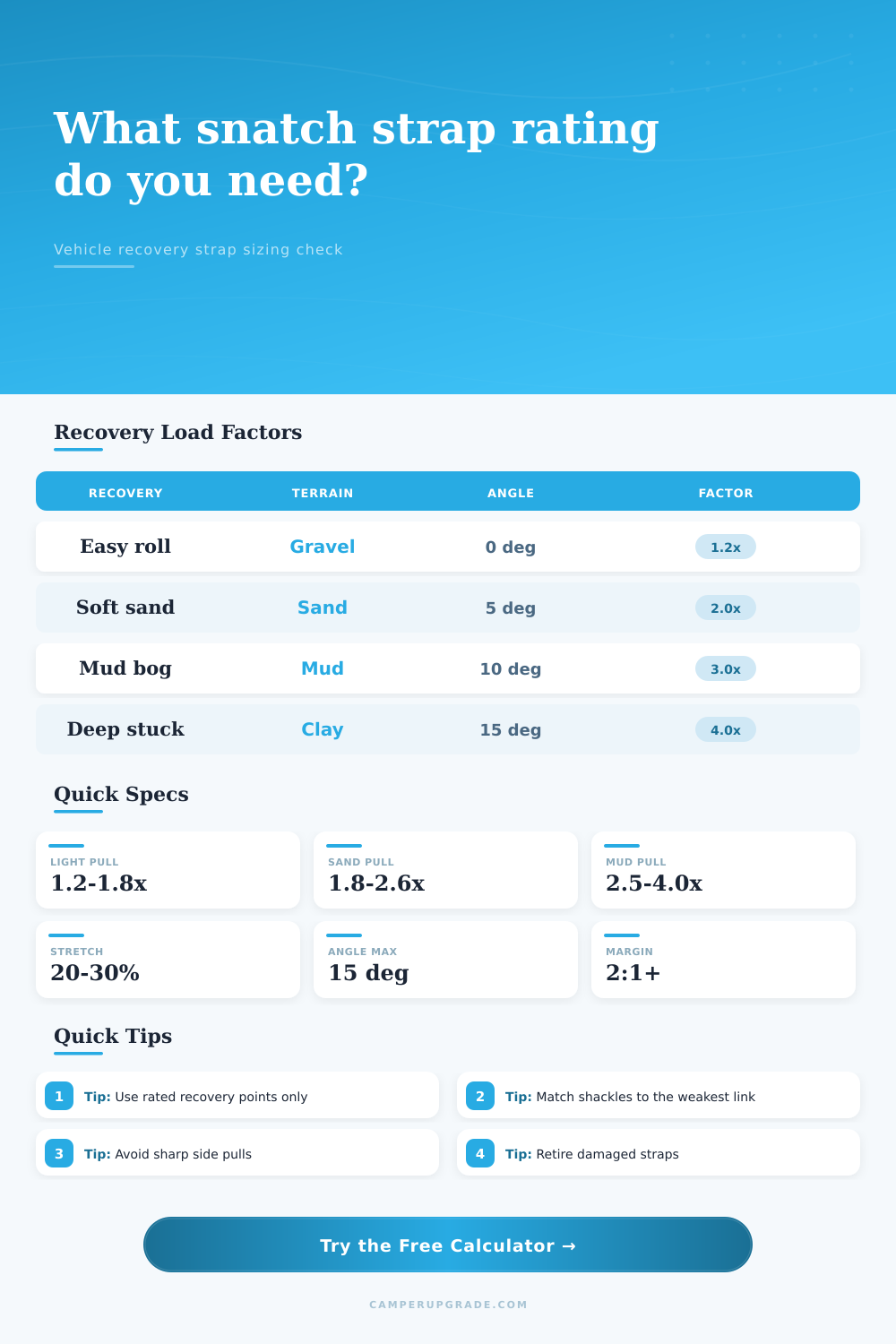
So once you get the weight you choose the type of terrain you are traveling on. Mud is not like sand. Clay is not like mud. Each type of surface have its own pattern of how hard it is going to resist you and multiply the force needed to overcome it. Deep mud may multiply by 3 times. Soft sand may only be twice the weight.
Next, it takes into account how serious the scenario is and how you’re going to recover. Is it a high-energy kinetic snatch? That take way more power than a gentle static pull. Is it a kinetic recovery, pulling on the elastic energy of the strap to snap the truck loose? It is good if rated properly but bad news if it is not. The tool will tell you whether your expected maximum line force is within shackle working load limit and minimum breaking strength of your strap. You get a margin of safety (and if it’s low), you’re not ready to pull, nor do you want to be out there with this weaker strap.
The other thing a lot of folks don’t think about is the angle of the recovery line. It is very efficient if you are pulling with a straight line. However, every degree off the line will cause more side stress on both the recovery points and the vehicle’s frame. Side loads introduced by even slight angles in the line can tear at the tow hooks if they isnt rated for those forces. As the reference tables on this page demonstrate, those forces scale up rapidy. Fifteen degrees may not seem like much but will add lateral force that can pull a weak spot right out of the bumper. Your goal should of be to keep your line as straight as you possibly can.
Power is nice, but as they say, preparation can be more important. The less the tires has to fight, the better. Letting them down allows for a larger area to push on the ground and float a bit on soft ground. Get the junk off the tires that cause drag. Clearing the area around the diff will prevent parts from getting stuck. This all takes some weight off the maximum amount of force applied by the strap. Lessen the force, lessen the chance of failure. It is simple physics, but it is not always thought about in the heat of the battle.
Inspect all the links in your chain. What’s the weakest link? Attach that ten thousand pound strap to a three thousand pound shackle and what good does it do? Rated recovery points are required on soft shackles. Metal bow shackles requires proper pin tension. Make sure it all matches up with whatever has the most load in the mix. Check your strap for sun damage, cuts and fraying. A compromised strap will snap when you least expect it.
In summary, this is all about energy management, how do I give the truck the energy needed to get moving without breaking anything. The calculator is a starting point in finding what gear to use. It will tell you what’s safe. Then your experience will tell you what is practical. So use the calculator to plan the site, prep the rig and pull confidently. Safe isn’t about having the strongest strap, it’s about understanding the forces at play, being conservative on what could happen worst case, and then planning accordingly before you ever crank up.