Winch Line Pull Rating Calculator
Estimate required recovery pull from loaded vehicle weight, slope grade, surface resistance, stuck severity, rigging line count, drum layer loss, snatch block efficiency, and safety factor.
🚙 Vehicle and recovery presets
⚙ Recovery inputs
Use trail weight with passengers, water, fuel, armor, drawers, and recovery gear included.
Enter the uphill grade along the pull direction, not the side slope.
A double line roughly doubles mechanical advantage, then loses some force to pulley friction.
Winches pull hardest on the first layer and lose rating as line stacks on the drum.
Enter the first-layer advertised pull rating for your winch, not the rope working load.
Use 0 for a straight pull. Add penalty for off-angle fairlead drag or awkward anchors.
📊 Rigging comparison grid
🔧 Recovery factor cards
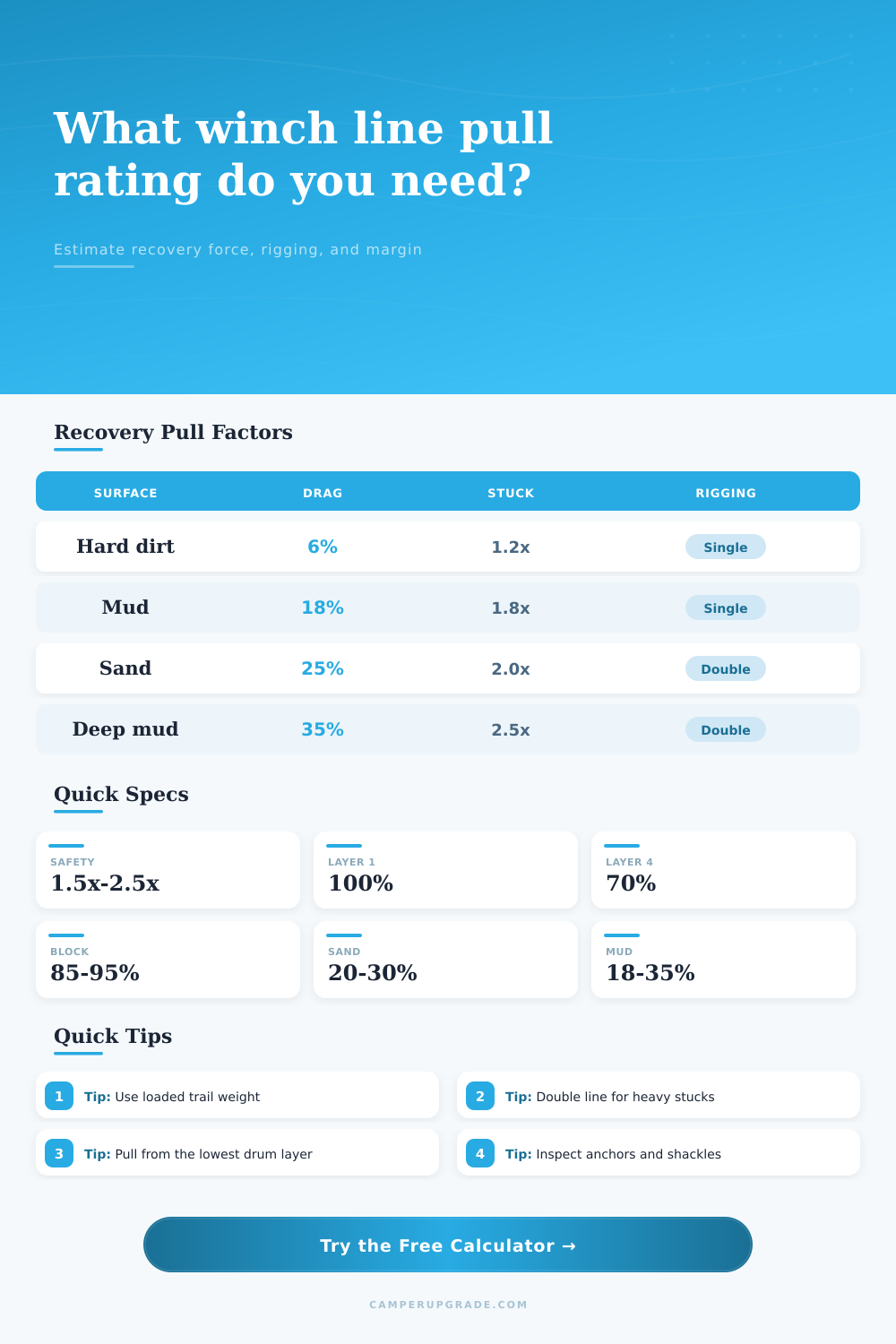
🗺 Surface resistance table
| Surface or obstacle | Resistance factor | Typical stuck factor | Recovery note |
|---|---|---|---|
| Firm dirt or gravel | 4% to 6% of vehicle weight | 1.0x to 1.2x | Usually rolling resistance plus a small grade component. |
| Wet grass or slick clay | 7% to 10% of vehicle weight | 1.2x to 1.5x | Traction loss may matter more than burial depth. |
| Loose gravel or ruts | 10% to 15% of vehicle weight | 1.3x to 1.6x | Tire plowing and rut walls add drag quickly. |
| Shallow mud | 16% to 22% of vehicle weight | 1.5x to 1.8x | Use a higher factor if axles or diffs touch mud. |
| Soft sand | 20% to 30% of vehicle weight | 1.6x to 2.0x | Air down, shovel, and reduce suction before pulling. |
| Deep mud or suction | 30% to 45% of vehicle weight | 2.0x to 2.6x | Often needs double line rigging and careful anchor choice. |
⛓ Drum layer and rigging table
| Setup | Line multiplier | Typical efficiency | Effective pull example |
|---|---|---|---|
| Single line, layer 1 | 1.00x | 100% | 9,500 lb winch gives about 9,500 lb. |
| Single line, layer 3 | 1.00x | 78% | 9,500 lb winch gives about 7,410 lb. |
| Double line, layer 1 | 2.00x | 85% to 95% | 9,500 lb winch gives about 17,100 lb at 90% block efficiency. |
| Double line, layer 4 | 2.00x | 70% drum, 90% block | 9,500 lb winch gives about 11,970 lb. |
| Off-angle fairlead pull | Varies | Minus 5% to 25% | Side load and fairlead friction reduce useful pull. |
⚠ Safety factor table
| Safety factor | Use case | What it covers | Calculator effect |
|---|---|---|---|
| 1.25x | Light assist on firm ground | Minor estimate error and short pulls | Lowest recommended cushion. |
| 1.50x | Common trail recovery | Loaded weight uncertainty and modest surface change | Good baseline for many overland rigs. |
| 1.75x | Remote route or poor anchors | Harder setup, changing slope, longer pull time | Adds margin before equipment selection. |
| 2.00x | Heavy stuck or uneven pull | Burial, suction, and angle losses | Often points toward double line rigging. |
| 2.50x | Conservative planning | Severe unknowns and recovery reserve | Use for planning, not a guarantee of safe recovery. |
🚚 Preset comparison table
| Preset | Loaded weight | Surface | Rigging choice |
|---|---|---|---|
| Stock Jeep Trail Mud | 4,600 lb | Shallow mud | Single line, layer 2 |
| Overland Tacoma Sand | 5,800 lb | Soft sand | Double line, layer 2 |
| Half-Ton Snow Bank | 6,700 lb | Packed snow | Double line, layer 3 |
| Sprinter Gravel Climb | 8,400 lb | Loose gravel | Double line, layer 2 |
| Rock Crawler Step | 5,200 lb | Rock step | Double line, layer 1 |
💡 Recovery calculation tips
This calculator is an estimating aid for planning recovery loads. Follow your equipment manuals, use rated recovery gear, stay clear of loaded lines, and stop if any component is overloaded.
When your winch reaches capacity, it’ll make itself known to you. Not with a bang but a whimper. A strained whining sound. Suddenly there’s no tension at all, it smells like burnt insulation. You’re in the mud and your overland rig has come to rest. You look around and see the number painted on the side of the winch doesn’t match what you see in front of you.
What is that line pull number? That’s the best case scenario. On the first layer of cable. Straight up, pull perfectly. There is no friction. This is a perfect situation and real world isn’t often so helpful.
How to Choose the Right Winch
We have all heard about the good ol’ rule of thumb for buying a winch. It’s twice your vehicle weight. They wonders why it stalls out halfway through a recovery. Plug the number into this calculator and let it do the math for you. Plug your situation in. No more guesswork. No more stacking the deck against yourself with unknown variables.
First off, weight does not equate to drag. Even though your rig may weigh five thousand pounds. That has nothing to do with the force necessary to get it moving. What resists movement determine that amount of force. If you’re on a hard dirt road, there is almost no resistance. It’s basically rolling friction plus a bit of an uphill incline. Drop that same rig in soft sand or muddy conditions. Now you’ve got a huge drag coefficient. That’s where the tool comes into play.
There’s a selection of surface type. Drag applies a percentage of its resistance based off your loaded weight. How badly stuck are you? Is it merely a light slide on gravel? Are you dragging the frame on bottom of some stream? Multiply the stuck factor by basic drag. Get that part wrong and you make the biggest mistake in making any recovery plan.
Winch geometry is another consideration. A winch are strongest when there are only one or two wraps of cable left on the drum. As you take line off the drum, the larger diameter decreases the motor’s mechanical advantage. By the time you get to four layers, you could lose 30 percent or more of your rated pull. That’s why savvy off-road folks will get near their anchor point and then crank upward. The calculator takes that drum layer reduction into consideration. It tells you how much pull you’ll actualy have. With three layers down, your winch has much less pull than what the box say.
How can you fight back? Enter rigging. Doubling up the line with a snatch block basically doubles the pulling force. Friction in the pulley does mean you lose some efficiency. You’ll enter the block efficiency into the tool which takes account of this real world loss. So what do you get? You get increased force. What’s the tradeoff? You get less line speed and more stress on the anchor point.
Angle of pull needs to be considered as well. Straight line pull is best. Anything else adds side load on the fairlead, which reduce the effective pull. Small angles will reduce your margin but eat away at it nonetheless. But there are safety reasons for all this stuff. Having a multiplier provides extra space on your equipment. It allows for unexpected resistance or shock loads. When anchors aren’t known, it’s a good idea to have a conservative factor. When terrain isn’t known, same thing.
So what does that give you? It gives you an output. That output tells you what your suggested rating is. Then you compare that to what you’ve got rigged now. If the output says the needed pull exceeds the actual winch capacity, rig a mechanical advantage system. Otherwise adjust the way you’ll be approaching it.
Better yet plan for how much force you will require before the engine gets hot. Knowing those facts makes this a controlled recovery instead of one based off guesswork. We want to get the vehicle out but we also don’t want to break our anchor or break our gear. We should of gone home with our equipment and rig intact. That is all that matters in the end.