Recovery Gear Working Load Calculator
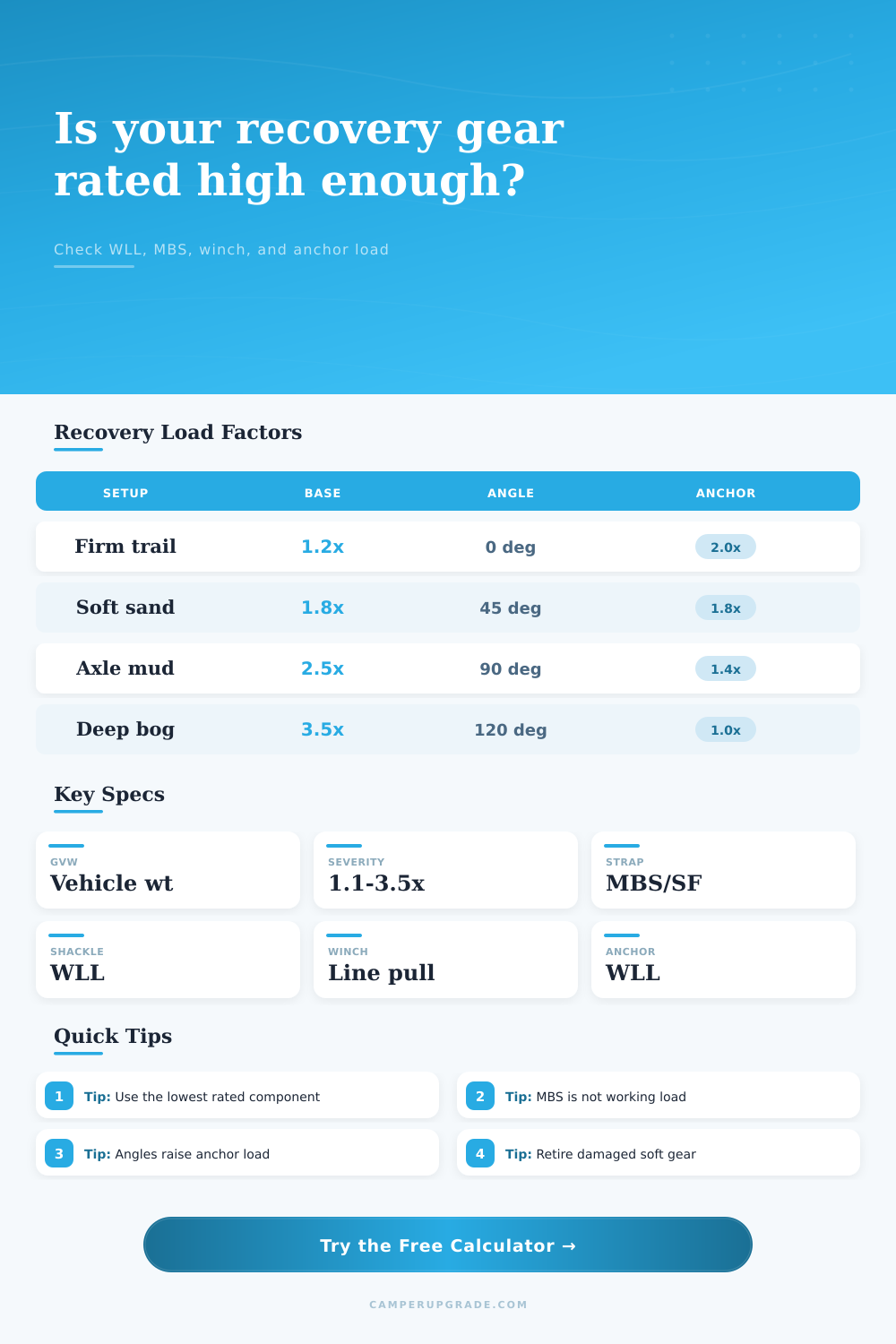
Estimate recovery demand from vehicle GVW, stuck severity, mud or sand multiplier, grade, snatch angle, strap MBS, shackle WLL, winch line rating, and anchor rating.
Load breakdown
| Severity | Multiplier | Typical condition | Example demand on 5,000 lb GVW |
|---|---|---|---|
| Rolling assist | 1.10x | Vehicle moves once tension is steady | 5,500 lb before surface and grade |
| Light stuck | 1.35x | Shallow sand, snow, or tire rut | 6,750 lb before surface and grade |
| Moderate stuck | 1.75x | Tires digging, some chassis drag | 8,750 lb before surface and grade |
| Axle contact | 2.25x | Differential, frame, or belly contact | 11,250 lb before surface and grade |
| Deep bog | 3.00x | High suction or buried tires | 15,000 lb before surface and grade |
| Mud or sand surface | Multiplier | When to use it | Load effect |
|---|---|---|---|
| Firm dirt or gravel | 1.00x | Hard track with minor wheelspin | No extra surface multiplier |
| Wet grass or shallow snow | 1.15x | Low traction but limited suction | Adds 15% to stuck load |
| Packed beach sand | 1.30x | Sand supports tires but resists rolling | Adds 30% to stuck load |
| Soft sand or loose wash | 1.50x | Tires plow and recovery ramps sink | Adds 50% to stuck load |
| Sticky clay mud | 1.70x | Tread packs and suction increases | Adds 70% to stuck load |
| Deep wet mud suction | 1.90x | Axles or frame dragging in wet mud | Adds 90% to stuck load |
| Snatch redirect angle | Anchor multiplier | Anchor example at 8,000 lb line | Planning note |
|---|---|---|---|
| 0° near-parallel return | 2.00x | 16,000 lb at anchor | Highest anchor load in a double-line setup |
| 45° shallow redirect | 1.85x | 14,800 lb at anchor | Still close to double line tension |
| 90° side redirect | 1.41x | 11,300 lb at anchor | Common right-angle redirect estimate |
| 120° wide redirect | 1.00x | 8,000 lb at anchor | Anchor sees about one line of tension |
| 180° straight pass-through | 0.00x | 0 lb redirect load | No meaningful redirect force at the block |
| Gear rating entry | What it represents | Calculator comparison | Common weak link |
|---|---|---|---|
| Shackle WLL | Marked working load for bow, screw-pin, or soft shackle | Compared to recovery demand with margin | Underrated connector at recovery point |
| Strap MBS | Minimum break strength of kinetic strap, rope, or tow strap | Converted to WLL by selected safety factor | MBS mistaken for usable working load |
| Winch line rating | Line pull or rope rating for the active layer and setup | Compared to recovery demand with margin | Outer drum layer or damaged rope |
| Anchor rating | Tree saver, ground anchor, vehicle anchor, or rated point | Compared to snatch-angle anchor demand | Redirect anchor overloaded by angle |
These tables are planning aids. Field recovery requires rated attachment points, controlled tension, inspection, and manufacturer limits for every component in the load path.
Shackle WLL
Marked working loadUse the lowest marked WLL in the connection, including soft shackles, bow shackles, recovery rings, and vehicle recovery points.
Strap MBS
Break rating dividedThe calculator divides strap or rope MBS by the selected safety factor before comparing it with calculated working demand.
Winch line
Pull rating pathEnter the practical line rating for the winch layer, rope condition, fairlead path, and any pulley or ring arrangement being used.
Anchor rating
Angle adjustedA snatch block or recovery ring can load the anchor with more than one line of tension when the redirect angle is small.
The strongest shackle and the strongest strap don’t matter if your recovery system is only as strong as the weakest link. And most of us concentrate on what we have in our hands. We forget to consider how much it takes to get a vehicle unstuck, like how a couple of guy plus a full tank of fuel adds a lot more weight. We also neglect angle of redirection and type of tree being used as an anchor point.
Enter the vehicle weight and stuck conditions and the calculator does the rest. You’ll know for sure if your rig will hold up to the task or not without having to guess. This makes you think about whole load path instead of just the hardware.
Plan Your Recovery for Safety
So what is weight of your vehicle? That’s the first question you must answer. It is not the dry curb weight from the brochure. This is gross vehicle weight rating with everything inside it, including passengers, camping gear, water and fuel.
Don’t assume the resistance is just five thousand pounds if you’re towing an SUV rated to pull that weight out of mud. It will be significanly more than five thousand pounds. The tool accounts for this dragging force through severity multiplier.
While soft sand may only increase resistance by a small amount, axle-deep mud or a slick clay can double what you’ll have to pull against. How far stuck and what the terrain is made of matter.
A kinetic strap that appears easy to work with on the road becomes a deadly projectile if load is too great for its working limits. Most come undone at angles. Snatch blocks redirect the line and this increase the tension on the anchor point. The closer the angle to the anchor, the greater the multiplier. Pulling eight thousand pounds of force around an anchor at a tight angle multiplies that many times. If you have eight thousand pounds of force on your anchor, it may reach as much as sixteen thousand pounds, or even more.
The page reference tables makes all this clear. Even pulling at right angles (a ninety degree redirect) still puts about one and a half times the line tension on the anchor. That little bit of geometry make the difference between holding and ripping free. Always consider the rated load on the anchor based off the angle it is placed at, not just the straight line pull.
A lot of people gets confused with working load limit and minimum breaking strength. The first thing to know is that manufacturers rate their straps by the amount of force required to break them. You do not want to come anywhere close to that figure. Using a safety factor, the tool figures out your strap’s minimum breaking strength and makes it into safe working load. For recreational recovery, the standard is three to one. So if your strap breaks at 30 thousand pounds, you should of consider it a ten thousand pound limit.
Why? Because dynamic loads spike immediately. When a vehicle snaps free from suction, the shock load can be well beyond the steady pull by a huge margin. If your working limit is even remotely close to the demand, that spike will tear up the gear.
There is also a maximum on the Winch Line, depending on the number of drums it is layered through. Because lines are stacked and there is more resistance on the outside layer, they will generaly rate lower. You can put in the actual line rating you have installed. This ensures you aren’t using a maximum limit that might not match your actual setup.
From hook to shackle, every component must exceed calculated demand. That’s what determines if the system is safe or not.
“Strong isn’t everything. Strong is knowing how to use the equipment you have while considering how it reacts to physics. When I’m driving down a trail, my rig creates huge forces on bad ground that I can’t sense naturaly. Running those numbers beforehand removes the guesswork out of a high stress situation. You stop worrying about whether the strap will hold so now you can focus on making the pull safe instead of wondering if it will work or not. The point being, don’t turn your recovery kit into scrap metal while getting unstuck. Plan accordingly, respect the limits and save some margin for the unknown.”