Camper Cooking Moisture Output Calculator
Estimate moisture from propane combustion, boiling steam, simmer loss, people breathing during meal prep, ventilation CFM, camper air volume, and a target indoor humidity level.
Moisture breakdown
| Propane stove use | Fuel burned | Combustion water | Planning note |
|---|---|---|---|
| One 7000 BTU burner for 10 minutes at 50% | 0.027 lb | 0.68 oz | Small by itself, but it stacks with steam. |
| One 7000 BTU burner for 30 minutes at 70% | 0.068 lb | 1.71 oz | Common skillet dinner range. |
| Two 9000 BTU burners for 25 minutes at 80% | 0.278 lb | 7.1 oz | Heavy indoor flame load for a camper. |
| One 11000 BTU burner for 45 minutes at simmer | 0.076 lb | 1.9 oz | Low flame helps, but long time still matters. |
| Water cooking style | Typical loss | Moisture from 1 qt | Best calculator input |
|---|---|---|---|
| Lidded kettle or quick coffee water | 5-12% | 1.6-3.8 oz | Use 8-10% if lid stays on. |
| Lidded rice or oats simmer | 10-20% | 3.2-6.4 oz | Use higher end for loose lids. |
| Open pasta boil | 25-45% | 8-14 oz | Use measured pot loss when possible. |
| Soup, stew, or uncovered reduction | 20-60% | 6.4-19 oz | Long simmer can dominate humidity. |
| Camper interior | Approx volume | 60 CFM exchange | Moisture meaning |
|---|---|---|---|
| Compact campervan | 650-900 cu ft | 4-5.5 ACH | Humidity changes fast, but fans also exchange fast. |
| Full-size van or small trailer | 900-1400 cu ft | 2.6-4 ACH | Good default range for a roof vent estimate. |
| Travel trailer living area | 1500-2400 cu ft | 1.5-2.4 ACH | Needs more CFM for the same source load. |
| Large fifth wheel or Class A zone | 2500-4000 cu ft | 0.9-1.4 ACH | Local stove moisture may linger without hood capture. |
| Indoor temperature | Water at 50% RH | Water at 60% RH | In 1000 cu ft air |
|---|---|---|---|
| 50°F / 10°C | 2.1 oz | 2.5 oz | Cold air hits target quickly. |
| 60°F / 16°C | 3.1 oz | 3.7 oz | Condensation risk rises on cold glass. |
| 70°F / 21°C | 4.5 oz | 5.4 oz | Warm air hides more vapor temporarily. |
| 80°F / 27°C | 6.4 oz | 7.7 oz | Cooling later can reveal condensation. |
Lidded kettle
Low steamShort flame time and a lid keep the water source small; propane vapor may be the larger share.
Open pasta pot
High steamLarge water volume plus uncovered boiling can overwhelm a small camper without direct exhaust.
Skillet meal
Flame-ledLess boiling water means combustion water and people often become the main measured sources.
Winter meal
Target tightCold air and cold window surfaces make the same ounces of moisture more likely to condense.
Moisture is water vapor which take up space and has weight. It condenses on that chilly windowpane inside your cozy camper. The phase change destroy the dry environment you work so hard for.
Campers view moisture as a annoyance to remove after-the-fact. Think of it as amount issue that needs to be managed as it happens.
How to Stop Moisture in Your Camper
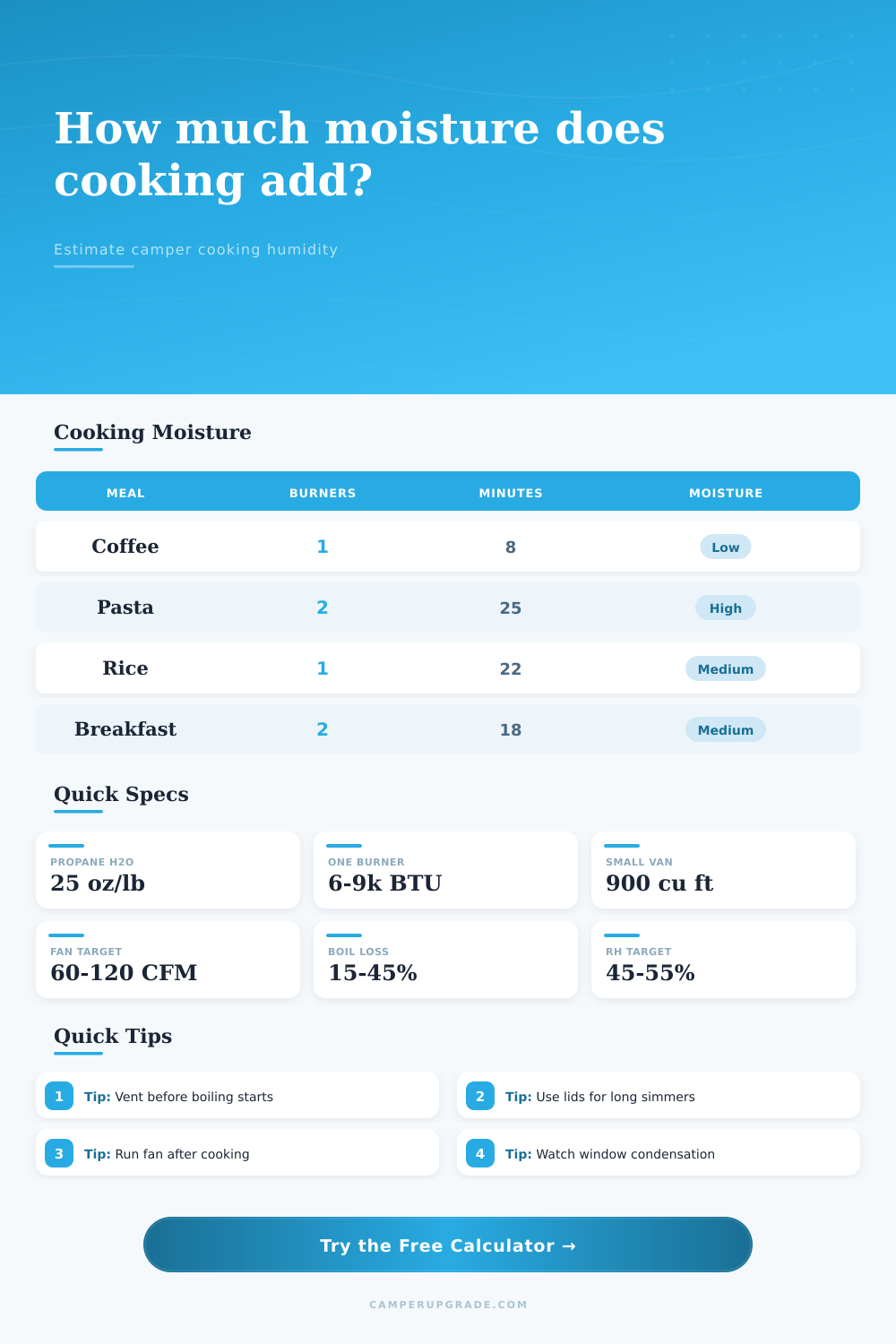
Propane produces two sources of humidity when cooking: combustion and water being boiled. For every pound of propane burnt, approximately twenty five ounces of water are released as a direct by-product of burning propane. Whether you’re simmering on low or searing over high heat, it doesn’t matter. Some of the water comes directly from the water itself. When you boil a quart of water for pasta, a large portion of that water will be turned into steam.
How much? The calculator does math for you. It can breaks down what percent of humidity results from the water versus the flame. That way, you’ll know which factor you need to control more carefuly.
Don’t activate the ventilation fan when you notice the air is getting muggy. At that stage, moisture will have spread through cabin. Without good airflow, it’ll settle in corners, bedding and cushions. Proactive ventilation are more effective than reactive. Ideally you’d like the fan running air long before water bubbles in the pot. A fan located immediately above cooktop catches the air far more effective than a fan pulling air from across the room. A vent/hood close to the source of moisture picks it up while its still concentrated. That’s what the tool takes into account. Because it knows quality of capture by your set-up, it changes its retained moisture to match the amount of moisture removed as generated.
The first item of protection are lids, and they’re something you frequently misuse. You don’t boil away as many molecules when a pot is covered as you do if there’s no lid at all, but if it’s just barely on, then it’s almost like being lidless. Try cooking something in a tightly closed container, oatmeal, perhaps, or some rice… Next time. Compare it to one cooked using a loose lid. There will be twice as much water in the pan from the loose-fitting lid then the tightly closed one.
Why? Because a van is hardly big enough. When I say ‘van’, I’m referring to the interior space of a small van, which is often under nine hundred cubic feet. Not much room to play with. A pot of boiling water might occupy only a quarter of that space, meaning that even if you start out with less than a gallon of water, its steam may raise the relative humidity in the van beyond 55% mark, making the walls cold enough to cause condensation. See the reference table on this page for confirmation. It shows how much each style of cooking contribute.
Humans contribute to the problem as well, though in smaller amounts. Boiling water loses moisture to the surroundings. Combustion releases moisture too. Then two human get into the van for a half hour and breathe some moisture into the mixture. A little bit, yes, but it compounds everything else. That compounding matters a lot in the winter. Warm air contains much more moisture than cold air. So while the same amount of steam you exhale in summer might be harmless, it’ll condense immediately onto a chilly window if your interior temps are sixty degrees and your windows is just below freezing. The calculator allows you to visualize this. You can enter target humidity and starting temperatures. It calculates how many ounces of water are in the air at any time and when you will reach your comfort limit.
Nope, no one needs to go cold-turkey on cooking. It’s all about learning the physics of small spaces and managing moisture. Each flame, each simmer, each boil increase the overall load. You know what happens when propane burns? Water. And you know what happens when you boil water? It turns into steam and goes right back up in the air.
So use lids. Vent early. Keep track of the humidity. Stop thinking of condensation as some sort of strange force and instead begin measuring its volume as vapor. Then you’ll realize how manageable the issue is. The window will be dry. The air will remain clear. Your morning cuppa will taste just as good, minus result of an overly humid inside.