Dog Crate Size for Camper Calculator
Calculate crate interior size, exterior footprint, bed allowance, door swing, ventilation clearance, camper floor fit, and loaded crate weight before choosing a travel spot.
🐶Dog breed and size presets
⚙Dog, crate, and camper measurements
Measure the dog while standing naturally. Length is nose to rump, height is floor to the top of the head or ears when that is the tallest point, and shoulder width is the broadest comfortable turn-around width.
Used with dog length to size the turn-around width.
Extra room added to length and width beyond a minimum turn radius.
Clear space in front of the crate when the door is open.
Use the bunk, cabinet base, drawer slide, or cargo bay limit for that spot.
Recommended Interior
Exterior Footprint
Camper Fit
Loaded Weight
Calculation breakdown
📊Live standard crate comparison
🧱Crate shell weight grid
📏Breed and size preset table
| Preset | Typical dog length | Typical standing height | Camper placement note |
|---|---|---|---|
| Chihuahua travel crate | 13 to 16 in | 8 to 10 in | Often fits below a dinette or bed extension |
| Dachshund low crate | 18 to 22 in | 9 to 11 in | Length matters more than height |
| French bulldog camper | 17 to 21 in | 13 to 15 in | Check width and airflow around the door |
| Beagle weekend crate | 20 to 24 in | 15 to 17 in | Commonly lands near a 30 inch crate shell |
| Border collie aisle | 25 to 29 in | 21 to 23 in | Needs a longer bay and good turn clearance |
| Labrador dinette bay | 28 to 32 in | 23 to 25 in | Usually needs a 36 to 42 inch crate family |
| German shepherd garage | 34 to 38 in | 27 to 31 in | Measure height under cabinets and beds carefully |
📦Standard crate size table
| Nominal crate | Typical interior | Common dog range | Camper fit watchpoint |
|---|---|---|---|
| 24 inch crate | 23 x 16 x 18 in | Small dogs to about 25 lb | Door swing can exceed the crate footprint |
| 30 inch crate | 29 x 19 x 21 in | Medium dogs to about 40 lb | Works in many dinette or bunk spaces |
| 36 inch crate | 35 x 23 x 25 in | Large dogs to about 70 lb | Check aisle width with ventilation gap |
| 42 inch crate | 41 x 27 x 30 in | Large dogs to about 90 lb | Often needs rotated placement or cargo bay |
| 48 inch crate | 47 x 30 x 33 in | Giant breeds above 90 lb | Usually needs a toy hauler or fixed bay |
🌬Clearance and comfort table
| Allowance | Typical range | Used in calculator | Why it matters in a camper |
|---|---|---|---|
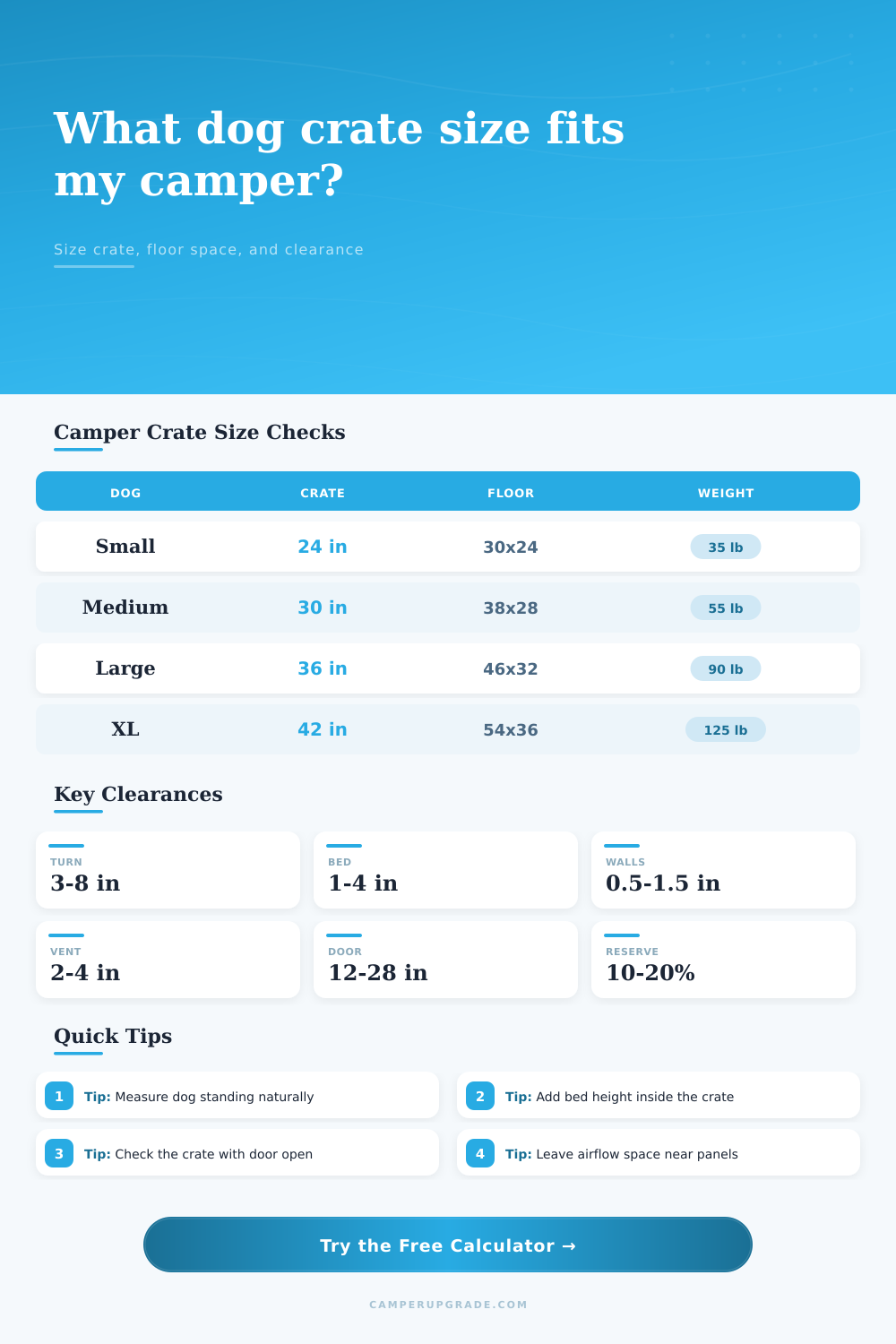
| Turn-around clearance | 3 to 8 in | Adds to length and width | Prevents a crate that only works on paper |
| Bed thickness | 1 to 4 in | Adds to required interior height | The dog stands on the bed, not the bare floor |
| Crate wall thickness | 0.5 to 1.5 in | Adds to exterior length, width, and height | Converts dog space into real camper footprint |
| Ventilation clearance | 2 to 4 in | Adds around width and above height | Keeps soft goods and panels off vented sides |
| Door swing | 12 to 28 in | Adds to occupied floor length | Checks whether the crate can open in place |
🛻Camper placement table
| Camper location | Typical floor bay | Best crate class | Fit check priority |
|---|---|---|---|
| Under dinette edge | 28 x 22 in | 24 to 30 inch | Door swing and knee clearance |
| Converted lower bunk | 72 x 28 in | 30 to 42 inch | Height and ventilation at walls |
| Rear cargo bay | 48 x 36 in | 36 to 42 inch | Loaded weight and tie-down access |
| Toy hauler garage | 72 x 48 in | 42 to 48 inch | Door opening path and airflow |
💡Camper crate sizing tips
When you discover your dog crate does NOT fit in your Camper but does fit in your living room, well then you are in for a special brand of panic. Suddenly that space you thought was big on paper is way too small to slide a wire dog cage into a snug dinette bay. And this is only part of the issue (that being getting the dog to fit into the crate). The other part of the issue is that the crate has to also fit into the world around it! That means thinking about the airflow, door swing, bedding, shell thickness….the list goes on. If you input your dimensions into the calculator above, it will do the math for you…but knowing what the numbers represent helps avoid expensive mistakes.
If they’re like most dog owners, the first thing they do is take their dog’s measurements. That is good. From the ground to the top of the dog’s ear/head, plus from its nose to its rump, that’s the minimum size your crate needs inside. But remember: The crate isn’t a vacuum. There are walls in there. On average, a typical folding wire crate will add three-quarters of an inch to all sides of interior. And a molded plastic crate even more. That’s what separates a snug fit from a jammed fit. To see things correctly, you need to consider exterior dimensions… Not just interior dimensions.
Why Your Dog Crate Might Not Fit in Your Camper
And what about the bed? Yeah, we love our pups and they need to be comfy too! So now we have an orthopedic mat or memory foam bed. Add two to four inches of that. Forgetting how much that adds up can mean standing on your toes in the crate for your dog while traveling. It is not exactly a relaxing ride. The tool adds the bed thickness to the minimum space required for the dog and compares it to vertical clearance in your camper. This helps you see how much room you realy need.
The quiet killer for most camper layouts is the door swing. The crate might fit both width-wise and length-wise. However, the door could open and bang into a cabinet or swing out into the aisle. You must have some space in front of the crate. A small crate might need 12 inches of space. You might need 28 inches for a large crate so the door can open completely. If there’s not empty space in front of the crate because you’re blocking it with something like a ladder or storage bins, then the crate is useless. Measure its footprint when the door is open before buying.
A camper is not a house; it’s a metal box on wheels and airflow counts. Campers become hot boxes. You also want a gap between the crate and any panel or wall that it sits next to for ventilation. This gap should typically be at least a couple of inches, and sometimes as much as four. This is especially critical with plastic crates which depend on their sides to vent. Close the vent openings and you’ve got yourself an oven. The page contains a helpful chart (shown below) showing how much extra area you’ll need for ventilation clearance.
Another aspect that is frequently overlooked until you attempt to pick up the crate is weight. Aluminum crates are heavy and if you have a big dog and he has a nice cushy bed, well over a hundred pound crate isn’t uncommon. Drawer slides and bunk frames aren’t exactly built for carrying hundred-pound loads. Find out the maximum weight capacity of the area where you plan to park the crate. 50 pound max? Problem. The calculator figures out the overall loaded weight of the crate so you can compare it to your camper’s structural limits.
So don’t rush it. Get out the tape measure. How wide is the aisle? How high will it need to be under the overhead bin? Will there be enough room for you to get the crate in and out while you’re on the road? If it’s a fit but you can’t get into the kitchen because the crate is blocking the way, then that’s a fail on the design. Go by the presets if your dog is a common breed, but check your own measurements first. Every dog are different. So is the space you’ll be working with. It is about safety and comfort.
The crate shouldn’t be a prison. A properly sized crate should of be big enough for them to stand up in, turn around, and lay down without bumping their tail or head into it. It must be big enough to fit inside the camper but not take up your breathing space or get in your way. Do this now while sitting at home so when you hit the road you are good. You’ll both thank me. Dog gets his/her safe space and you get a sane mind. Measure twice, cut once, we keep coming back to that. Because the road doesn’t forgive guessing.