Dog Camping Calorie Needs Calculator
Estimate your dog's daily camping calories from weight, activity level, temperature, trail miles, age and neuter status, body condition, treat share, trip days, and food calories per cup.
Calorie Breakdown
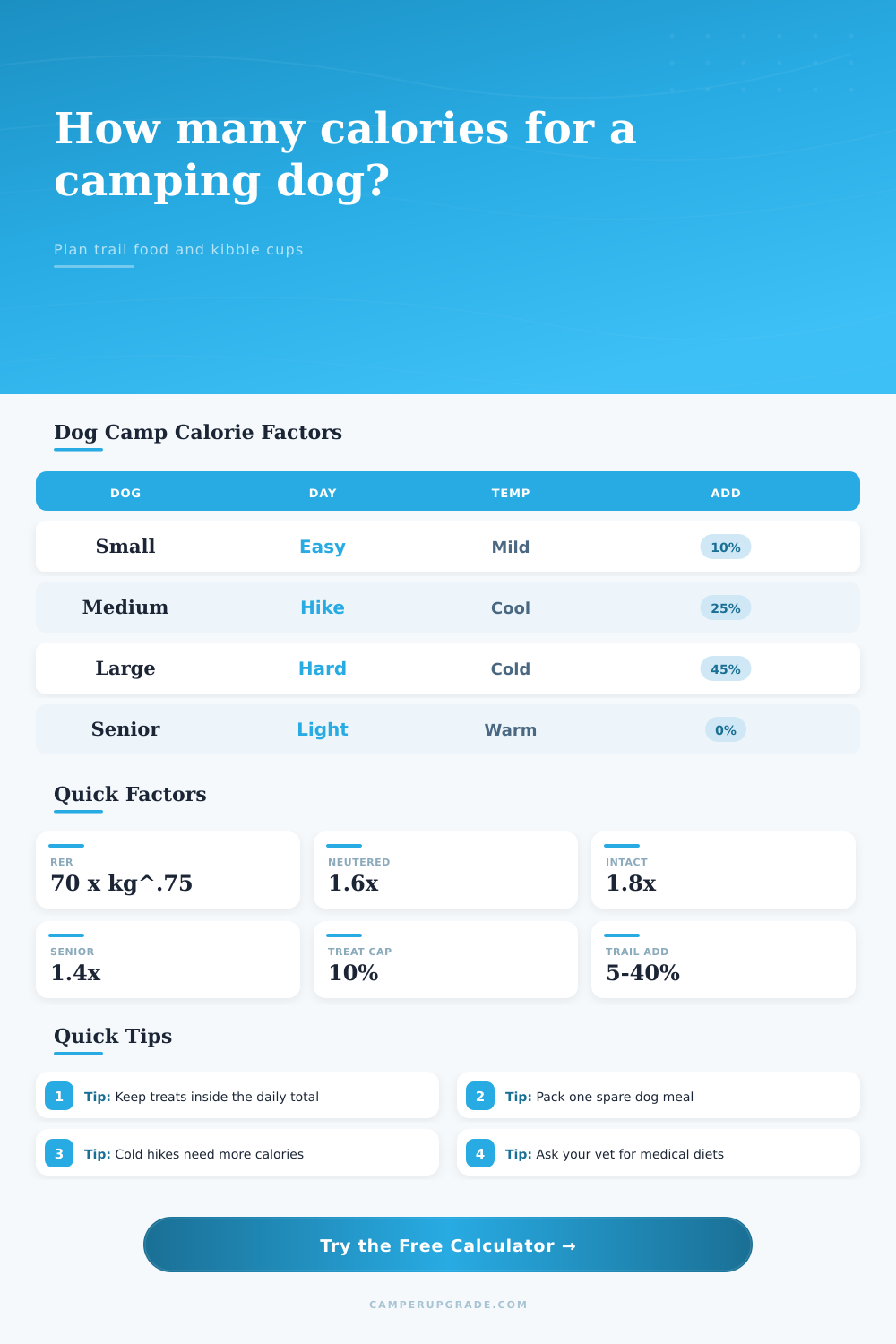
| Life stage or status | RER multiplier | Use when | Camping note |
|---|---|---|---|
| Weight-loss adult | 1.20x | Vet-directed calorie reduction | Do not add large trail extras without veterinary guidance. |
| Senior adult | 1.40x | Lower metabolism or easy days | Watch fatigue and split food into smaller meals. |
| Neutered adult | 1.60x | Typical maintenance baseline | Good default for many healthy adult camp dogs. |
| Intact adult | 1.80x | Higher maintenance demand | May still need trip adds for mileage and cold. |
| Growing puppy | 2.50x to 3.00x | Growth stage, not endurance training | Keep mileage conservative and ask your vet about food volume. |
| Camp activity | Activity add | Typical miles | Best fit |
|---|---|---|---|
| RV or rest day | 0% | 0 to 1 mi | Short leash walks, campsite lounging, and travel days. |
| Easy campground walks | 8% | 1 to 3 mi | Camp loops, lake access paths, or town strolls. |
| Moderate hiking | 16% | 3 to 7 mi | Most family hikes with stops and steady terrain. |
| Long hike or swimming | 26% | 7 to 12 mi | Big lake days, long trail outings, or repeated fetch. |
| Backpacking or mountain day | 38% | 10+ mi | Climbs, uneven footing, overnight dog pack, or big elevation. |
| Temperature band | Calculator adjustment | Why it matters | Planning cue |
|---|---|---|---|
| Below 20°F / -7°C | +18% | Cold air and snow travel raise energy use. | Pack extra food and insulated rest spots. |
| 20°F to 39°F | +10% | Cool weather often supports longer movement. | Add food if the dog stays active all day. |
| 40°F to 74°F | 0% | Mild conditions match normal estimates. | Use activity and mileage as the main drivers. |
| 75°F to 89°F | -3% | Heat may reduce safe activity and appetite. | Prioritize water, shade, and shorter outings. |
| 90°F and above | -8% | High heat usually means shorter, slower work. | Avoid pushing miles to justify more food. |
| Example dog | Food kcal/cup | Moderate camp day | Approx cups |
|---|---|---|---|
| 15 lb small adult | 380 | About 530 kcal | 1.4 cups before treats |
| 35 lb trail dog | 400 | About 930 kcal | 2.3 cups before treats |
| 60 lb retriever | 380 | About 1,370 kcal | 3.6 cups before treats |
| 85 lb large breed | 420 | About 1,730 kcal | 4.1 cups before treats |
| 45 lb senior adult | 360 | About 850 kcal | 2.4 cups before treats |
Easy RV Camp
Low addUse the maintenance estimate, keep treats modest, and pack a small sealed reserve for delayed travel.
Moderate Hikes
15% to 30%Most healthy adult dogs land here when daily mileage, rolling trails, and camp play are included.
Cold Trail
30% to 60%Cold weather, snow footing, and long active days can stack quickly, especially for lean dogs.
Hot Weather
Limit effortHeat does not make a bigger food target by itself; it usually means shorter activity and more water breaks.
RER = 70 x body weight in kilograms^0.75.home maintenance calories = RER x selected age and neuter factor x body condition factor.camp calories = home maintenance x (1 + activity add + mileage add + terrain add + temperature add).food cups = camp calories x (1 - treat percent) / kcal per cup; trip cups include days and the selected sealed food buffer.
There comes a time on every camping adventure where you remember that you brought sunscreen for yourself but not the dog’s lunch. That moment is after the sun sets, the fire is roaring and your hungry friend are staring at your food with pleading eyes. It wasn’t an intentional act of starvation; rather, you simply guessed at how much he require. But guesswork isn’t good business when you’re out in the middle of nowhere, miles away from a grocery store.
Your dog’s going through calories like mad while also burning them off. The calculator above does the math for you, simply enter his weight and expected temperature, and it spares you from guessing how many cups of kibble will fuel him for a whole day of hiking.
How to Calculate Your Dog’s Food Needs
It’s all about metabolism: The main point is that humans burn energy one way, dogs another. We’re measured in calories-per-mile. They are measured by their own bodyweight, which changes with age and size. It also change with how they regulate temperature, because dogs lose heat based off their surface area to volume ratio. That means a big dog isn’t simply larger; he requires more food. However, he doesn’t always require more just because he is big.
Therefore the tool begins with his weight (in kilograms or pounds) as a baseline to set an estimate of how much energy he need at rest. This is before adding the chaos of the trail, you have to know where he’s starting from so you can calculate then where he might end up after six hours of rock scrambling.
The other one most folks forget is weather. Yes, heat limits you. But cold is a calorie vacuum. Your dog are burning fuel simply to move and maintain his body temperature when he’s hiking through chilly mountain air, let alone snow. This gets picked up by the calculator because it adjust for temperature bands, adding more calories for predictions under zero.
In the spreadsheet, it’s a small addition. But it makes a massive difference in the pack. Ignore it and you may find yourself pulling into campsite with a tired dog who has nothing left for warmth or play. The reference tables on the page explain that clearly: A winter hike requires nearly twice the food than a mild summer evening.
The treats. Who doesn’t like giving their dog a treat along the way? A strip of jerky here and a bite of cheese there. It’s nothing big realy, but it adds up quickly. And the tool allow you to input your percentage of treats (typically 10% of overall calorie intake).
That way you know that if you’re handing him snacks, you aren’t accidentalily taking away from his main course. Subtract the treat caloric value from number of kibble cups. Otherwise, come the end of the trip, you’ll be digging in the bottom of the bag hoping there might still be a crumb or two hiding. You can use less kibble to make room for treats, as long as the total amount stays the same.
Body condition also matters. A husky who’s in good shape requires less support than a husky who could stand to lose some weight (that applies more so to dogs with harder trails). Because they’re different animals, those questions asks what he looks like now and if he’s neutered or intact; they change how his body processes energy. A puppy burns through reserves at an alarming rate; a senior dog might need less of an activity boost but more care for joint stress; you just adjust these dials to fit his reality. You dial them accordingly to match his reality.
It is not precise down to the single calorie, but it provides a buffer nonetheless. It’s not so much what you’re packing as it is the feeling of confidence that comes with having something to eat. I stopped stressing over the ounces. I stopped thinking about every bite. I knew I had enough for three days (plus a 10 percent safety net), so I didn’t worry anymore.
I just fed him, let him enjoy the woods, and knew he would of have enough fuel to make it back home. That peace of mind was worth every ounce of kibble. Get the spare bag too. It doesn’t hurt to have the added security when the trail gets tough.