Baby Formula Water for Camping Calculator
Estimate how much safe water to pack for formula mixing, bottle cleaning, optional sterilizing, safety reserve, bottle counts, container planning, and total carry weight.
Water breakdown
| Infant and trip pattern | Feeds per day | Prepared oz per feed | Mixing water per day |
|---|---|---|---|
| Newborn short day away from camp | 8 to 10 | 2 to 3 fl oz | 16 to 30 fl oz before cleaning |
| Young infant weekend campsite | 7 to 8 | 4 to 5 fl oz | 28 to 40 fl oz before cleaning |
| Older infant RV or cabin stay | 5 to 6 | 6 to 8 fl oz | 30 to 48 fl oz before cleaning |
| Twins or two bottle-fed infants | 10 to 16 | 4 to 7 fl oz | 40 to 112 fl oz before cleaning |
| Ready-to-feed backup plan | Any count | Container amount | 0 fl oz for mixing, but still plan cleaning water |
| Formula form | Water share setting | Ratio note | Calculator use |
|---|---|---|---|
| Powdered formula | 100% | Measure label water first, then add powder | Use prepared bottle ounces as water ounces for packing |
| Liquid concentrate | 50% | Often mixed with equal parts water and concentrate | Half the prepared bottle volume is added water |
| Ready-to-feed liquid | 0% | No water added to the formula container | Only cleaning, sterilizing, and reserve water are counted |
| Custom medical or specialty mix | Custom% | Use the exact written mixing instructions | Enter the water share needed for that plan |
| Emergency powdered formula | 100% | Use safe water and exact label amounts | Increase reserve if water access or cooling is uncertain |
| Cleaning or sterilizing method | Planning water | Best fit | Field setting |
|---|---|---|---|
| Pre-sterilized bottles from home | 0 to 4 fl oz per bottle | Short trips with enough bottles packed | Low cleaning, 0 sterilizing add-on |
| Wash and rinse at camp | 8 to 16 fl oz per bottle | Camp sink, dish basin, or RV galley | Moderate cleaning per used bottle |
| No reliable sink water | 16 to 24 fl oz per bottle | Boondocking and dispersed camping | Higher cleaning plus extra daily water |
| Daily sterilizing water batch | 32 to 96 fl oz per day | Young infants or high-caution plans | Enter as sterilizing add-on per day |
| Disposable liners or cups | 0 to 8 fl oz per feeding item | Emergency backup when washing is difficult | Lower cleaning, still pack hand-clean water |
| Container option | Volume | Water weight | Camping note |
|---|---|---|---|
| Single disposable bottle | 16.9 fl oz / 0.5 L | 1.1 lb / 0.5 kg | Easy to ration but creates more trash |
| One liter bottle | 33.8 fl oz / 1 L | 2.2 lb / 1.0 kg | Simple for day trips and diaper bag staging |
| Half-gallon jug | 64 fl oz / 1.9 L | 4.2 lb / 1.9 kg | Fits small coolers and camp bins |
| One gallon jug | 128 fl oz / 3.8 L | 8.3 lb / 3.8 kg | Good baseline unit for car camping |
| 2.5 gallon cube | 320 fl oz / 9.5 L | 20.9 lb / 9.5 kg | Efficient for RV counters or basecamp tables |
Powder
Most compactCounts nearly all prepared formula volume as mixing water and adds scoop estimates for packing formula powder.
Concentrate
Half waterUses less added water than powder, but the concentrate containers still need protected storage and cleanup planning.
Ready Feed
No mixRemoves mixing water from the calculator, while cleaning, sterilizing, and reserve water can still matter at camp.
No Sink
Water heavyCleaning water rises quickly when every bottle, nipple, cap, and prep surface must be washed from packed water.
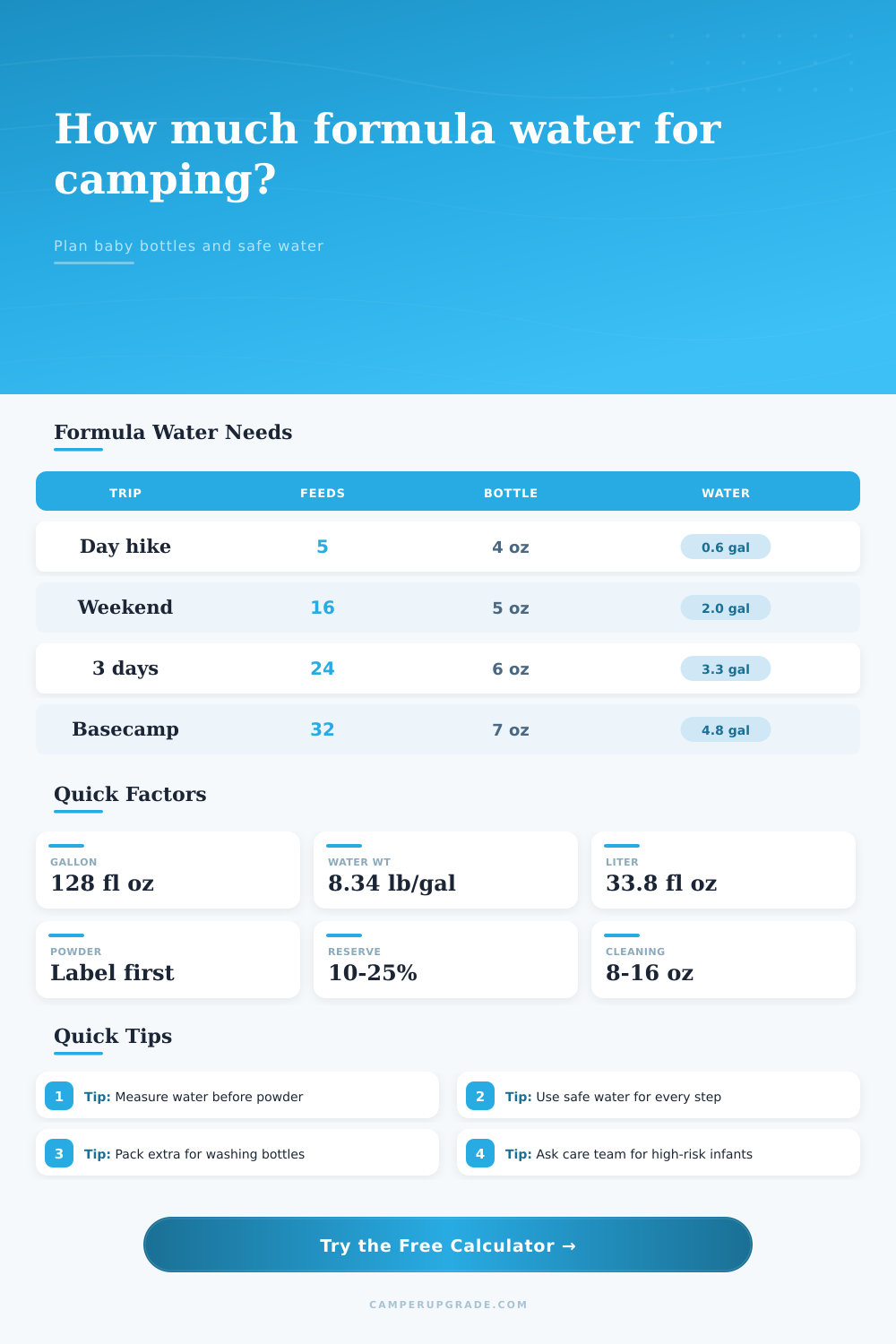
prepared formula = feeds per day x prepared ounces per feed x trip days.mixing water = prepared formula x water share. Powder is commonly planned from label water ounces; liquid concentrate is commonly 50% water.cleaning water = feeds x trip days x bottle fills per feed x cleaning water per bottle.total water = mixing water + cleaning water + sterilizing water + extra daily safe water + safety reserve.water weight = total gallons x 8.34 lb. Always follow the formula container label or your clinician instructions for the actual mix.
At the same time, preparing mix at camp is not the same as home. No tap, no sink (well, it’s a bucket), and now you’re responsible for feeding your child who can’t negotiate. So most parents begins with a guess. They pack a gallon of water and a few bottles, then cross their fingers. On hour three, they runs out of safe water.
But here’s the issue: there are some hidden costs when packing a formula. You don’t count the water used to clean yourself (your hands), or the nipple, or the cap. And yet that water is part of cost of making formula. If you only pack for drinking volume, you’re already behind because you aren’t accounting for the water needed to clean everything.
Why You Need More Water for Camping
The calculator above takes all of those unseen uses of water and accounts for them for you. It does math so you can understand how and why they matter, which makes you a smarter packer.
First thing, know your mix ratios. For powdered formula, generally speaking, you measure out the water first, followed by scoop(s) of formula powder. How much water? How many scoops? The bottle will tell you precisely.
With liquid concentrate, it’s typically one-to-one: equal parts concentrate and water. And what about ready-to-feed? No water is needed for the mix. That makes a huge difference in terms off the overall load.
Ready-to-feed saves in mixing water, but you lose on cost and portability. Powder requires more water, but it is lightweight. Concentrate falls somewhere in between. Consider your storage space and time away when deciding which type to bring.
That’s where the numbers goes up, cleaning. Because when it comes down to it, a used bottle isn’t just a container, it’s a hygiene project. Rinse it off in your home kitchen, pop it in dishwasher and out it goes. Out in the wild, you’ll want to be able to clean it by hand with some safe drinking water. You need enough to rinse it and ensure it is truly free from residue. The amount of water required here can increase significently.
Say you’re at a dry camp and have no sink. Suddenly, each bottle require sixteen to twenty-four ounces of water just to clean. That adds extra weight to the package. And that’s why the tool includes this in its calculation and allows you to enter how much water each bottle use during cleanup.
There is more. There’s sterilizing. If you have an infant, especially a new one, or someone with a compromised immune system, then there’s no question, everything has to be sterilized. That means using either steam or boiling, which uses water that evaporates or becomes part of the equipment and cannot be used again. The calculator also allows for a daily buffer for this.
This is a little number that avoids a large error. It is a small input to avoid a potentially large mistake. Ignoring it might save a pound today but risk health issues later. But it could of cost you your health later on.
The silent killer of camping comfort is weight. A gallon of water weighs eight and a third pounds. Ouch! Pack four gallons for that weekend trip? Now you’re lugging more than thirty pounds just in water. This means balancing against your own ability.
With the tool, convert total volume to weight and number of containers. Can you fit it all in 4 half-gallon jug? Or should you take 2 one-gallon jugs? How will it affect how well you pack and how you ration as you go?
The last safety net is reserve capacity. Life happens. Stuff spills. It gets hot. Babies eat more (or less) than expected. Those changes is covered by a 10-20 percent safety reserve. Cheaper insurance. And no one wants to be the parent staring down into their cooler and wishing they’d brought another quart along for the ride.
That’s what the reserve field does: it gives you the margin without going more far and packing too much.
The planning isn’t just about surviving. It’s about sanity. Once you have a good idea of how many liters of water to carry, you can relax and enjoy the trip. You can pack with confidence. You know where your limits are. You don’t worry if you’ll run out. The math becomes easy because everything is laid out before you. You don’t panic when something goes wrong because you packed enough water to get through it.
And then remember this: Water isn’t just for drinking! It’s for washing, sterilizing, and being ready for the unexpected. Pack for the mess, not just the meal. That’s how you stay comfortable in the wild.