Diaper Count for Camping Trip Calculator
Estimate daytime diapers, overnight diapers, swim diapers, travel-day extras, emergency buffer, pack count, sealed trash volume, and used diaper weight for camping with a baby.
Planning breakdown
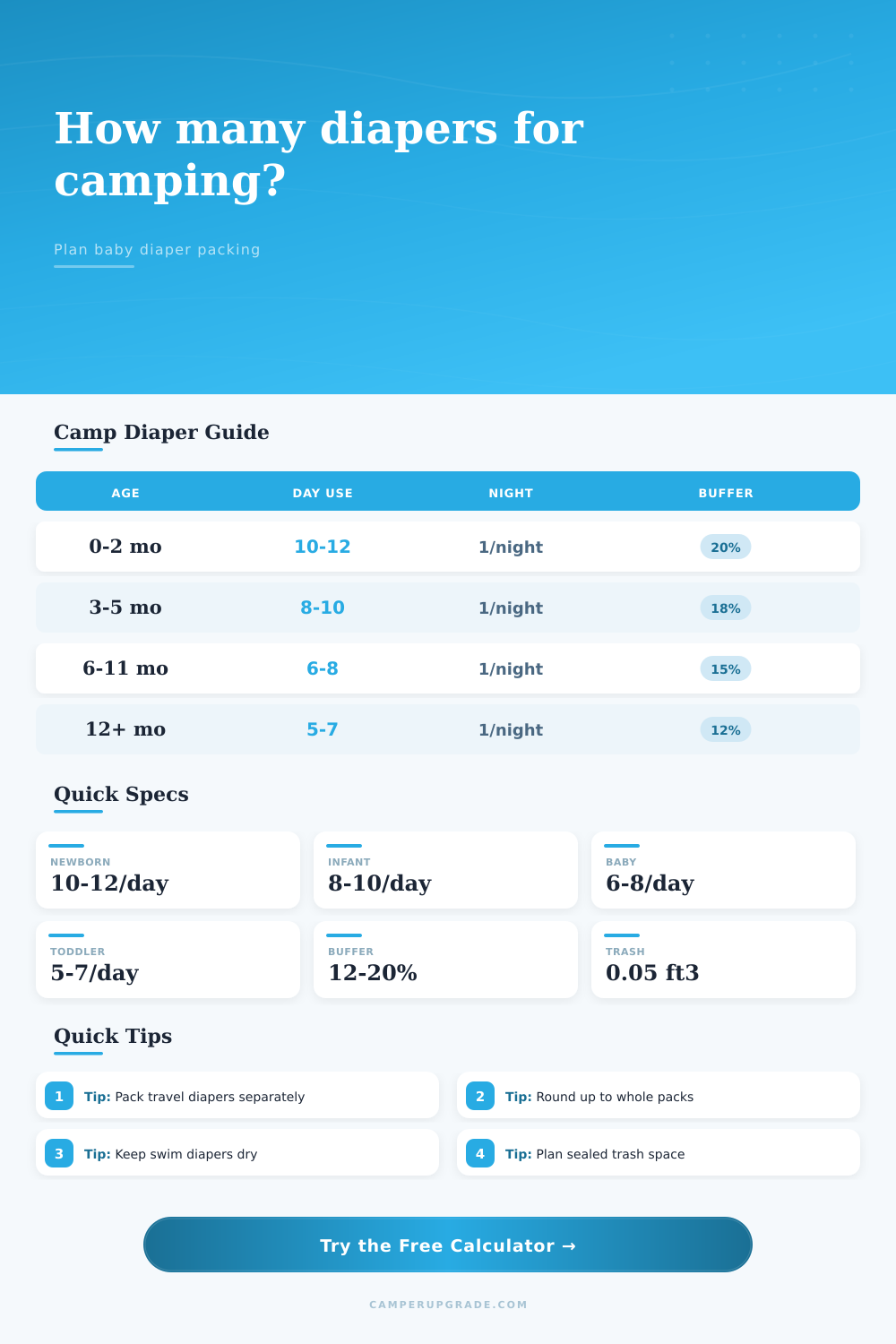
| Baby age | Typical daytime diapers | Overnight planning | Camp buffer idea |
|---|---|---|---|
| Newborn 0 to 2 months | 10 to 12 per day | 1 to 2 overnight or night-change diapers | 18% to 25% because changes are frequent and unpredictable. |
| Infant 3 to 5 months | 8 to 10 per day | 1 dedicated overnight plus one possible extra | 15% to 20% for car delays and disrupted routines. |
| Baby 6 to 11 months | 6 to 8 per day | 1 overnight diaper per night | 12% to 18% for wet clothes, new foods, and long outings. |
| Toddler 12 to 24 months | 5 to 7 per day | 1 overnight diaper if still needed | 10% to 15% unless swimming or travel is heavy. |
| Training toddler 24+ months | 3 to 5 per day | 0 to 1 overnight or nap diaper | 15% to 25% if toilets are far from camp. |
| Trip pattern | Travel-day adder | Swim diaper note | Trash planning note |
|---|---|---|---|
| Short campground weekend | 1 to 2 per travel day | Pack 1 to 2 per water day | A small sealed liner is usually enough for one baby. |
| Lake or pool campground | 2 per travel day | Pack 2 to 4 per water day | Keep swim diapers separate from absorbent diapers. |
| Long drive to camp | 2 to 4 per travel day | Only if water stop is planned | Store a travel pouch outside the main diaper sleeve. |
| Backcountry or pack-out site | 2 per travel day | Usually avoid extras unless required | Trash volume and weight matter more than pack count. |
| Cabin or store nearby | 0 to 1 per travel day | Pack per actual swim plan | Lower buffer works if resupply is easy and reliable. |
| Pack size | Best use | Rounding behavior | Packing comment |
|---|---|---|---|
| 18 to 24 diapers | Short trips or training toddlers | Rounding surplus stays small | Easy to split between car bag and tent bin. |
| 28 to 36 diapers | Most weekend baby trips | Often one full sleeve plus a travel pouch | Good default when storage space is moderate. |
| 40 to 60 diapers | Long weekends or younger infants | May leave a large surplus | Useful when the pack can stay dry in a vehicle. |
| 70+ diapers | Weeklong camp or newborn | Whole-pack rounding may be simplest | Separate one day of diapers before arrival setup. |
| Trash estimate | Conservative value | Lighter value | Use when |
|---|---|---|---|
| Used diaper weight | 5 to 7 oz each | 3 to 5 oz each | Choose higher values for overnight diapers and younger babies. |
| Used diaper volume | 70 to 100 cu in each | 45 to 70 cu in each | Use conservative volume for sealed, odor-controlled bags. |
| Clean diaper volume | 25 to 35 cu in each | 15 to 25 cu in each | Thin compressed diapers pack smaller than bulky overnight types. |
| Small bag capacity | 3 to 5 gallons | 1 to 2 gallons | Small bags are easier to seal and stage by day. |
Campground Weekend
ModerateUse the home daily rate, add two travel days, and round to the nearest pack or sleeve.
Lake Camp
Swim heavySwim diapers are counted separately because they do not replace regular absorbent diapers.
Long Drive
Travel extraKeep travel-day adders in a separate pouch so the main camp supply stays sealed and dry.
Pack-Out Site
Trash focusTrash bag capacity, used diaper volume, and used diaper weight drive the final packing plan.
full camp diaper days = camp nights + 1.base daytime diapers = diapers per day x full camp diaper days.trip subtotal = base daytime diapers + overnight diapers + extra night changes + swim diapers + travel-day adders.final diapers = ceiling(trip subtotal x (1 + emergency buffer percent)).packs needed = ceiling(final diapers / diapers per pack).trash volume = changed diapers x used diaper volume x (1 - compression allowance).
When you’re half-way to that secluded campsite, the last thing you need is to realize you forgot to pack the diapers. It’s easy to make this mistake; it’s difficult to be tired and figure out all of the logistics of what you has to pack for a baby!
Once you input how long you’ll be gone and what your evening routine look like, the diaper calculator does the rest for you. No more math conversions or coefficients to worry about, it reduces the stress down to a nice, straightforward pack list.
How to Use the Diaper Calculator
First: What does your kid realy use? Use that as your base for daily home use. Diapers for newborns tend to be 10-12 a day. For toddlers it slows way down. You can change this baseline in the tool if eating solid foods changes how often they poop. Make sure you’re being truthful with this one. This is foundation of all of the rest and if you underestimate here, then everything else falls apart. The reference table on page breaks it down by age group. If you don’t know, it will give you a conservative start.
Then there’s the nights. Routine gets complicated when you’re camping out. If it’s cold at night, maybe you’ll bring that one additional change. Maybe you’ll be concerned about leaks through a sleeping bag. The calculator allow you to split up daytime changes versus overnight changes. Why? Because overnight diapers will frequently be heavier and thicker then daytime changes. This adds more weight to your pack-out trash. This uses more space in your bag.
How to Plan for Travel Days
If it is a long ride by bus or drive, there will be more changes. Remember, this isn’t a regular day’s production. This is a baby in a car seat. In many cases, they have wore that diaper for hours before unpacking. With the tool, you can also add special buffer for those days. It keeps you from panicking because you’re about to run out while on the way to the site.
Add another variable called swimming. Swim diapers are for solids only. They don’t absorbs waste. When the baby is out of the water, they require a regular diaper. The calculator accounts for this so that you don’t accidentally use one type instead of the other. Both are needed. Store each in its own bin to avoid cross-contammination. This keeps your dry gear dry.
Campers mostly trip over trash. Pack it in, pack it out. A used diaper weights roughly five or six ounces. If you have three nights of camping, that totals a few pounds over three nights of waste in a sealed bag. How many diapers? That’s what the tool helps you determine so you can estimate the weight and volume of your trash load. This helps you determine how many sealed bags you should of bring. Also, knowing this allows you to plan for compression. When sealed tight to keep odors down, trash bags don’t compress very well. Know your volume before packing.
Your emergency buffer is your insurance policy. It’s your “what if?” What if there’s an extra change on the day of the big storm? What if you run out of wipes and realize you only packed one too few? What if there’s a blowout? The unexpected? Fifteen percent is a reasonable place in the middle for most people. It doesn’t transform your car trunk into a diaper warehouse, yet it’s also enough to cover any mishaps.
Separate out what you need for the first day: This is packing smart 101. Have a little trash bag (for trash), wipes, and travel diapers on hand in the car where they can be reached quickly. Don’t hide it all underneath your tent! This will save your sanity when you’re trying to set up camp at night. The little organization goes a long way.
It is only as good as how you execute the math. Camping with a baby isn’t really about asking what you need. As it is how do I get into the groove? What’s most important is to try to bring some amount of comfort to an environment that doesn’t provide any. The number cruncher provide the answers. Knowing you’ve got the bases covered puts your mind at ease. By the time you pull up to campsite, you’re good to go. Got the trash bags. Got the diapers. Got the place. Now you can sit around the fire and, well, you know.