DEF Consumption While Towing Calculator
Estimate diesel gallons used, DEF demand, towing load factor, trip miles, DEF tank range, refill bottle count, reserve threshold, and storage loss for diesel tow trips.
Calculation breakdown
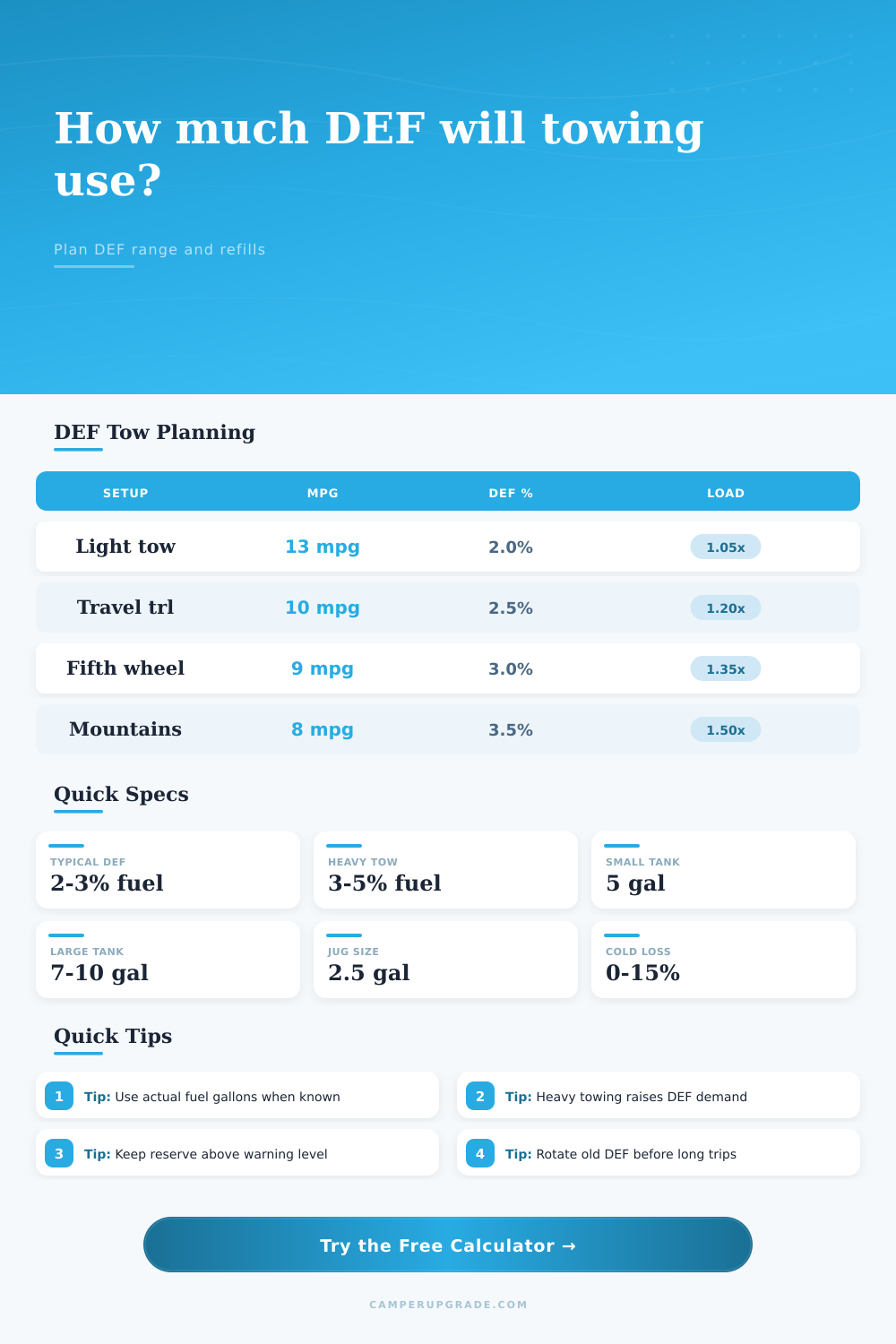
| Diesel tow setup | Typical towing MPG | Planning DEF rate | Load factor cue |
|---|---|---|---|
| 3/4-ton diesel with travel trailer | 9 to 13 mpg | 2.3% to 3.2% of diesel | Use normal load unless wind or grade is high. |
| One-ton truck with fifth wheel | 8 to 12 mpg | 2.8% to 3.8% of diesel | Large frontal area and high weight raise DEF use. |
| Dually diesel with toy hauler | 7 to 10 mpg | 3.2% to 4.5% of diesel | Use heavy or severe load for mountain routes. |
| Diesel Class C or Super C | 8 to 12 mpg | 2.5% to 4.0% of diesel | Plan from loaded trip weight and road speed. |
| Diesel van or box camper | 12 to 18 mpg | 2.0% to 3.0% of diesel | Roof gear and headwind still matter. |
| Base DEF percent | DEF per 100 gal diesel | DEF per 50 gal diesel | Best planning use |
|---|---|---|---|
| 1.5% | 1.5 gal | 0.75 gal | Light highway load or older observed average. |
| 2.0% | 2.0 gal | 1.0 gal | Light trailer with steady cruise. |
| 2.5% | 2.5 gal | 1.25 gal | Common starting point for towing estimates. |
| 3.0% | 3.0 gal | 1.5 gal | Heavy camper, hills, or faster speeds. |
| 4.0% | 4.0 gal | 2.0 gal | Severe load, high exhaust heat, long grades. |
| DEF tank size | 20% reserve | Usable DEF | Range at 10 mpg and 3% |
|---|---|---|---|
| 5.0 gal | 1.0 gal | 4.0 gal | About 1,333 towing miles. |
| 6.0 gal | 1.2 gal | 4.8 gal | About 1,600 towing miles. |
| 7.5 gal | 1.5 gal | 6.0 gal | About 2,000 towing miles. |
| 10.0 gal | 2.0 gal | 8.0 gal | About 2,667 towing miles. |
| 13.0 gal | 2.6 gal | 10.4 gal | About 3,467 towing miles. |
| Refill bottle size | Good for | At 3% DEF rate | Planning note |
|---|---|---|---|
| 1 gallon bottle | Small top-off | 33 gal diesel | Easy to store but inefficient for long towing legs. |
| 2 gallon jug | Moderate top-off | 67 gal diesel | Useful when tank space is limited. |
| 2.5 gallon box | Common refill | 83 gal diesel | Often matches a visible gauge drop on pickups. |
| 5 gallon pail | Long tow trip | 167 gal diesel | Plan storage temperature and age carefully. |
| Bulk pump fill | Full tank reset | Varies by fill | Stop filling before overfilling the DEF neck. |
Light Tow
2% to 2.5%Small trailers, moderate speeds, flat roads, and easy exhaust temperatures usually stay near the lower planning band.
Normal Camper
2.5% to 3.5%Travel trailers and fifth wheels often fit here when the truck is loaded but not at its hardest duty cycle.
Heavy Grade
3.5%+Long climbs, high gross weight, headwind, and hot exhaust treatment cycles can push DEF demand upward.
Stored DEF
Add lossUse the storage loss field when DEF is old, heat exposed, freeze-thawed, contaminated, or partly crystallized.
diesel gallons = entered diesel gallons, or miles / towing MPG when gallons are left at 0.effective DEF percent = base DEF percent x towing load factor.raw DEF needed = diesel gallons x effective DEF percent / 100.adjusted DEF needed = raw DEF needed / (1 - cold storage loss percent).usable current DEF = current DEF - reserve threshold; refill bottles = shortage / bottle size rounded up.
Long hauls with a heavy trailer will strain your transmission and engine. Fuel gauges goes down fast. The high cost of diesel causes most folks to focus on that item.
Many overlook the Diesel Exhaust Fluid (DEF) tank located beneath bed. That’s a no-no. Moddern diesels need DEF. Don’t let it get low; the truck won’t limp home. The truck stops dead in its tracks. DEF planning is just as important than diesel planning.
Why You Need to Plan Your DEF
It’s easy chemistry. Bad stuff comes out of an engine: nitrogen oxides (pollution). Urea solution come in through the DEF injector. The exhaust goes over a catalytic converter that separates bad stuff into water vapor and nitrogen.
When you put a heavy load on the engine (towing), the exhaust heat rise, increasing pollution. The computer senses it and adds more DEF. It’s not something you can change with how nature works. It’s just something you can plan for.
Now that you know how far you’ll be traveling and your fuel mileage, the calculator does math for you. You no longer have to guess about usage. Most folks think that using DEF is always going to be x percent of what you burn for fuel. On an empty tank while driving down highway, that’s true. But if you’re towing a heavy trailer up a mountain, it’s not.
The DEF calculator has a towing load factor. This is a multiplier to increase the base rate to match increased stress on engine. This little bit make a big difference in real life. Without accounting for the load factor, you could end up running out of DEF and getting stuck by side of the road… needing a tow truck.
Your range depends on storage conditions DEF will freeze at approximately 12 degrees Fahrenheit. Frozen DEF doesn’t go bad. Repeated freezing and thawing can form crystals. Those crystals jams up the intake filter. The fuel pump won’t pull in fluid correctly.
There’s a field on the calculator for cold storage loss. Apply it if you think the fluid might be questionable. Be conservative. Plan for five percent less capacity due to bad fluid. Avoid that risk.
Before a lengthy trip, rotate some old stuff. A good habit is keeping fresh DEF handy for refilling. It’s not easy to buy DEF at gas stations, at least not at most truck stops. They may have it but only in small bottles or jugs.
But with this app, it will tell you how many containers you require. It shows how much is missing from what you currenty have compared to what you want to fill up to. Then, divide that by how big each container is so you don’t run out of containers in the middle of nowhere. No more abstract worries. Just a concrete list for packing.
Part of this is learning what your truck can handle. Dually toy haulers will burn through more DEF than smaller trailer. Check out the range of normal MPG/DEF % on those reference charts above. Depending on how heavy you go, you could be burning two to four percent of that fuel for DEF.
Knowing how your rig falls on that spectrum help set some realistic expectations. And it’ll help determine if you want to top off before departure or hang on until the next pitstop.
Finally, there’s the reserve threshold. Never go empty. Sensors can fail and fluid can slosh. To account for this, the calculator allows you to specify how much buffer you want to keep in reserve (typically 20% or so of your tank volume).
Everything above this line is available. Any lower is off-limits. Think of it like a virtual floor: don’t cross it even if the calculator says you can. It forces you to top up before you run dry. It stops you from panicking and it saves you from being stranded on the side of the road.
“It’s all about managing towing. You must manage your fuel, your speed, and your weight. Another thing you should of manage is DEF. Brake temperature. You should treat tire pressure and DEF like those things. Ignore it at your own peril. Pay attention to it and have peace of mind knowing what the numbers are telling you. Stay one step ahead with them. Let them help you make a plan for stops. Bring enough along. Top off your reserve tank. And then you can concentrate on driving. Control comes from preparation.”