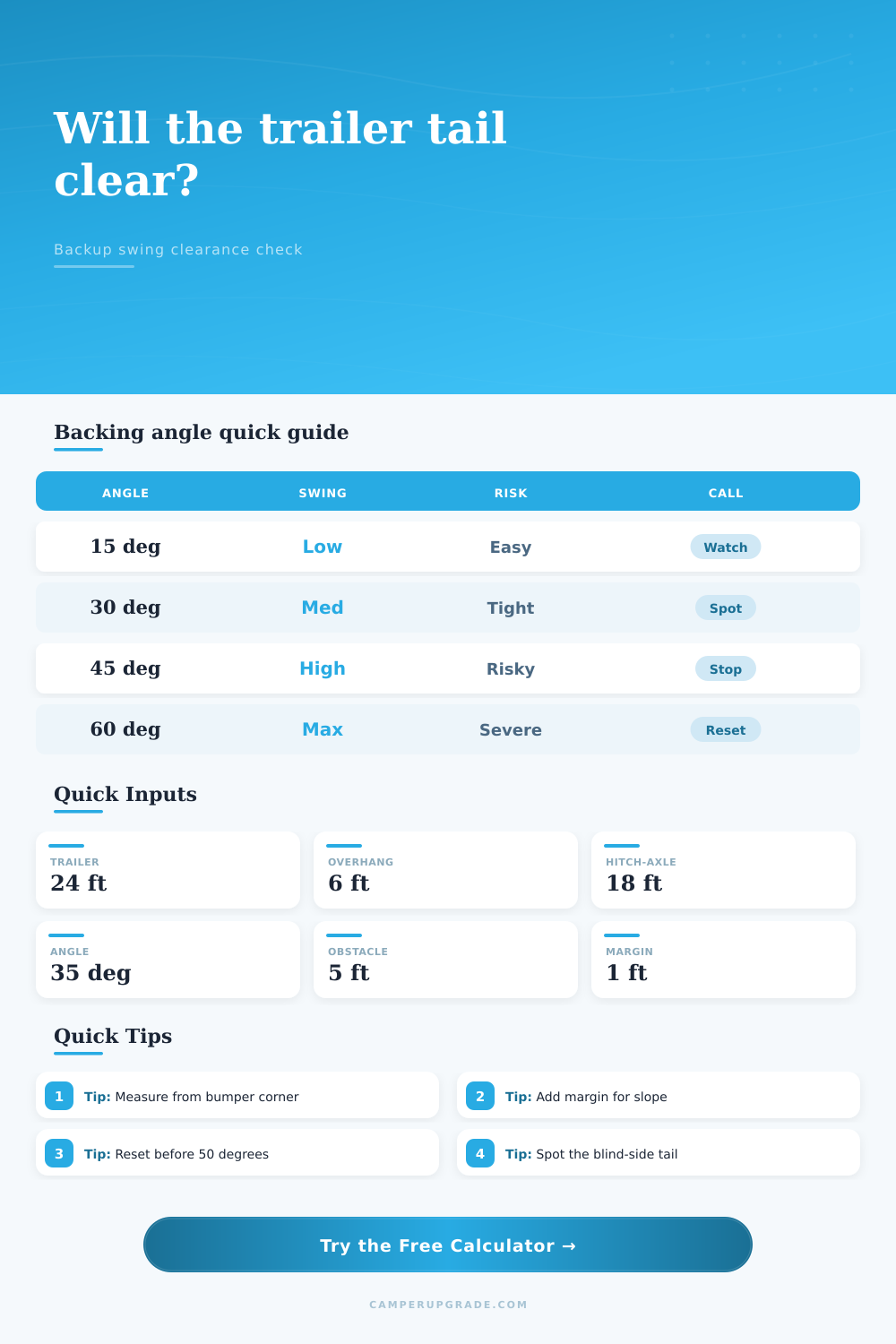
Trailer Backup Swing Clearance Calculator
Estimate rear bumper tail swing, clearance to an obstacle, jackknife limit angle, and the spotter margin needed before a tight backing turn.
Switches length inputs between feet and meters.
Used only for the guidance text and comparison notes.
Overall trailer length from coupler or pin to rear bumper.
Measure from axle centerline or tandem midpoint to rear bumper corner.
Measure from coupler or pin to axle centerline or tandem midpoint.
Angle between tow vehicle path and trailer centerline while backing.
Side clearance from the rear bumper corner to wall, post, tree, or vehicle.
Extra no-touch buffer for mirrors, slope, tire scrub, and delayed stopping.
| Overhang | 15° | 30° | 45° | 60° |
|---|---|---|---|---|
| 3 ft | 0.8 ft | 1.5 ft | 2.1 ft | 2.6 ft |
| 5 ft | 1.3 ft | 2.5 ft | 3.5 ft | 4.3 ft |
| 7 ft | 1.8 ft | 3.5 ft | 4.9 ft | 6.1 ft |
| 9 ft | 2.3 ft | 4.5 ft | 6.4 ft | 7.8 ft |
| Angle | Control feel | Swing risk | Spotter instruction |
|---|---|---|---|
| 0°-15° | Minor bend | Low | Watch both rear corners |
| 16°-30° | Normal correction | Moderate | Call out tail movement |
| 31°-45° | Tight backing | High | Spotter at swing side |
| 46°-60° | Near reset | Severe | Stop before blind-side loss |
| 60°+ | Jackknife zone | Critical | Pull forward and reset |
| Trailer | Length | Hitch-to-axle | Rear overhang |
|---|---|---|---|
| Teardrop camp trailer | 12 ft | 8 ft | 3 ft |
| Pop-up camper | 16 ft | 11 ft | 4 ft |
| Single axle travel trailer | 20 ft | 15 ft | 5 ft |
| Bunkhouse travel trailer | 30 ft | 22 ft | 7 ft |
| Toy hauler | 34 ft | 24 ft | 8 ft |
| Fifth wheel | 36 ft | 24 ft | 9 ft |
| Condition | Minimum margin | Better margin | Reason |
|---|---|---|---|
| Flat open pad | 0.5 ft | 1.0 ft | Mirror delay and tire scrub |
| Fence or post | 1.0 ft | 1.5 ft | Hard object, no forgiveness |
| Blind-side backing | 1.5 ft | 2.0 ft | Driver cannot see tail path |
| Slope or loose gravel | 1.5 ft | 2.5 ft | Trailer may drift or roll |
Backing in a narrow campsite in a long travel trailer can be daunting at first; It feels like world becomes condensed down to size of your side mirrors. You no longer see the other RVs or even those trees, only the arc your rear bumper is about to take. And then it takes a wider swing different than anticipated. Why? We humans are challenged by combining geometry with counter-steering.
But we can plan this one ahead of time… Before ever touching the brake pedal. So what’s the issue? Leverage. The back end of your vehicle act like a pivot point. Whatever is behind that is going to swing out farther then whatever is in front of it. A short teardrop barely shifts his tail, whereas a long overhanging thirty-foot bunk house will swing a couple of feet to each side at a slight angle.
How to Back Your Trailer Safely
The math gets done for you on the calculator above. Once you enter in your exact dimensions, you’ll save yourself the guesswork and know if there really is a gap by a fence post or not. To do this, you should of know your overhang (sometimes referred to as axle-to-bumper distance). Overhang is by far most critical dimension for knowing your tail swing.
If you have a five-foot overhang at a thirty degree turn, then you’re looking at about two and a half feet of swing off to the side. Two and a half feet may seem insignificant until it’s the difference between a clean park and a repair bill because you’re parked next to a concrete utility box. The tow vehicle is the one everybody concentrates on. The driver will miss a step, the front bumper will hit a tree. Nobody thinks about the tail end of the trailer. That’s the part of the trailer moving the most. That’s the part hitting what you can’t see.
Backing up, when you turn the steering wheel to the left, the rear of the trailer swing to the right. At first it seems backwards but after practice it’s second nature. If you haven’t practiced, learning on a nice clean driveway will be an expensive lesson. Measuring before hand makes sense. Not having to get out and grab a tape measure in the dark doesn’t make much sense. It helps to just know how big your rig is and the space you have to work with.
How far do you think you can turn without screwing up? There’s a limit. It is a hard limit. We refer to this as the jackknife limit. That’s when the back end of your tow vehicle push the trailer so hard that you lose control. Your limit varies for every rig depending on how far away your axles are from the hitch. The closer they are together, the tighter your limit. Get your angle too steep and the trailer fold into your car. There’s no recovering steering out of it. You have to pull forward and start over.
The tool lets you see just how close you’re getting to that danger zone. Does your intended turn look safe, or do you need to straighten out and try again at another angle? Consider the context. Is it a paved pad? That’s forgiving. Is it loose gravel or does it slope down from your house? Then the tires will slip and the trailer will wander. Uneven ground require more room to compensate.
A couple of feet of clearance isn’t much money. It gives time for your eyes to see something and your brain to react with a brake. It also allows for tire scrub and the reality that you’re likely pooped after a long day on the road. As that angle increases, so does your risk: Fifteen degrees is under control; Forty-five degrees is a fight against the geometry of it all; Sixty degrees? Yeah, you’re probably in trouble now. And the idea is to get into and stay in the green zone here. Park it before you find yourself in the red.
It’s a matter of mathematics, but there’s a technique involved, too. There are ways to back in well. Or badly. You’ll learn the right way by feeling your way around: measure the overhang, check the angle, add some wiggle-room just in case, then ease in slow. Let the numbers do the talking. When you’re done, the tail should be where you wanted it. That’s what happens when you leave the guessing behind and adopt a game plan… The panic goes away. The bumper never touches a tree. Everything’s nice and centered, just like you want it … no sweat.