Towing Fuel Economy Penalty Calculator
Estimate MPG loss, extra gallons, and trip impact from trailer drag, weight, speed, wind, terrain, route miles, and fuel price.
Calculation breakdown
60 mph tow
Run the calculator to compare a slower highway cruise against the current setup.
Current speed
Your entered speed becomes the middle comparison point.
70 mph tow
Higher speed usually increases the aerodynamic share of the fuel penalty.
| Trailer style | Frontal area | Loaded weight | Typical MPG penalty |
|---|---|---|---|
| Low teardrop camper | 22 to 30 sq ft | 900 to 2,000 lb | 15% to 25% |
| Popup camper | 30 to 42 sq ft | 1,500 to 3,500 lb | 20% to 30% |
| Small travel trailer | 42 to 55 sq ft | 3,000 to 5,500 lb | 30% to 45% |
| Tall travel trailer | 55 to 70 sq ft | 5,000 to 8,000 lb | 38% to 55% |
| Fifth wheel or toy hauler | 65 to 85 sq ft | 8,000 to 14,000 lb | 45% to 65% |
| Cruise speed | Aero multiplier | Best use | Planning note |
|---|---|---|---|
| 55 mph | 0.72x | Back roads | Lower drag, longer travel time |
| 60 mph | 0.85x | Fuel-saving tow | Often the sweet spot for tall trailers |
| 65 mph | 1.00x | Baseline highway | Good default for route planning |
| 70 mph | 1.16x | Fast interstate | Drag rises quickly with speed |
| 75 mph | 1.33x | Legal only where allowed | Check trailer tire speed rating |
| Condition | Derate | What it means | When to use |
|---|---|---|---|
| Tailwind or mostly flat | -5% | Slightly easier than normal | Prairie tailwind or flat valley |
| Calm and rolling | 0% | Baseline planning weather | Mixed highway with mild grades |
| Light headwind or hills | +6% | Noticeable extra throttle | Rolling terrain or breezy day |
| Headwind or mountain route | +12% | Harder pull for long stretches | Common conservative tow estimate |
| Severe wind or high passes | +30% | Major MPG loss possible | Use for difficult route planning |
| Towing MPG | Fuel for 250 miles | Fuel for 500 miles | Range from 26 gal |
|---|---|---|---|
| 8 mpg | 31.3 gal | 62.5 gal | 208 miles |
| 10 mpg | 25.0 gal | 50.0 gal | 260 miles |
| 12 mpg | 20.8 gal | 41.7 gal | 312 miles |
| 14 mpg | 17.9 gal | 35.7 gal | 364 miles |
| 16 mpg | 15.6 gal | 31.3 gal | 416 miles |
Aerodynamic considerations aren’t limited to cars, they apply to towing as well. Pulling a trailer impact your gas mileage. When you go fill up, you think it’s going to be cheap, but it’s always more expensive. Why? It’s all about physics. Master those concepts and learn how speed and wind impact your rig so that you can better manage what it costs to tow.
Wind drag, or air resistance, is the problem, and it doesn’t matter how heavy the trailer are. The bigger its surface area, the harder it resist. A taller trailer act like a wall for the air rushing toward you. Faster = higher aerodynamic cost. The drag rise at an accelerating rate (the square of speed). It costs much more fuel to go fast then slow.
Why Towing Uses More Gas
Lots of people think “I’m already going 70 mph. If I just drop to 60, there won’t be much difference.” But that little decrease in speed lower the wind resistance noticeabley.
Fortunately, someone built a calculator that do the math for us. Simply input your desired speed and the dimensions of trailer. Input length of route you typically take and your solo mileage and weight of the load. The calculator takes all those physics terms we learned in high school and translates them into concrete gallon costs. Then it calculate your additional gas required based off your trailer’s dimensions and weight, solo mileage, route length, and planned speed. That way, you can budget for the true expense of traveling with a trailer. No more hoping you won’t be surprised by sticker shock.
Fuel economy will be affected by terrain as well. Hills requires additional power from your engine due to gravity. Grades will see an increase in the effect of the trailer’s weight. For windy roads and headwinds, you can calibrate the tool. Headwinds causes the engine to have to work harder. This is important if heading into the Rockies or across high plains. Running out of gas somewhere in the middle of nowhere is no fun.
Other drivers attempt to make up some of the deficit with extra cargo, or by simply driving fast. Most often both plans backfire. Cargo in the truck bed doesn’t become more aerodynamic. Driving faster raise drag exponentially; it’s just not linear.
For most towing rigs, the ideal speed is between fifty-five and sixty-five miles per hour. Anything slower will slow down traffic, be uncomfortabley, or perhaps even unsafe. Anything faster waste money. But then again, this is in real life. The highway is not always calm. Sometimes it’s a windy mountain pass. What effect does that have on mileage?
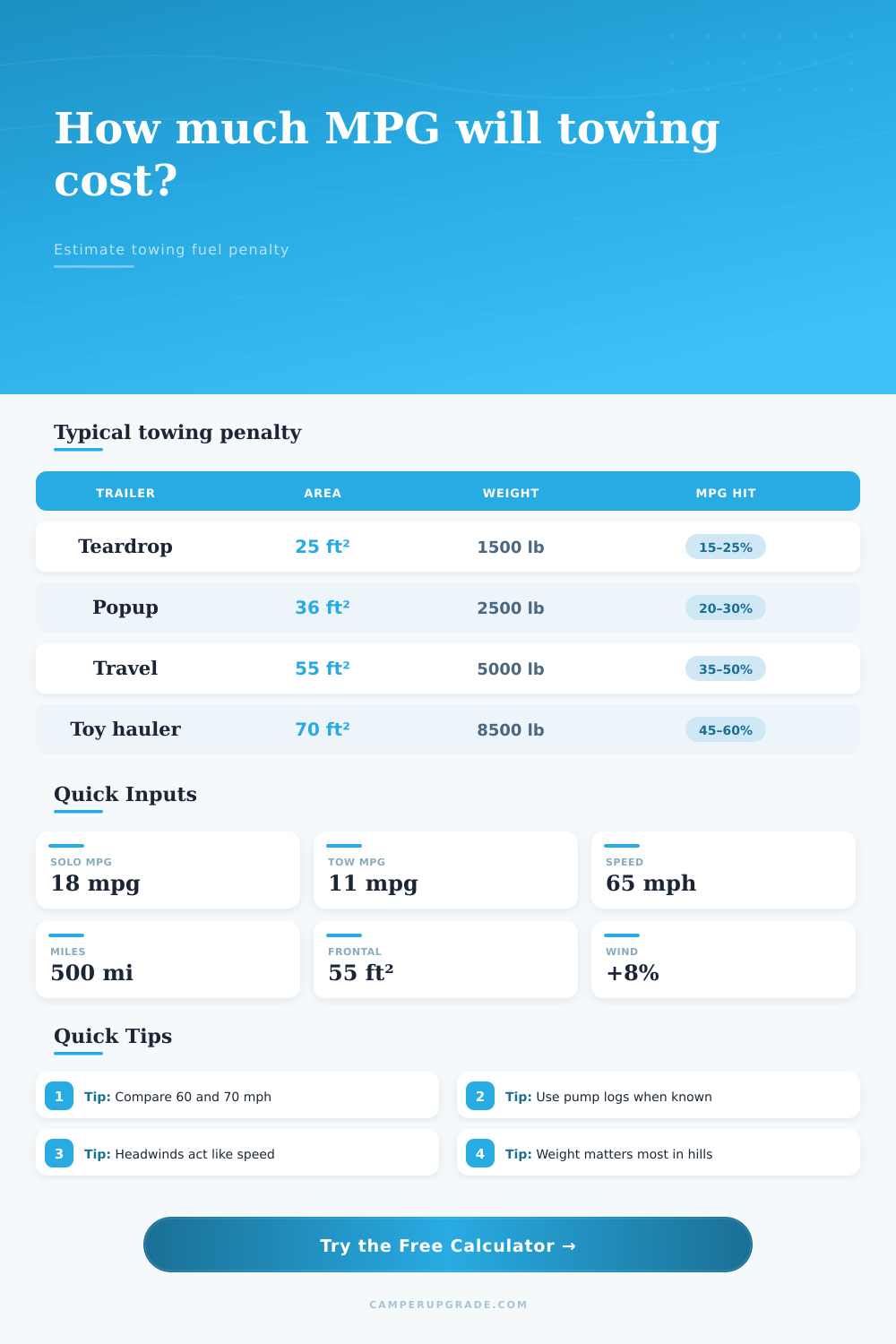
Here’s a reference table detailing effects of various types of trailers on mileage. A little camper might take off 15% efficiency while a big ol’ toy hauler cuts your mileage almost in half. These are just ranges to give you an idea of what to expect. They help you plan what to bring while knowing exactly how much gas will cost.
There’s a trade off when towing. You get more stuff at the cost of time and fuel. That’s fine, as long as you know what that cost would of been.
Wind and weight impact how fast you drive. Don’t let this catch you by surprise. Plan for it so you’re buying the gas but also understanding why the bill is so large. When you do, that bill becomes easy to swallow. You see it coming up, and you’re willing to pay it because you anticipated it.