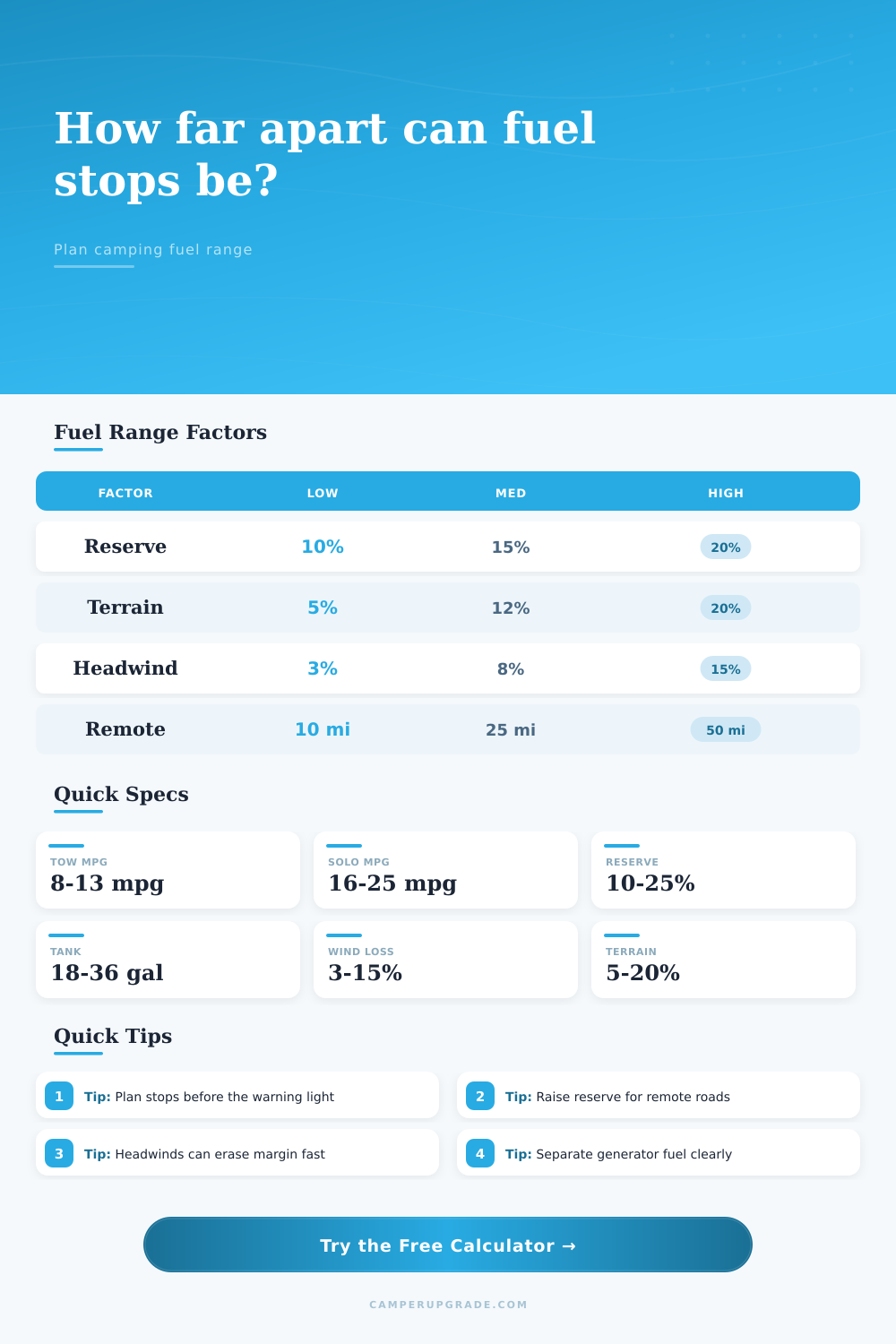
Camping Fuel Stop Spacing Calculator
Plan fuel stop intervals from tank gallons, towing and non-towing MPG, usable reserve, route distance, terrain and headwind derates, generator fuel carry, and remote-segment buffer.
Calculation breakdown
| Camping setup | Typical tow MPG | Typical solo MPG | Planning note |
|---|---|---|---|
| Half-ton pickup with travel trailer | 8 to 12 mpg | 16 to 22 mpg | Wind and speed can change range more than tank size. |
| Diesel pickup with fifth wheel | 9 to 13 mpg | 17 to 23 mpg | Mountain climbs and regeneration cycles may reduce margin. |
| Camper van or truck camper | 13 to 18 mpg | 15 to 22 mpg | Use loaded MPG when roof gear or water weight is high. |
| Small SUV with teardrop | 11 to 16 mpg | 22 to 30 mpg | Small tanks make stop spacing more sensitive to reserve. |
| Class C motorhome | 7 to 11 mpg | 7 to 11 mpg | Treat all miles as loaded, especially with toad or bikes. |
| Reserve style | Percent reserve | Remote buffer | Use when |
|---|---|---|---|
| Highway services frequent | 10% | 10 to 20 mi | Fuel options appear every 30 to 60 miles. |
| Normal camping route | 15% | 20 to 30 mi | Useful for mixed interstate, state roads, and campground detours. |
| Remote public land | 20% | 35 to 50 mi | Good for long approaches with few open pumps. |
| Winter or night travel | 20% to 25% | 40 to 60 mi | Closed stations and idling can eat planned margin. |
| Unverified fuel availability | 25%+ | 50 mi+ | Call ahead or shorten intervals before the remote segment. |
| Derate condition | Typical loss | What it affects | Planning cue |
|---|---|---|---|
| Rolling terrain | 3% to 7% | Average MPG | Use a small derate when climbs are short and speeds are steady. |
| Mountain passes | 8% to 15% | Average MPG | Climbing, braking, and low gears reduce real range. |
| Gravel or forest roads | 12% to 25% | Average MPG | Slow speeds, soft surfaces, and detours call for more reserve. |
| Steady headwind | 5% to 12% | Aero drag | Large trailers and motorhomes are most exposed. |
| Open plains gusts | 12% to 20% | Aero drag | Shorten stop spacing even if the route is flat. |
| Example safe range | Stop spacing | Stops on 400 mi | Stops on 700 mi |
|---|---|---|---|
| 125 miles | 100 to 120 mi | 3 stops | 6 stops |
| 175 miles | 150 to 170 mi | 2 stops | 4 stops |
| 225 miles | 200 to 220 mi | 1 stop | 3 stops |
| 300 miles | 250 to 290 mi | 1 stop | 2 stops |
| 400 miles | 350 to 390 mi | 0 stops | 1 stop |
Frequent Highway
10-15% reserveWorks when stations are common, grades are modest, and a missed exit does not create a long backtrack.
Remote Segment
20%+ reserveShorter spacing protects against closed pumps, campground spur roads, and unplanned scouting miles.
Windy Tow Day
Cut spacingLarge frontal area makes a headwind expensive, so use observed MPG or a stronger derate.
Generator Carry
Separate cansKeep generator fuel distinct unless you intentionally count part of it as emergency driving range.
blended MPG = 1 / (tow share / towing MPG + non-tow share / non-towing MPG).adjusted MPG = blended MPG x (1 - terrain derate) x (1 - headwind derate).driving fuel = tank gallons + extra vehicle fuel + shareable generator fuel - larger reserve.safe range = driving fuel x adjusted MPG - remote segment buffer; stop spacing is rounded down.
When you’re driving along a mountain road while towing something heavy, the low fuel light comes on and you worry because you’re nowhere near next exit. If gas gauge were truly accurate, that wouldn’t happen. Because it’s not. It doesn’t factor in the incline. Or the wind resistance. Or the fact that you’re towing a bunch of gear. That’s why your margin vanish quicker then you realize.
Before departing your house, make a plan for refueling. It is not out of over-caution. Instead, do it to acknowledge physical laws of what you’re towing. All you do is plug your tank capacity, your towing and solo MPG, and any wind or terrain derates into the calculator. You don’t have to guess when you’re creeping along a steep hill.
How to Plan Your Fuel for Safe Towing
People tend to plan a loaded trip using their empty vehicle miles per gallon. That’s hazardous. A half-ton pickup may have twenty miles per gallon on the highway if it’s only got the driver in it. When towing that travel trailer? It is ten or twelve. Why? It is because of trailer air resistance. It is not just the weight.
You enter both your solo MPG and your towing MPG into the tool. The system mix them based off your route. Why does that matter? Because most trips have some legs where there is no trailer. If you don’t account for the mix, you’ll stop too frequently. And you’ll run dangerously low on fuel.
Your range will be much lower due to weather and terrain. You are fighting a headwind. That wind burn extra fuel as your engine struggle to hold speed. If you have terrain, the tool lets you add a terrain and wind derate. This reduces your expected MPG to match. If you climb over some high passes, that’s not good for efficiency. If you drive lots of gravel road? That is also not great for efficiency. Adding a terrain penalty isn’t being pessimistic. It’s being realistic. And the page provides a clear example in their reference table. There is a five percent range loss on rolling hills. It is twenty percent or more on severe climbing.
Fuel separation. Good planning vs. Reckless guessing: You don’t burn all the fuel in your tank. There’s a buffer between the fuel pump and bottom of your tank. There should of be a buffer for detours. A buffer for closed stations. You need a buffer if you get lost. For remote camping, it’s normal practice to have a 15-20% reserve. The calculator will subtract this reserve from your total gallons. Then it’ll calculate distance.
You can also set a floor, or a minimum number of gallons. This prevents you from running down to nothing. This protects you from sucking up sediment. It protects you from water that settles on the bottom of the tank.
The appeal of generator fuel is special. Those jerry cans could be tempting, and you may think “Well, what’s a few gallons for emergencies?” They aren’t. They are not, unless you have specifically set them aside for that purpose. Keeping vehicle fuel and generator fuel mixed only confuses things. And that is a problem during an emergency. Separate in your mind. Separate in your planning. Does anyone have generator fuel that can also be used for driving? The safe bet (usually) is to say no. Keep that gas for your camp. Don’t waste it on a wrong turn.
A second level of protection is remote buffers. If you’re going into an area with few services, throw on a buffer distance. That’s because off-roading is often inefficient. You’ll back track. Scout water sources. Detour around bad road sections. All those miles add up. And they suck down your tank differently than straight line miles do. The buffer gets subtracted out of your range by the calculator. So you know that all your planned stops are still viable. This stays true even if map gets it wrong.
When it comes to fuel, it’s all about redundancy. Multiple layers of protection is what you’re looking for. You don’t want to break down. The tool gives you the numbers. You supply the judgement. Check your tires. Inspect the weather. Fill up before the needle gets too low.
It is better to arrive at camp with some extra fuel. Being stuck waiting on a tow truck is not. Having accurate plans makes for peace of mind. Peace of mind is worth far more than saving a few bucks when you cut it close. Drive smart. Let the math tell you where to stop.