Camping Gear Cost Per Use Calculator
Estimate real cost per trip, night, user, and item after resale value, annual maintenance, expected repairs, shared use, and bundled gear.
🏕Gear Presets
💰Purchase, Resale, And Bundle
📅Use Pattern
🔧Maintenance And Repair Risk
📋Value Snapshot
📊Reference Tables
| Gear type | Planning life | Resale signal | Best cost basis |
|---|---|---|---|
| Tent or shelter | 4 to 8 years | 10% to 35% | Per night or user-night |
| Cooler or storage box | 6 to 12 years | 25% to 55% | Per trip |
| Stove and kitchen kit | 5 to 10 years | 10% to 30% | Per meal use |
| Sleeping bag and pad | 4 to 8 years | 5% to 25% | Per user-night |
| Furniture and tables | 3 to 7 years | 5% to 20% | Per trip |
| Use pattern | Trips/year | Nights/trip | What it means |
|---|---|---|---|
| Occasional weekend | 2 to 3 | 1 to 2 | Purchase price dominates cost per use. |
| Family season | 5 to 8 | 2 to 3 | Mid-priced shared gear amortizes quickly. |
| Frequent basecamp | 10 to 16 | 2 to 4 | Durability and repairability matter more. |
| Long travel year | 18 to 35 | 3 to 7 | Cost per night drops, upkeep becomes visible. |
| Maintenance item | Low | Typical | High |
|---|---|---|---|
| Tent cleaning and waterproofing | $5/yr | $15/yr | $35/yr |
| Stove seals and small parts | $3/yr | $12/yr | $30/yr |
| Cooler gasket care | $0/yr | $8/yr | $25/yr |
| Chair, cot, and table repairs | $0/yr | $10/yr | $35/yr |
| Bundle example | Items | Shared users | Cost reading |
|---|---|---|---|
| Starter car camp kit | 8 to 12 | 2 to 4 | Check both per trip and per item. |
| Family sleep kit | 4 to 8 | 3 to 6 | User-night basis is usually fairest. |
| Camp kitchen box | 6 to 14 | 2 to 8 | Meal use count can lower the estimate. |
| RV outdoor room | 3 to 6 | 2 to 5 | Include repairs for fabric and poles. |
🧭Comparison Grid
Borrow First
1-2 tripsBest when use is uncertain and resale value would be low after a short trial.
Buy Used
3-5 tripsWorks well for durable coolers, tables, and simple shelters with visible wear.
Buy Midrange
6-20 tripsOften the best value when gear is shared by a family and repaired once.
Premium Gear
20+ tripsMakes sense when high resale, heavy use, comfort, or lower failure risk matters.
💡Cost Per Use Tips
Don’t think about the $300 price of tent in terms of one big payment. Think about it in terms of what fraction of your total experience it represents. That is what you are actualy paying for, and that cost will be spread out over your years of use.
That’s the thing: when you understand the dilution effect, you change the way you shop. Instead of seeking low sticker price, you seek the low cost per night. When you plug in your projected lifetime use and initial purchase price, the calculator do the math for you. No more wondering if it’s worth spending an extra buck on a premium sleeping bag.
Thinking About Cost Per Use
To do this, you’ll have to answer some honest questions about how often you go camping. Those doing so casually (two times per year) has trouble explaining the expense since their cost-per-trip remains high. They’re not getting much bang-for-their-buck and they leave their gear in the closet collecting dust for 10 months. For frequent campers, these expenses melt away. That fancy shell gets paid for fast with volume: If you camp 20 nights per year, that pricey sleeping bag will soon pay for itself.
There’s a hidden variable called resale value. If you maintain cleanliness and dryness, outdoor equipment retain its resale value quite nicely. You can get 25% back on a used tent if it still seals right. Essentially, that gets some of your money back as return on investment. The tool does this by subtracting the expected resale value.
And then there’s maintenance, which most folks overestimate or don’t plan for enough. Washing, re-sealing seams, replacing zippers, those little thing add up. They’re actual dollars spent each year. When ignored, they make gear appear less expensive than it is.
When it’s paid for between friends/family, it reduce the unit cost for each member. For example, if that family of 4 shares a 6-person tent, they’re splitting the cost much more better. Fixed costs gets spread amongst more people, and that will work in your favor with the math. That’s why many times, “shared” gear makes more financial sense then one lightweight kit per user. You’re spreading the cost of the same piece of equipment over more heads.
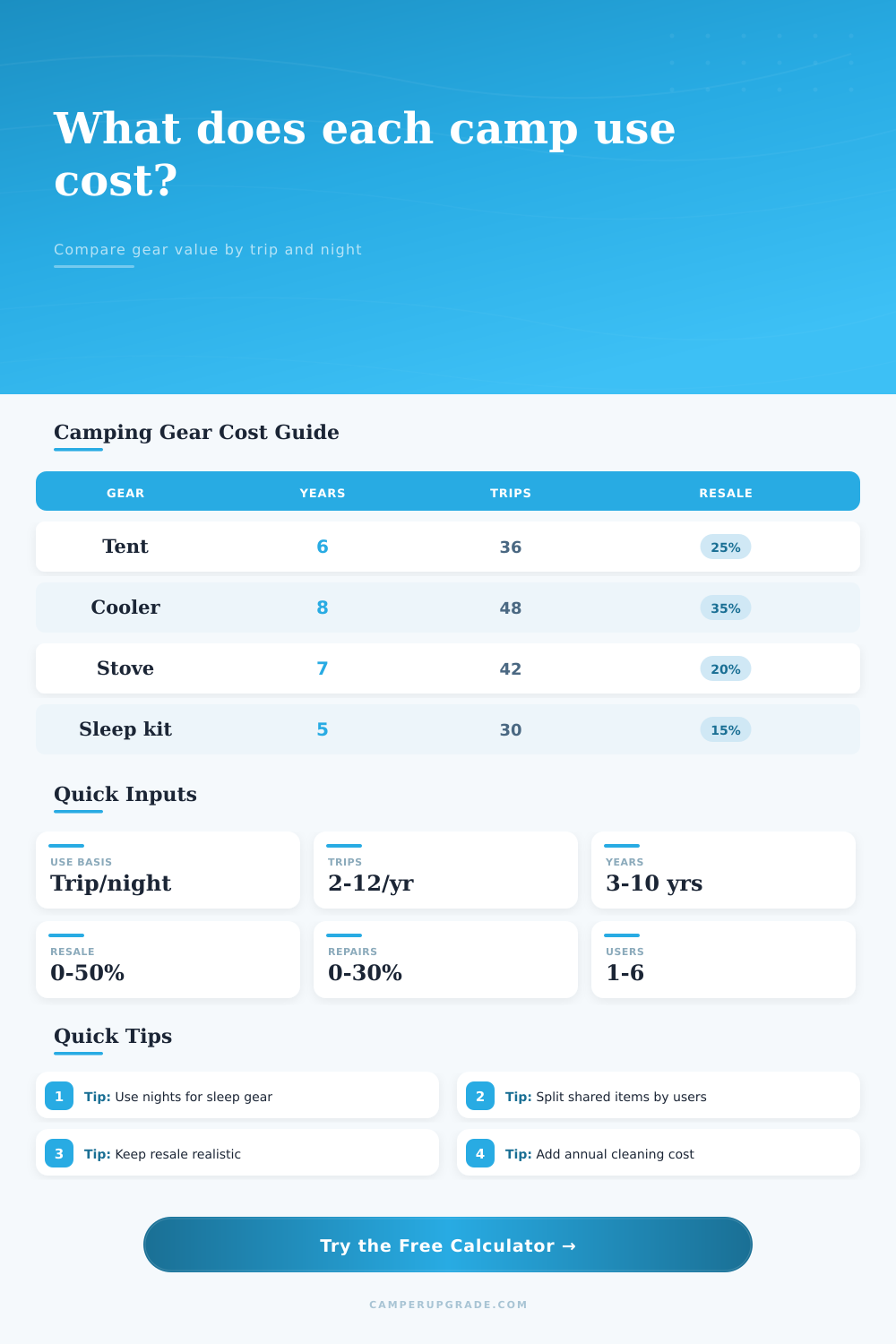
This is laid out in reference table, which describes the depreciation of each type of gear. Stoves wear out faster than shelters; coolers hold value longer then chairs. This informs your purchasing decisions. Spend on things that last a long time and sell well (a good cooler will last a decade and resells well) and skimp on things that don’t (a budget chair because it breaks eventually and costs little to replace).
But it also factors in repair risk. There’s always the chance something is going to break. The more you use stuff, the greater the chances. Enter a repair cost/probability into the calculator. That provides a real world buffer on your estimates. No longer can you assume everything just works like magic all the time. You have to account for a bent pole or snagged zipper at some point in time.
Let’s say you estimate 10 trips (conservatively). Now let’s say each trip costs $X/night. Does that seem like too much? Buy used or borrow if so. Does that seem like enough? Go ahead and buy then. It comes down to matching your money to your behavior. You don’t want a piece of gear because it works on a marketing brochure; you want a piece of gear that works for you.
Ultimately, camping is about comfort and reliablity in the wild. But those comforts has a price. And they come at a cost. Cost per use makes that cost manageable. It makes the initial cost less terrifying. It makes the long term value obvious. It makes it an investment instead of a purchase. It is an experience, not an item.
A tent is a pole and some fabric until it’s unfurled across your campsite. When it is, then it’s a home for tonight. And when you know how much every night costs, you’ll enjoy it that much more. Guilt-free because you know what the receipt costs per night.