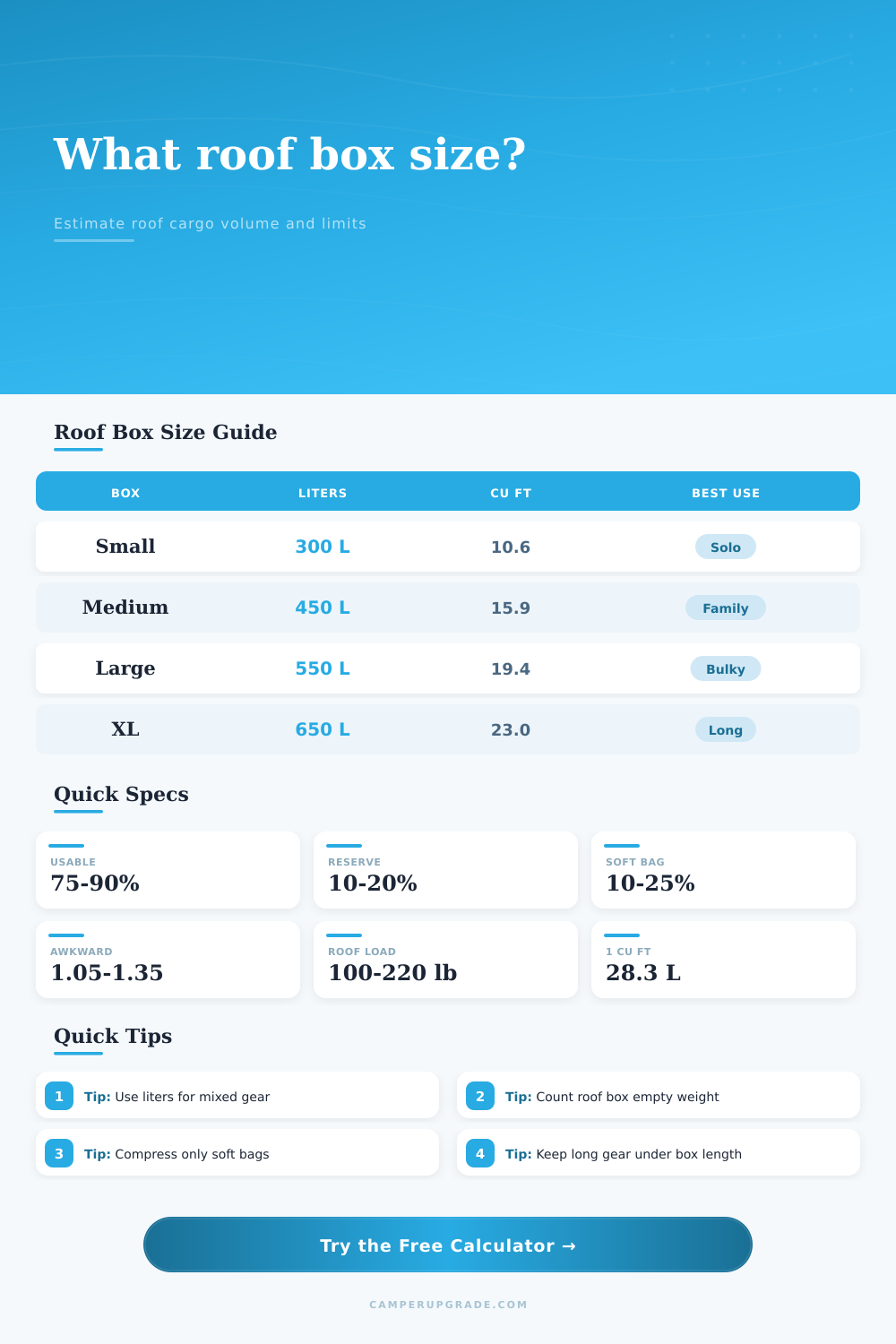
Roof Box Volume Needed Calculator
Estimate the roof box size needed for camping gear, usable internal space, odd-shaped items, waterproof bag compression, reserve room, and roof load limits.
📌Trip Presets
🧮Gear Volume Inputs
Enter packed volumes by category. Use the count and average packed size of each item group; the calculator applies compression, awkward packing space, usable box volume, and safety load checks.
Soft Sleep Gear
Clothing and Linens
Tent and Shelter
Chairs and Furniture
Kitchen and Dry Food
Long or Awkward Gear
⚖️Weight and Roof Limits
Your Roof Box Sizing Result
📦Gear Volume Reference Grid
📊Roof Box Comparison Grid
📐Usable Volume by Box Size
| Listed box size | Usable at 78% | Usable at 84% | Usable at 90% | Good planning range |
|---|---|---|---|---|
| 300 L / 10.6 cu ft | 234 L | 252 L | 270 L | Solo clothing, coats, boots |
| 400 L / 14.1 cu ft | 312 L | 336 L | 360 L | Couple weekend overflow |
| 450 L / 15.9 cu ft | 351 L | 378 L | 405 L | Small family soft gear |
| 500 L / 17.7 cu ft | 390 L | 420 L | 450 L | Family camping mixed load |
| 550 L / 19.4 cu ft | 429 L | 462 L | 495 L | Bulky shelter and chairs |
| 650 L / 23.0 cu ft | 507 L | 546 L | 585 L | Long tour or winter gear |
🎒Common Gear Category Volumes
| Gear category | Compact volume | Typical volume | Bulky volume | Packing note |
|---|---|---|---|---|
| Sleeping bag or quilt | 18-25 L | 30-40 L | 45-70 L | Compresses well if dry |
| Personal clothing bag | 12-18 L | 20-35 L | 40-55 L | Soft bags fill side gaps |
| Four-person tent bundle | 35-45 L | 50-70 L | 80-110 L | Poles may limit fit |
| Camp chair | 8-12 L | 15-22 L | 25-35 L | Rigid shapes add air gaps |
| Kitchen or dry food bin | 15-25 L | 30-45 L | 50-70 L | Watch weight before volume |
| Long sports gear | 20-35 L | 40-65 L | 70-100 L | Check internal length first |
⛑️Roof Load Limit Checklist
| Limit to check | Typical range | What counts against it | Use in calculator |
|---|---|---|---|
| Vehicle dynamic roof rating | 100-220 lb | Box, bars, mounts, cargo | Usually the hard ceiling |
| Crossbar or rack rating | 110-220 lb | Box and contents while driving | Use the lowest rack part |
| Roof box cargo limit | 110-165 lb | Contents inside the box only | Do not include empty box |
| Clamp spacing and overhang | Varies | Hatch clearance and support | May rule out long boxes |
| Internal box length | 60-90 in | Skis, poles, paddles, awnings | Compare longest item |
🧽Compression and Reserve Planning
| Planning factor | Low setting | Normal setting | High setting | Best used for |
|---|---|---|---|---|
| Waterproof bag compression | 10% | 18% | 25% | Sleeping bags and clothes |
| Awkward item factor | 1.08 | 1.15 | 1.25 | Rigid gear and long bundles |
| Reserve space | 10% | 15% | 20% | Wet returns and loose repack |
| Target fill | 80% | 88% | 95% | How hard the box is to close |
💡Roof Box Sizing Tips
There you are: standing in your driveway, looking down on a roof box that looks like it’s packed to the gills, but the hatch won’t shut. There’s a tangle of duffle bags, tent poles, and sleeping bag inside. You shove again. Nothing.
It’s not just a lack of gear that frustrates. It’s also the math of cubic space. When buying a roof box, most folks looks at the manufacturer’s headline volume number and assume that’s how many actual liters of stuff will fit inside. They’re not. There are latch mechanisms taking up space; there are thick plastic shells; there are tapered internal corner. Before you even put one bag into the box, you’ll find yourself losing between ten and twenty-five percent of what was advertised.
How to Pack Your Roof Box
It’s a little complicated, admittedly. After all, there is an infinite number of ways to set up your pack. But once you enter your own load into the calculator (above), you don’t have to guess whether any given box will hold yours. For starters, it makes you reckon with the distinction between gross volume and usable space.
And then it drills down further: After choosing a common family box size, it assumes a reduction factor, which recognize that no box is perfectly cubical. And finally, it asks you to categorize your gear, not as one big lumpy mass, but rather by gear type. Soft gear take up different space than hard gear. A stack of clothing can be compressed; a stiff camping chair cannot.
For example, if you have four clothing duffels and four sleeping bags to pack, then the calculator apply a compression factor to them. They take up less space. You can choose a suitable percentage (eighteen percent is realistic for normal dry bags). It takes into account how dense t-shirts get compared to a jacket with puffy sleeves, or how much you squeezed out of air from a quilt. But if you attempt to shove your ski poles in there, or your kitchen bin…you’ll have no luck. They require room for awkward space. The tool has a multiplier for anything long or rigid. It takes into account the air gaps that will be created as you try to pack a rectangular cooler alongside a round tripod bag. It is a small thing, but it matters, because failing to do so result in an open hatch.
The other silent killer of road trips is weight. Just because that five hundred liter box fit everything doesn’t mean you’re safe to load it up. What happens when the total weight of the gear, the empty box, and all the hardware to tie it down adds up to more than your rig can safely carry? That means you don’t have a packing problem (you have a safety problem).
The calculator compares the weight of your gear against the lowest rating in your system. Is it the box’s own internal limit? Is it the crossbars or the roof? Dynamic roof ratings are typically between one-hundred and two-hundred twenty pounds for most vehicles. That includes everything on the roof and the hardware. Then subtract the weight of the box, which is likely at least forty pounds. So now you’re down to about one-hundred sixty pounds of gear before dealing with the structural limits.
Then there is the geometry puzzle of long things. You could pack a ski bag or a paddle into the space, but then what about those that are too long for the inside length of the box? The tool compares your longest item against the candidate box’s internal dimensions. It also reminds you to consider the taper to the nose and the hinge at the back. You can’t squeeze a seven foot pole into a seventy inch box no matter how much emptiness looks like space in the center.
Lastly, there is the reserve space percentage question. Twenty seems nice, but five is tight. Whatever number you enter, that’s your buffer for the souvenirs you didn’t budget for, the wet gear you’re bringing back, or the repacking nightmare when you have a terrible night’s sleep.
Roof boxes aren’t so much about getting everything in as they are a series of compromises: heavy versus light gear, small box versus tightly packed. It’s not about filling the box up; it’s about shutting the box. If you nail down the weight and volume, then the hatch will shut with a satisfying click and all you should of do is go drive.