Family Camping Packing Volume Calculator
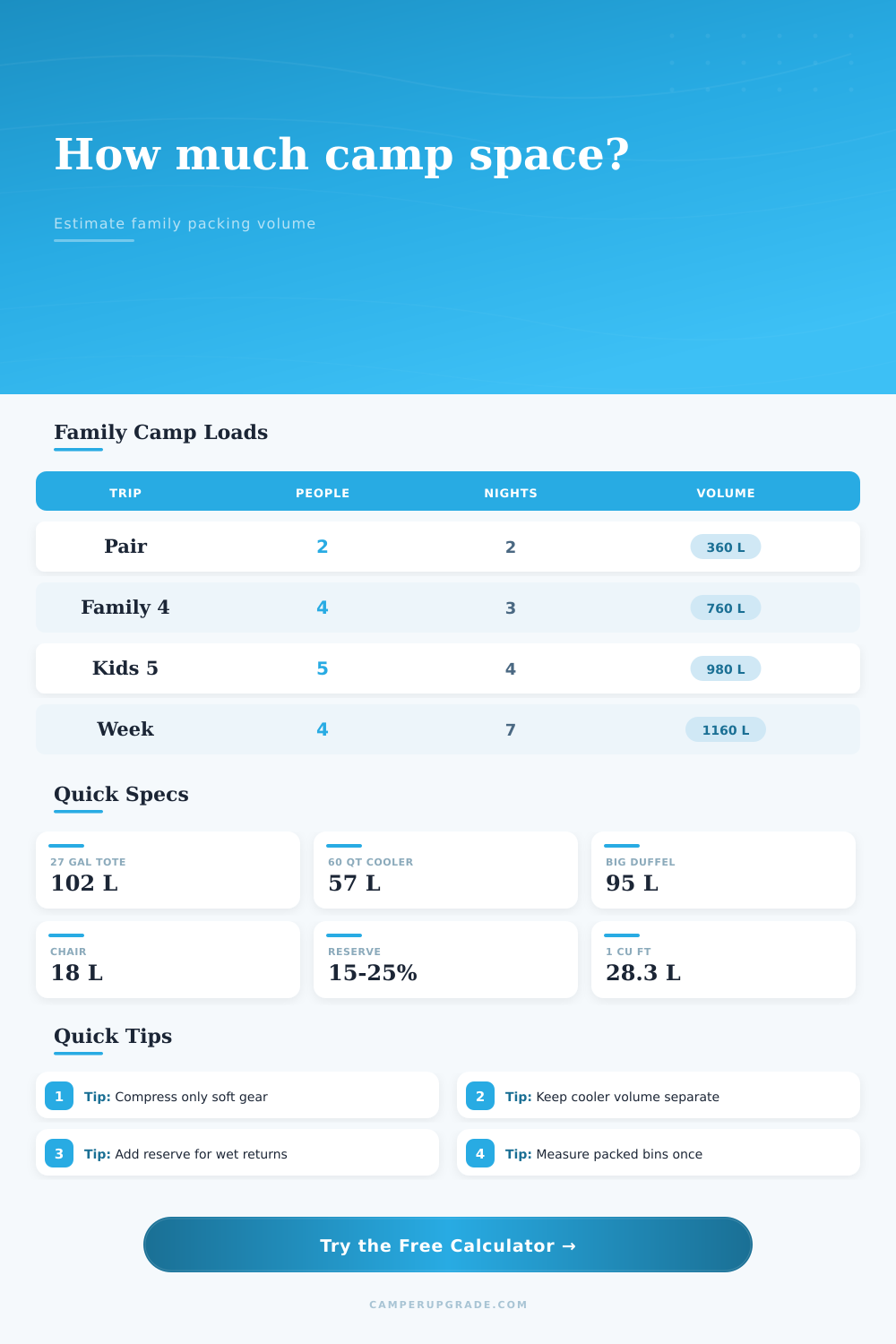
Estimate packed volume for tents, sleeping kits, clothing, kitchen bins, food, coolers, chairs, kids gear, compression, and reserve space.
🗂Family Presets
👪Family And Trip Size
⛺Shelter And Sleep Bins
🧺Camp Kitchen, Food, And Furniture
🧸Kids Gear, Compression, And Reserve
📦Gear Comparison Grid
📊Common Container Volumes
| Container | Nominal Size | Approx Liters | Approx Cubic Feet |
|---|---|---|---|
| 18 gallon tote | Small gear bin | 68 L | 2.4 cu ft |
| 27 gallon tote | Common garage tote | 102 L | 3.6 cu ft |
| 32 gallon tote | Large family tote | 121 L | 4.3 cu ft |
| 40 gallon tote | Oversize camp bin | 151 L | 5.3 cu ft |
| 60 quart cooler | Weekend food cooler | 57 L | 2.0 cu ft |
🛏Shelter And Sleep Volume Guide
| Item Type | Compact | Standard | Bulky |
|---|---|---|---|
| Tent or shelter bin | 55 L backpacking family tent | 80 L dome or tunnel tent | 120-160 L cabin or canvas tent |
| Sleeping bag or quilt | 18 L summer quilt | 35 L 3-season bag | 55-75 L cold or rectangular bag |
| Sleeping pad or cot | 12 L compact inflatable | 28-45 L foam or self-inflating pad | 80 L cot or thick camp bed |
| Extra bedding | 10-15 L per person | 15-25 L per person | 25-45 L per person |
🍲Food, Kitchen, And Chair Guide
| Category | Light Load | Family Load | Notes |
|---|---|---|---|
| Dry food | 3 L per person-day | 4.5-6 L per person-day | Bulky snacks and packaging raise volume quickly. |
| Kitchen bin | 35 L simple cook kit | 60-90 L standard bin | Cast iron, wash tubs, and coffee gear add bulk. |
| Cooler | 28 L small cooler | 57-95 L family cooler | Shell volume is counted as cargo space. |
| Camp chairs | 10 L compact chair | 18 L standard chair | Rockers and recliners may exceed 30 L each. |
🚘Family Load Benchmarks
| Scenario | People | Typical Volume | Planning Comment |
|---|---|---|---|
| Two adults, warm weekend | 2 people | 320-450 L | Often fits behind a rear seat with one cooler. |
| Family of four, 3 nights | 4 people | 650-850 L | Usually needs two to three totes plus cooler and chairs. |
| Family of five, cold weather | 5 people | 950-1300 L | Soft bedding and extra layers dominate the load. |
| Week at lake campground | 4 people | 1000-1450 L | Food, towels, toys, and spare clothing push volume upward. |
💡Packing Volume Tips
A minivan’s trunk are a limited space. It doesn’t expand to hold all your equipment. When you stuff a cooler in there, you fight geometry as you try to squeeze in a sleeping bag. For a family camping trip, volume is more important then weight. Yes, you could schlep around eighty pounds of gear, but that gear may take up four hundred liters. Soft things such as clothes is bulky and most families underestimate their volume. That cause them to circle the car attempting to force final bin into place.
Enter the number of people, nights, type of shelter, and desired amount of reserve space, and the calculator will tell you how many liters you can fits in your vehicle to help you avoid panic.
How to Pack Your Car
Begin with your shelter. An average family tent bin hold approximately eighty liters. That’s a big duffel bag. That isn’t even counting your clothing. Now add in sleeping pads and bags for everyone, and you’re off to the races. A three-season sleeping bag take up about thirty-five liters. A self-inflating pad might needs another forty-five. Hard shells don’t compress nicely. Plastic tent poles won’t squish down into nothing. They are your baseline volume. Your base floor of carrying capacity.
From there, this tool will handle soft goods different than these hard shell volumes. The math starts getting fun with clothing and bedding. The key word in that sentence is compression. Rolled-up clothing use less space then a heap of dirty laundry. Soft gear gets a compression factor on the calculator. Packing it down tight can save you fifteen to twenty percent of its space. This is where you should of use vacuum bags or stuff sacks.
But don’t try to compress your camp chairs or cooler. They’re fixed shapes. When a rigid object goes into a compressed space, you get crushed snacks and broken chair legs. Best just to accept their bulk and pack around them.
But there’s also a lot of food. Food scales by person-days, so it’s also a huge space-hog. Three people for two days will take up less space then two people for three. Sixty-liter bins are big enough that most kitchens have them; they fill fast with coffee makers and other cooking gear. To help you see this, the calculator converts dry food rates into liters. If your final volume jump up, double-check your food estimates. Are you carrying an entire bag of potato chips? Or are you only snacking on a few thing? Little decisions here make a big difference in trunk.
Leave yourself some room. Life happens. Kids lose toys, towels get forgotten, wet stuff takes up more room than dry stuff. Make sure you give yourself a 15-20% buffer. That gives you space for life’s surprises. And makes sure you don’t end up leaving the car without a cooler full of ice.
The table below shows how regular container sizes corresponds to your load. If what you’re packing can fit in two totes and still have some wiggle room, then you should be fine. Otherwise, you’ll need to make cuts.
And lastly, consider the cargo fit. That’s the final reality check. How much space do you have in your vehicle? How many people (and pets) can sits in it, and still have some room left over? That’s how much space you’ve got. And if the stuff you want to pack won’t fit in there, then…you have a problem.
The calculator takes a look at the volume of all the things you want to take. Then it looks at your vehicle’s cargo space. Then it shows you a number, a percentage. Eighty to ninety percent fill is a good target. There’s still a little wiggle room for bringing groceries home. This helps avoid the frustration of having items tumble out when you open the door.
Packing is humbling business. Square inches are not equal to cubic feet. But with a little planning you can get maximum use out of whatever space you have. The secret is knowing what you’re measuring. This will help you see that clear as day.