Tank Sensor Percentage to Gallons Calculator
Convert an RV tank sensor reading into gallons for fresh, gray, or black tanks, with optional nonlinear shape correction, measured calibration points, reserve allowance, slosh range, and multiple equal tanks.
Tank Reading Result
| Panel reading | Simple fraction | 40 gal tank | 60 gal tank |
|---|---|---|---|
| 0% | Empty | 0 gal | 0 gal |
| 25% | One quarter | 10 gal | 15 gal |
| 33% | One third | 13 gal | 20 gal |
| 50% | Half | 20 gal | 30 gal |
| 67% | Two thirds | 27 gal | 40 gal |
| 75% | Three quarters | 30 gal | 45 gal |
| 100% | Full | 40 gal | 60 gal |
| Correction | Best for | How it behaves | When to avoid |
|---|---|---|---|
| Linear rectangular | Box tanks | 50% level is 50% volume | Curved or sloped tanks |
| Flat wide RV tank | Low, broad tanks | Middle reads a bit high | Tall narrow tanks |
| Shallow belly tank | Sagging underbelly tanks | Lower marks gain slowly | Rigid rectangular tanks |
| Horizontal cylinder | Round tanks on side | Ends are nonlinear | Square plastic tanks |
| Sloped wedge | Draining tanks | Low readings hide less volume | Centered level probes |
| Calibration points | Measured fill tests | Interpolates your tank data | No measured gallons |
| Step | What to measure | Example | Calculator field |
|---|---|---|---|
| Start empty | Known drained tank | 0 gal | 0% mark |
| First change | Gallons when 25% lights | 8 of 40 | 25% mark = 20 |
| Middle change | Gallons when 50% lights | 19 of 40 | 50% mark = 47.5 |
| High change | Gallons when 75% lights | 31 of 40 | 75% mark = 77.5 |
| Full point | Filled to vent/known stop | 40 gal | 100% mark |
| Setting | Typical value | Fresh tank meaning | Waste tank meaning |
|---|---|---|---|
| Reserve | 5% | Short campground buffer | Small headroom buffer |
| Reserve | 10% | Dry-camp planning buffer | Dump before very full |
| Reserve | 15% | Pump pickup protection | Extra odor/backup margin |
| Slosh | 2% | Parked level reading | Stable parked reading |
| Slosh | 5% | Typical RV panel margin | Usual waste tank caution |
| Slosh | 8% | Off-level or travel range | Use caution before travel |
Recreational vehicle tank sensors aren’t always great. Fresh water tanks especially can be inaccurate. One day you’ll look at your dash and find your fresh water tank is half full, and then realize you’ve ran out of coffee for the next two days.
The sensor is trying to assist you, but what it’s really telling you is a suggestion, not a fact. It is a simple probe or conductivity-based sensor. That probe can become covered in sediment. That sensor can drift out of calibraion. It’s trying to read the water level based off a shape of the tank and it gets it wrong.
How to Fix Your RV Water Sensor
This calculator helps turn that unclear percentage into the actual amount of water left in your tank. Not all RV tanks are perfect cylinders. Some are square boxes with a linear relationship between height and volume. If it’s half full, then it is half full.
But most newer RV tanks is round or sloped (to save weight or fit underneath chassis rails). So if they’re half full, they may only be 40 percent full. They narrow down at the bottom. That’s why the calculator gives you the option of selecting the type of tank shape. Then it will apply a correction factor to your raw sensor readout. It converts that misleading percentage into a more realistic gallon count.
Finally, look at the reserve setting. This is an important parameter for dry camping. Let’s say you have a forty gallon fresh tank with a ten percent reserve. What that means is the tool tell you how much water you can use. How much you want to leave so you don’t suck air into your water pump. Pumping air is bad and will wreck a pump in no time. The reserve setting provides a buffer. So even though your sensor indicates you’re down to twenty percent, you won’t run the tank empty.
With waste tanks, the reserve setting are opposite. Think of it as headroom so you don’t overflow when searching for a dump station.
To add some realism, we’ve got slosh. When you drive anywhere with your tank full, the water sloshes back and forth. When you’re parked and it’s not perfectly level, it sloshes too. That slosh make the sensor jump from mark to mark. This results in a changing readout. What do you mean? It’s difficult to understand what the sensor has read.
The tool now includes an uncertainty range for slosh. Now there’s a min/max estimate so you have a margin of error that reflects reality. It accounts for the fact that the water isn’t sitting completely still.
Also, calibration tweaks stubborn sensors. If you know that your tank hold X gallons at some known mark, you can put those values into the calc and they will override the theoretical shapes of your tanks. The calculator will use your measurements. It is not a whole lot of work, just up front, but it is realy accurate. And most folks don’t take the time to fill test their tank. They go with the generic estimates. A fill test makes the sensor a real gauge rather than a guessing game.
Black and gray tank sensors also has issues of their own. Waste builds up on the probes, along with soap scum. This causes the sensor to register higher water levels then there actualy are. For example, a level that is three-fourths full may read as full. An empty tank may read as having a few gallons left. Knowing how they work makes reading the results easier to understand.
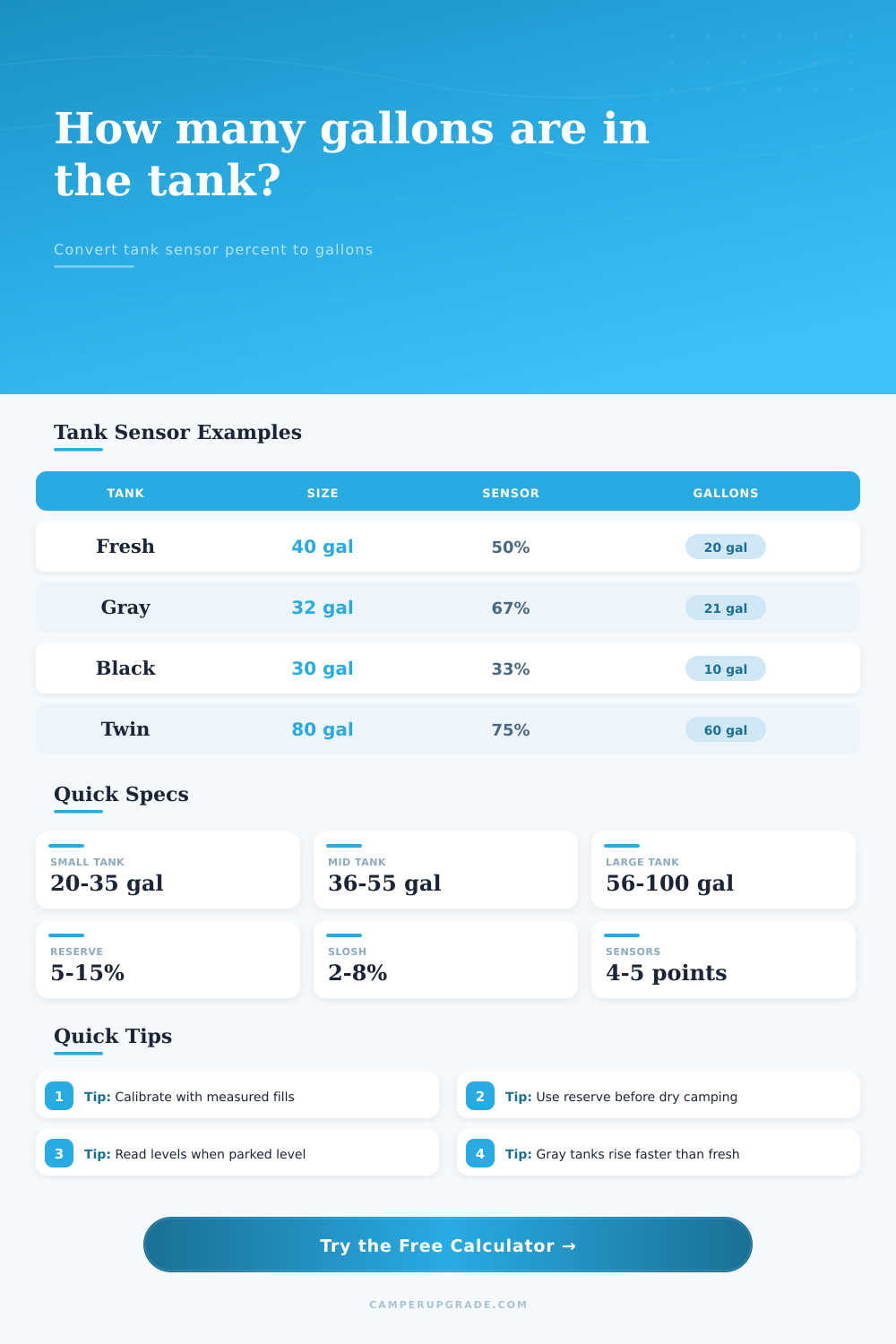
The table on the page outlines some typical scenarios. It will give you an idea of what those percentages could mean in various tank sizes. It can be helpful to have a baseline to compare different than when you apply your own adjustments. A single data point is never something you can rely on. Plug it into the calculator for a ball park. Then compare that number against your length of time on the water.
So if the math indicates you’re down to 10 gallons and yesterday you ran two gallons…you probably shouldn’t of been as low as the sensor suggests.
The best defense against the unpleasant surprise of running out of gas is practical observation combined with calculated estimates. That way you’ve got a plan to work off of rather than anxiety.