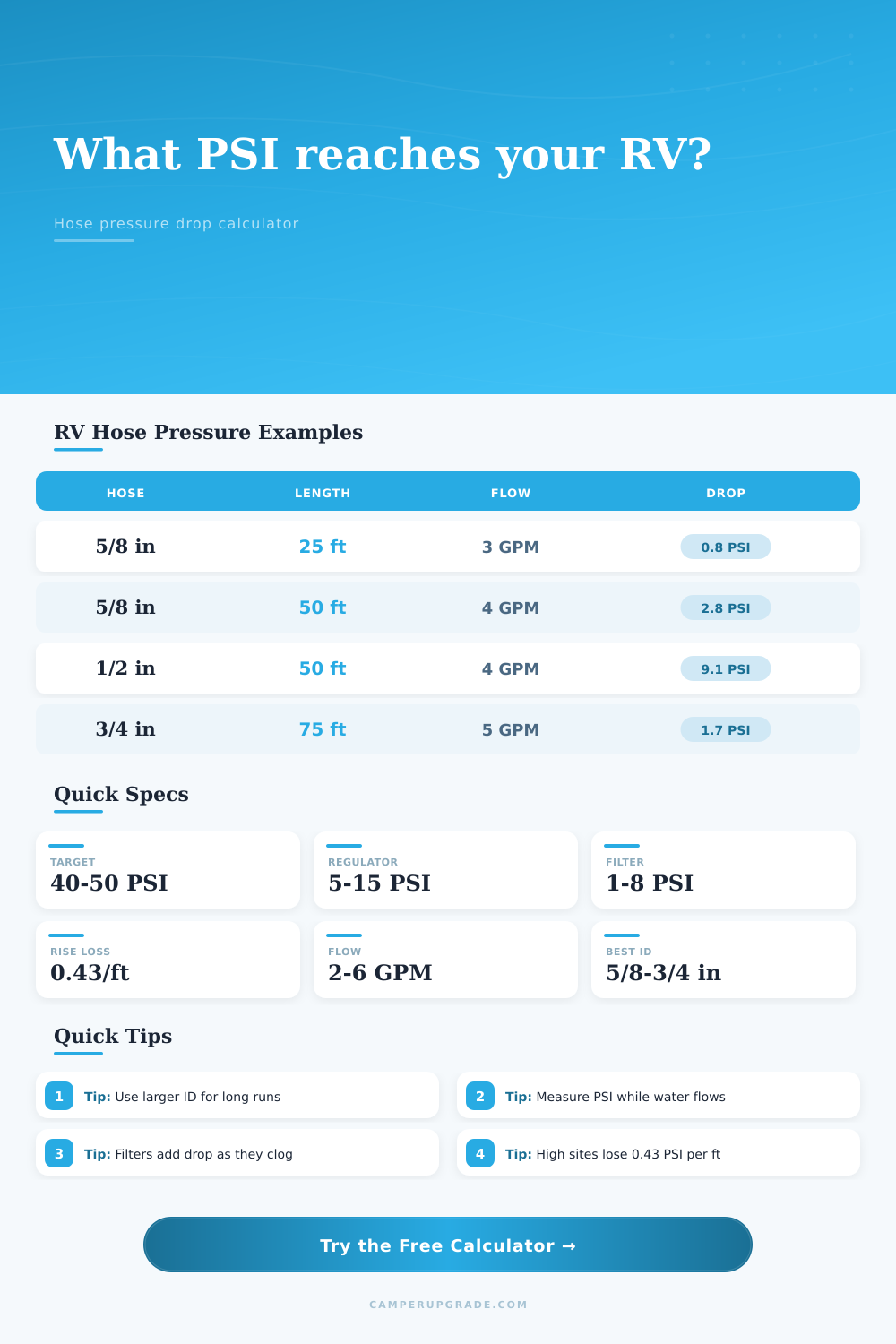
RV Water Pressure Drop by Hose Length Calculator
Estimate delivered fixture PSI from inlet pressure, hose length, inside diameter, flow rate, fittings, filters, regulator loss, and campsite elevation change.
📌 Hose Setup Presets
🚿 Water Line Inputs
Pressure Drop Estimate
📊 Current Setup Comparison Grid
🧮 Formula Basis
head loss ft = 4.52 x length ft x GPM^1.85 / (C^1.85 x inside diameter in^4.87). The calculator converts head loss to PSI with PSI = head ft x 0.433, then adds filter, regulator, fitting, and elevation effects.
🛠 Hose Diameter Reference
📏 Hose Size Pressure Drop Table
| Hose ID | Typical use | 50 ft at 3 GPM | 50 ft at 5 GPM |
|---|---|---|---|
| 1/2 in | Short compact hookup | 4.7 PSI | 12.1 PSI |
| 5/8 in | Most RV drinking-water hoses | 1.6 PSI | 4.2 PSI |
| 3/4 in | Long hose run or fast tank fill | 0.5 PSI | 1.3 PSI |
| 7/8 in | Large transfer or low restriction | 0.2 PSI | 0.6 PSI |
🚰 RV Flow Demand Table
| Water use | Typical flow | Pressure sensitivity | Calculator setting |
|---|---|---|---|
| Bathroom sink | 0.7 to 1.5 GPM | Low | 1 GPM for single faucet |
| Kitchen faucet | 1.0 to 2.2 GPM | Medium | 2 GPM for normal use |
| RV shower | 1.5 to 2.8 GPM | High | 2.5 GPM for shower feel |
| Fresh tank fill | 4.0 to 8.0 GPM | Medium | 5 to 6 GPM for fill time |
🔧 Fitting and Device Loss Table
| Component | Typical effect | When it matters | Input approach |
|---|---|---|---|
| 90-degree elbow | 2 to 6 ft equivalent | Many tight adapters | Add to fitting count |
| Quick connect pair | 4 to 12 ft equivalent | Small bore couplers | Use typical or restrictive |
| Carbon block filter | 2 to 10 PSI | High flow or dirty cartridge | Enter filter PSI loss |
| Pressure regulator | 3 to 15 PSI | Low-flow compact regulators | Enter regulator PSI loss |
🎯 Fixture Pressure Target Table
| Delivered PSI | Likely RV feel | Common cause | Adjustment to test |
|---|---|---|---|
| Under 30 PSI | Weak shower and slow fill | Long hose, filter, low source | Reduce restrictions or use larger ID |
| 30 to 40 PSI | Usable but modest | Normal park pressure plus losses | Shorten hose or clean filter |
| 40 to 50 PSI | Comfortable RV range | Balanced source and hose run | Keep reserve for filter loading |
| Over 50 PSI | Strong flow | High inlet or low line loss | Confirm RV pressure limits |
💡 Hose Pressure Tips
You get to the camp site, hook up the hose and go in to rinse off quickly. Then the water dribbles out. You blame the park, or the hose, or the filter, but culprit is usually just physics. Did the park mess up the hose? Most likely not: it’s physics.
As water move along, it loses pressure and how much it loses have a lot to do with how far away you are, how wide path is, and what’s in the way. With the calculator, you can predict that drop in advance so that you know if you’re getting weak shower. It is better than a guess.
Why Your Camp Shower Is Weak
Two factors determines most of the pressure loss: hose length and inner diameter. Consider the hose like a hallway. If you have a longer hallway it will tire you out. And if it’s narrower it will slow your pace, ditto water. Friction against walls of the hose slows the flow.
Enter the Hazen-Williams formula, which connects length, pipe diameter and flow rate to head loss. Go up a size on a half-inch hose (say from half-inch to five-eighth-inch) and there is big change. That added sixteenth of an inch greatly cuts down on friction. It is a small change in shape that offers a big practical benefit.
The flow are affected by obstacles too. Each filter, elbow, or quick connect is another speed bump in the system. You can enter fitting count into the calculator. It will then treat each fitting as equal to a certain amount of hose length. Three tight elbows? The calculator adds fifteen feet of additional straight hose. It is an approximation but it’s a pretty good one.
Filters are where it gets tricky. A clogged filter could completely stop flow while a dirty filter may only lower the output by a couple of PSI. You can plug-in your guess for that lost PSI using the tool. This helps you know which filter (if any) is the bottleneck.
One slight detail that counts is elevation. For every foot a spigot sits below your RV (or above), there’s roughly a loss of 0.43 PSI due to weight of water. So if your RV is parked 50 feet above the spigot, you’re automatically losing 20 PSI before the water even moves. Gravity is frequently blamed for pressure problems when in fact it was the hose.
This tool accounts for that and shows you what’s actualy getting to the fixture. Forty to fifty PSI is what most RV fixtures is happy with. Less than thirty PSI and your shower sucks and your sink gets slow. More than sixty and you might tear up a hose or appliance. You want somewhere in there.
The app calculates your PSI (delivered) and then compares it to where you want it. It will tell you if you’re short by X amount of margin. That lets you know if you need to change out the filter, cut down the hose, go bigger diameter etc.
Please note that these are just estimations. I recommend measuring your set-up. Sometimes static pressure (no flow) isn’t an accurate indication of anything. For example, your spigot could be 60 PSI if closed up but may fall to 20 with the shower turned on. The change there would be called dynamic loss and what this tool models. You can purchase an inline gauge fairly cheap for a few dollars that you can run at the RV inlet. Turn on the water and look at the number. That’s how you’ll know for certain.
It’s not just about hose size either. How good (or bad) of shape is the hose in? A kinked up, old hose that has some internal roughness will have more friction than a new hose with smooth walls. This impacts the roughness level and allows you to dial in based off how good (or bad) the interior condition of your hose is. Older gear can especially benefit from this input. Maybe you’ve had it all coiled up tight for several years and it now has permanent bends that limit flow.
It is about planning. Avoiding weak water on a hot night because you didn’t plan. Learning the interplay between fittings, diameter, and length so you know which hose to take to the campsite. Long runs requires large hoses. Steep sites require more pressure head. Complex setups with multiple filters require wide pipes. It is easy stuff to forget until you’re screwed.
Hose + Fittings = Pressure
Everything adds up: water loses pressure when you lift it uphill, and it hates resistance. How much is that costing you? The math matter. The calculator does the heavy lifting. But insight comes from knowing why things cost you what they do. When you see the tradeoffs, you’ll stop blaming the park and improve your setup. Your shower will thank you.