Lithium vs AGM Weight Comparison Calculator
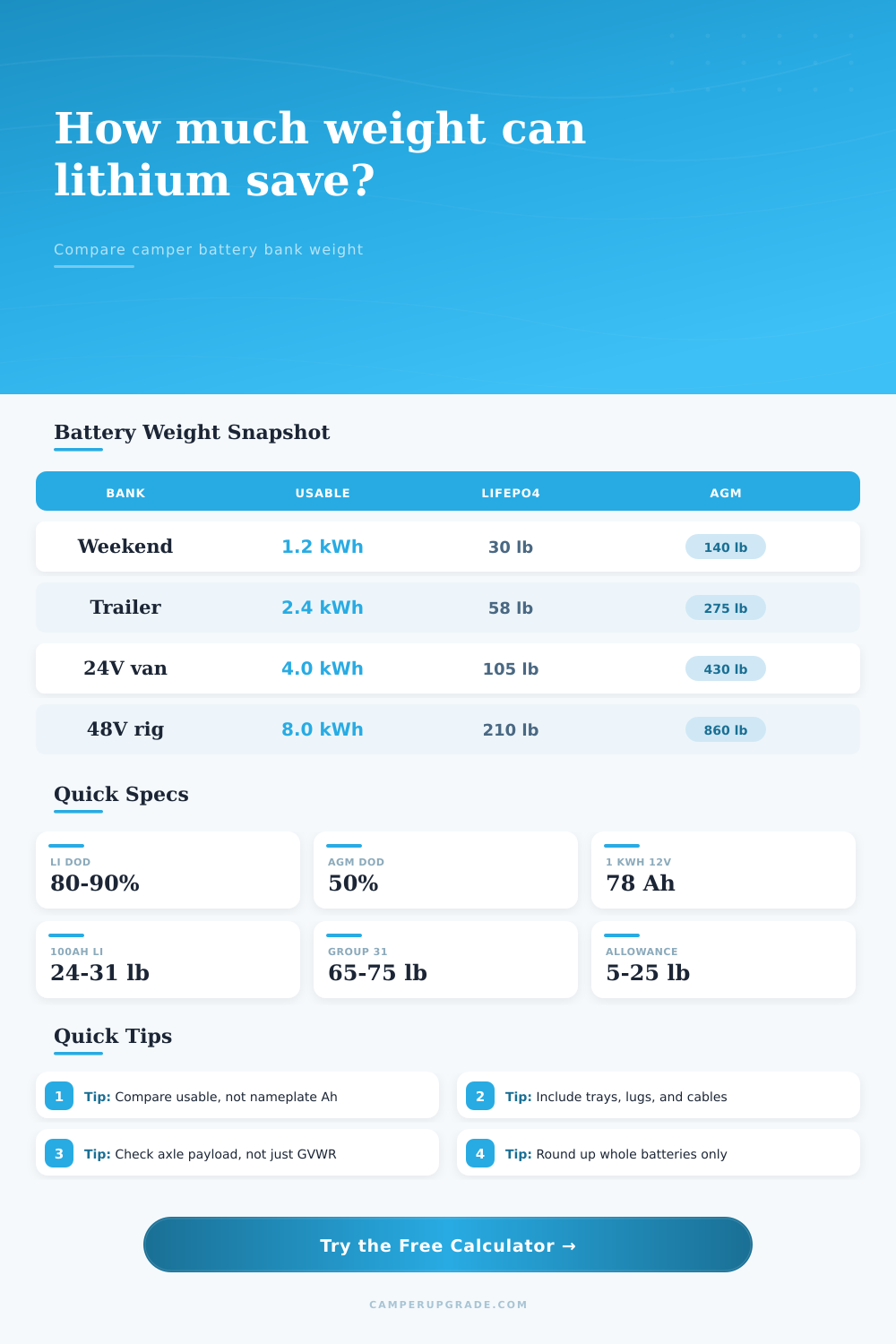
Compare LiFePO4 and AGM battery bank weight for a camper, van, trailer, truck camper, or motorhome using usable capacity, voltage, depth of discharge, reserve margin, install allowance, and payload limits.
Full sizing breakdown
LiFePO4 bank
AGM bank
| Battery size | Nominal rating | Typical weight | Camper use case |
|---|---|---|---|
| 100Ah compact LiFePO4 | 12.8V, 100Ah | 24 to 26 lb | Small van, teardrop, fridge and lights. |
| 200Ah LiFePO4 camper case | 12.8V, 200Ah | 48 to 55 lb | Common single-battery camper upgrade. |
| 300Ah heated LiFePO4 case | 12.8V, 300Ah | 70 to 85 lb | Cold-weather van or trailer bank. |
| Group 24 AGM | 12V, 75Ah | 45 to 52 lb | Small tongue box or under-seat bank. |
| Group 31 AGM | 12V, 100 to 125Ah | 65 to 75 lb | Common dual-battery RV replacement size. |
| GC2 6V AGM | 6V, 200 to 230Ah | 62 to 70 lb | Series pairs for 12V trailer banks. |
| 4D or 8D AGM | 12V, 200 to 255Ah | 125 to 165 lb | Large legacy coach and marine-style compartments. |
| Chemistry | Planning DoD | Weight effect | Calculator note |
|---|---|---|---|
| LiFePO4 conservative | 80% | Slightly larger bank | Useful when cold charging, high inverter load, or long storage margin matters. |
| LiFePO4 typical camper | 85% to 90% | Lower weight per usable kWh | Common setting for drop-in lithium batteries with a battery management system. |
| AGM long-life planning | 40% | Heavier bank | Leaves more reserve for voltage sag and cycle life. |
| AGM typical camper | 50% | Standard comparison point | Most weight comparisons use half of nameplate Ah as practical usable capacity. |
| AGM occasional deep draw | 60% | Lighter on paper | Use only if occasional shorter service life is acceptable for the bank. |
| Usable energy | At 12.8V | At 25.6V | At 51.2V |
|---|---|---|---|
| 1.0 kWh usable | 78Ah usable | 39Ah usable | 20Ah usable |
| 2.0 kWh usable | 156Ah usable | 78Ah usable | 39Ah usable |
| 4.0 kWh usable | 313Ah usable | 156Ah usable | 78Ah usable |
| 8.0 kWh usable | 625Ah usable | 313Ah usable | 156Ah usable |
| 12.0 kWh usable | 938Ah usable | 469Ah usable | 234Ah usable |
| Bank change | Weight shift | Payload meaning | Placement note |
|---|---|---|---|
| Two Group 31 AGM to 200Ah LiFePO4 | About 90 lb saved | Often equals a full water jug plus camp gear. | Check if removed batteries were ahead of or behind the axle. |
| Four GC2 AGM to 300Ah LiFePO4 | About 170 lb saved | Meaningful trailer tongue or truck camper cargo relief. | Reweigh tongue or axle load after relocating the bank. |
| Large 8D AGM pair to lithium module bank | About 200 lb saved | Large enough to change rear axle margin calculations. | Secure lithium cases against movement in all directions. |
| New lithium bank with no removed battery | Net payload used | Every installed pound reduces remaining payload. | Include trays, cable, shunt, fuses, and enclosure hardware. |
target kWh with reserve = entered usable target x (1 + reserve percentage).usable Ah target = target kWh x 1000 / system voltage. Battery count is rounded up to whole series strings, then installed weight adds the enclosure and cable allowance.payload impact = current battery weight removed - LiFePO4 installed weight. A positive number means the lithium swap frees payload; a negative number means the new bank uses payload.
Weight matter. How many times do you load a fully-packed van, only to realize that there’s no room for batteries? There they are in front of you, your brand-new Group 31 AGM battery, but it weighs a ton. Why isn’t my payload as high as it says in the brochure? It’s easy to fall into this newbie converter’s pitfall.
The mistake is buying batteries according to there amp-hour rating; the number printed on the battery itself. That’s a measure of capacity, not utility. Capacity has two parts: weight and usable capacity. A bank can be heavy but useless; it can run down before lunchtime. Alternatively, a bank can be light yet useful and keep the lights on all night long.
Why Weight Matters for Your Van
The point is that payload are limited. And recovering payload costs money. With that, you simply plug in your system voltage and your target energy and calculator (above) does the math for you. You no longer have to guess about conversions or coefficients. It makes sense if you change your perspective.
Stop thinking in terms of nameplate ratings. Start thinking in terms of usable energy. Say you have an AGM battery rated for one hundred amp-hours. You should of only plan to use half of that amount. Go over that and you run the very real risk of damaging the plates. With a lithium iron phosphate battery of equal nominal size, you can uses ninety percent of its capacity without shortening its life. That makes all the difference when trying to fit power into a tight space. It keeps you from breaking your axle.
The reserve margin input is that safety net for cloudy days or heavy loads. Sizing a bank to what you use in a day give you zero wiggle room. If it gets a few degrees colder or you have an extra long night at the campsite, you’re out of juice and flat on your ass. When you put 15-20% reserve into the mix, you’re carrying a bit more weight from the start. But you have some breathing room down the road. Not a bad trade off so you don’t wake up with a dead fridge.
The battery calculator throws that cushion onto your target and doesn’t begin calculating batteries until then. So resulting number isn’t a hypothetical best case scenario, but something closer to reality.
The other thing people forget about is there is some unseen weight in the installation hardware. Thick interconnect cables, a battery tray, shunt, bus bars, and proper hold-downs can all add up. These are the allowances included in the fields on the tool so you aren’t getting blindsided with fifty pounds of steel and copper. You may be changing out the chemistry so you save eighty pounds. But if you don’t account for the installation hardware, you realy only saved maybe fifty. Still good, but accurate.
You’re right at or over your gross vehicle weight rating for your vehicle. You’d like to know exactly what’s in it, how much weight it has, and where it sits in relationship to your axles. Where you put the weight matters as much as the overall amount. If you have a large battery bank, putting it near the rear of your trailer adds tongue weight which impacts towing dynamics. Bring the same weight forward into a van and it may impact handling through corners.
The good news about lithium banks is they’re lighter. So you can put them wherever works best for accessibility. Also, it lets you balance out vehicle to best effect. You don’t need to hang a dead weight anchor wherever it’s easiest. Instead, you can pick a location that makes sense for safety and for air flow. It also make it easier to service.
Now consider how this plays out in various voltage systems as shown by the reference table located on the page. For example, if you have a forty-eight volt system then you use fewer amps for the same amount of power. That equals thinner cables with less voltage drop over distance. To reach your desired capacity, you need fewer parallel strings, which means huge weight savings. Fewer batteries equal less complexity and fewer connection. This, in turn, gives less opportunity for a bad connection to become a fire hazard or a hot spot. As the available power goes up so does simplicity of the wiring.
The point really isn’t just having a battery bank. It’s having a power system you can rely upon without sacrificing carrying any other gear: food, water, etc. One pound less battery means one pound more whatever else. Perhaps it’s another 10 gallons of fresh water. Maybe it’s a beefier roof rack for bikes. There’s a tradeoff. And it’s always about what matters most to you.
Once you grasp that usable energy informs how you size things, you begin making better choices. You realize that weight only comes as a result of size. You quit getting hung up on amp-hour numbers and you manage energy. The battery is no longer an afterthought. Instead, it’s a planned part of your loadout. You go home with a working power system that fits your real life, instead of just your math.