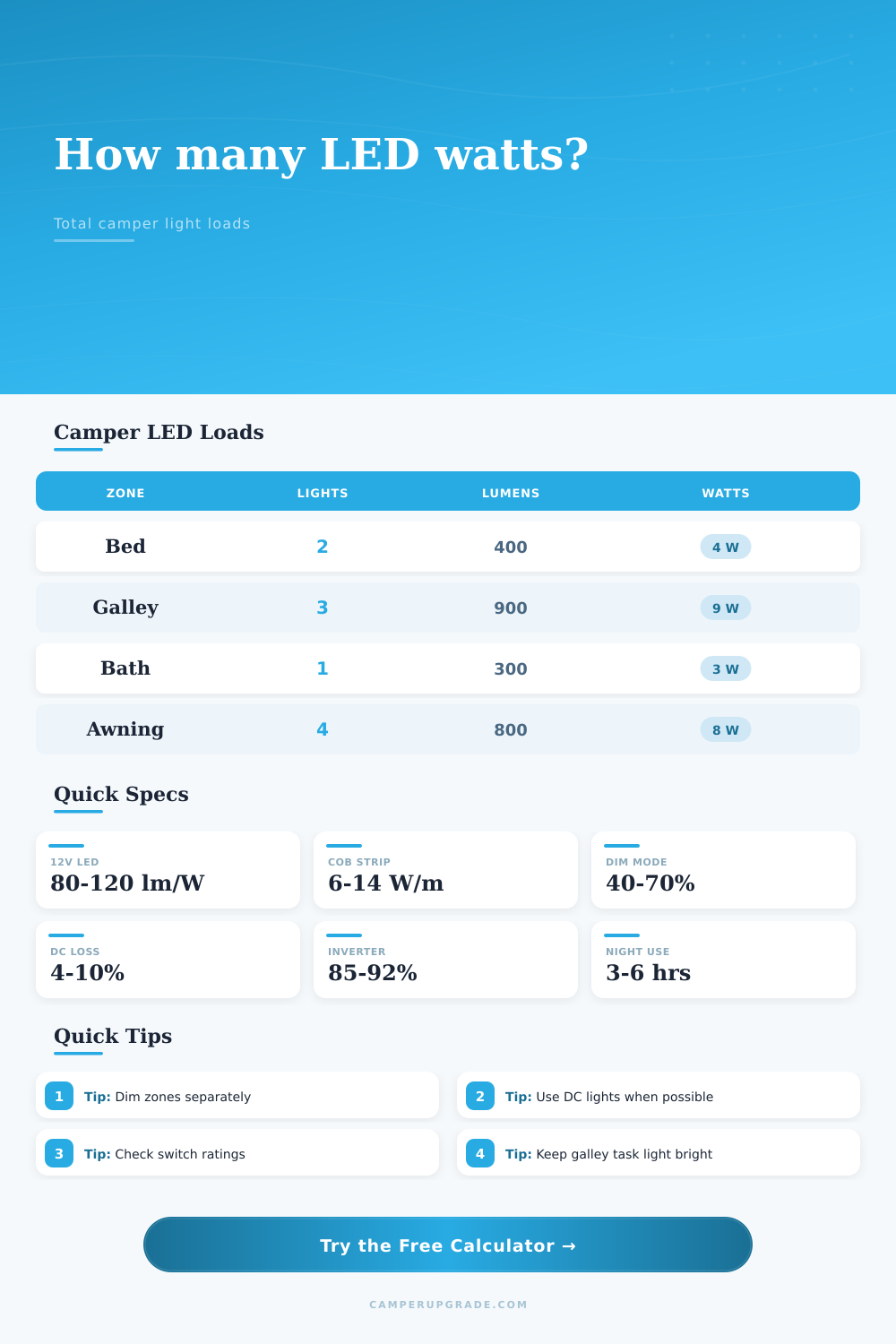
Camper LED Lighting Total Wattage Calculator
Total fixture watts, lumens, dimmed nightly energy, battery amp-hours, and zone-by-zone lighting loads for camper vans, travel trailers, truck campers, and RV interiors.
Main cabin / lounge
Ceiling pucks, dome lights, or panel lightsGalley / counter
Task lighting for cooking and cleanupBed / bunks
Reading lights and sleeping area accentsBath / entry
Short-use lights near door, wet bath, or closetAwning / exterior
Porch lights, step lights, and exterior stripsGarage / utility
Storage bay, rear hatch, workbench, or gear lightsZone wattage breakdown
| LED type | Typical lumens | Watts each | Best camper use |
|---|---|---|---|
| 12 V puck light | 250 to 450 lm | 2.5 to 5 W | General ceiling zones, compact cabins, dinettes, and entry lights. |
| Slim panel light | 400 to 700 lm | 4 to 7 W | Galley counters, lounge panels, and areas that need even task lighting. |
| LED strip section | 150 to 500 lm | 2 to 8 W | Under-cabinet accents, awnings, shelves, toe-kicks, and soft indirect light. |
| Reading spot | 120 to 300 lm | 1.5 to 3.5 W | Bunks, bed corners, swivel seats, and focused low-glare night use. |
| Porch or awning pod | 250 to 650 lm | 3 to 8 W | Exterior entry, step lighting, camp table lighting, and utility access. |
| AC LED bulb | 450 to 800 lm | 5 to 9 W | Converted AC lamps where inverter losses should be included. |
| Power path | Efficiency used | 12 V Ah per 100 Wh | When to use it |
|---|---|---|---|
| Direct DC short wiring | 96% | 8.7 Ah | Most camper puck, strip, and panel lighting on short fused circuits. |
| Direct DC long wiring | 92% | 9.1 Ah | Long awning runs, rear cargo lights, or thin wire with measurable voltage drop. |
| DC constant-current driver | 90% | 9.3 Ah | Higher-output modules, specialty panels, or regulated fixture drivers. |
| AC through inverter | 86% | 9.7 Ah | Household LED bulbs or lamps powered from a camper inverter. |
| Zone | Soft light target | Task light target | Common dimmer range |
|---|---|---|---|
| Main cabin / lounge | 600 to 1,200 lm | 1,200 to 2,000 lm | 40% to 75% for evening use |
| Galley / counter | 400 to 800 lm | 800 to 1,600 lm | 70% to 100% while cooking |
| Bed / bunks | 120 to 300 lm | 250 to 600 lm | 25% to 65% for reading |
| Bath / entry | 200 to 400 lm | 400 to 800 lm | 60% to 100% for short visits |
| Awning / exterior | 250 to 700 lm | 700 to 1,600 lm | 20% to 60% around camp |
| Garage / utility | 300 to 600 lm | 700 to 1,500 lm | 80% to 100% for gear work |
| Layout | Typical fixtures | Installed watts | Nightly use pattern |
|---|---|---|---|
| Minimal van | 4 to 6 small LEDs | 12 to 22 W | Low dimmer settings, short galley use, and one reading zone. |
| Truck camper | 7 to 10 mixed LEDs | 24 to 42 W | Brighter galley and entry lighting with limited exterior time. |
| Family trailer | 12 to 20 LEDs | 45 to 85 W | More zones active at once, especially bunks and bath lights. |
| Boondock dim plan | 8 to 14 LEDs | 28 to 55 W | Same installed load, but average draw drops through dimming. |
| Awning evening | Interior plus exterior strip | 35 to 70 W | Exterior strip hours can dominate the nightly watt-hour total. |
fixture watts = selected LED watts per fixture, or lumens per fixture divided by the LED type efficacy when that value is higher.zone Wh = fixture count x fixture watts x dimmer percent x hours per night, then battery Wh = zone Wh / path efficiency plus wiring allowance.battery Ah = battery Wh / battery voltage; runtime nights = reserved battery Wh / nightly lighting Wh.
Nobody likes it when romance of boondocking goes up in smoke because your battery bank has been drained into darkness. It happens to most everybody. You load the gear and the cooler. You’re all set to go. Then you remember the lights.
Why is it such an issue? LED bulbs aren’t inefficient; they are wonders of engineering. People gets tripped up by thinking that what’s wired in equals what’s actualy drawing energy. Sure, that 10-watt bulb in the ceiling looks innocent enough on a spec sheet. But if you leave it burning all night long while cooking dinner or reading a book, it can be a major hole in your nightly power budget.
How to Save Battery Power with Your Lights
Know the difference between what’s wired in and what’s drawing from battery. First off, think of each zone in isolation; don’t think of the entire camper as a single light switch. In the galley, you need bright task lighting so you can safely cut vegetables without cutting your fingers. The lounge would be more suitable for dimmable ambient lighting which will save energy. Our table on the page shows you what kind of lumen target makes sense for relaxing versus cooking, and it helps guide you toward matching the fixture with the activity.
You don’t want to buy overly bright lights only to have to turn them down later, right? This is where dimmers becomes your best friends. In many cases, running a light at 40% brightness consumes much less power then a lower wattage bulb at full brightness (assuming similar driver efficiency).
After entering your specific set-up on this calculator, it figures out all the math for you (no more guesswork on inverter losses or how much voltage drop there will be). You’ll see what happens to power paths. Running a light straight off a twelve-volt battery is efficient. Running that exact same light via an inverter cost you another 10 percent in conversion losses. That process adds a layer of conversion loss that can eats up another ten percent of your energy. This tool factors in that inefficiency automaticly.
It also factors in wiring allowance. Longer wires going back to the battery cause resistance, which equals lost energy and generates heat. A small thing, yes…but when you’re counting down amp-hours for a three-day trip, every bit help.
And then there’s battery size. That’s the last part of the puzzle. A 100-amp hour battery isn’t good if you don’t know how much of that 100 amps is dedicated to lighting. If the water pump and the fridge shares the same bank, your lighting budget shrinks dramatically! The tool allows you to see the reserve. It will tell you how many nights you’ve got until the lights turn off. It makes you face reality about your own habits.
Do you run the awning strip all night? That one little habit can double your nightly draw! Turn it off at midnight. It is a free efficiency upgrade.
“Watt cost matters more than the number of lumens per light. For example, high efficiency LEDs will deliver more light using fewer watts. But it’s the cumulative wattage that robs the battery. That’s why many people are getting carried away with the total number of lumens and not accounting for the cost in watts. A bunch of cheap pucks look like an economic buy, but those suckers draw a little more (and before long the sum total sucks big time).
Dedicated reading spots and slim panels provides more control. You can shut ’em down independently. Lighting zones allows you to use what you want. Flexibility transforms a huge power drainer into a series of manageable decisions.
Lighting up your camper is all about managing expectations. You need enough light to be comfortabley and feel safe, but not so much that you are looking for a power outlet at dawn. You should of create a system that will last as long as you do. It’s about creating zones so you can control what gets lit when. It’s about making sure you have the right mix of fixtures. And it’s about understanding how much efficiency loss there is in your wiring.
When you separate your zones, choose the right fixtures, and understand the efficiency losses in your wiring, you remove the guess work from the night. You no longer worry about that battery meter; instead, you enjoy the view. You plan for your lights to stay on. Because, well, they should.