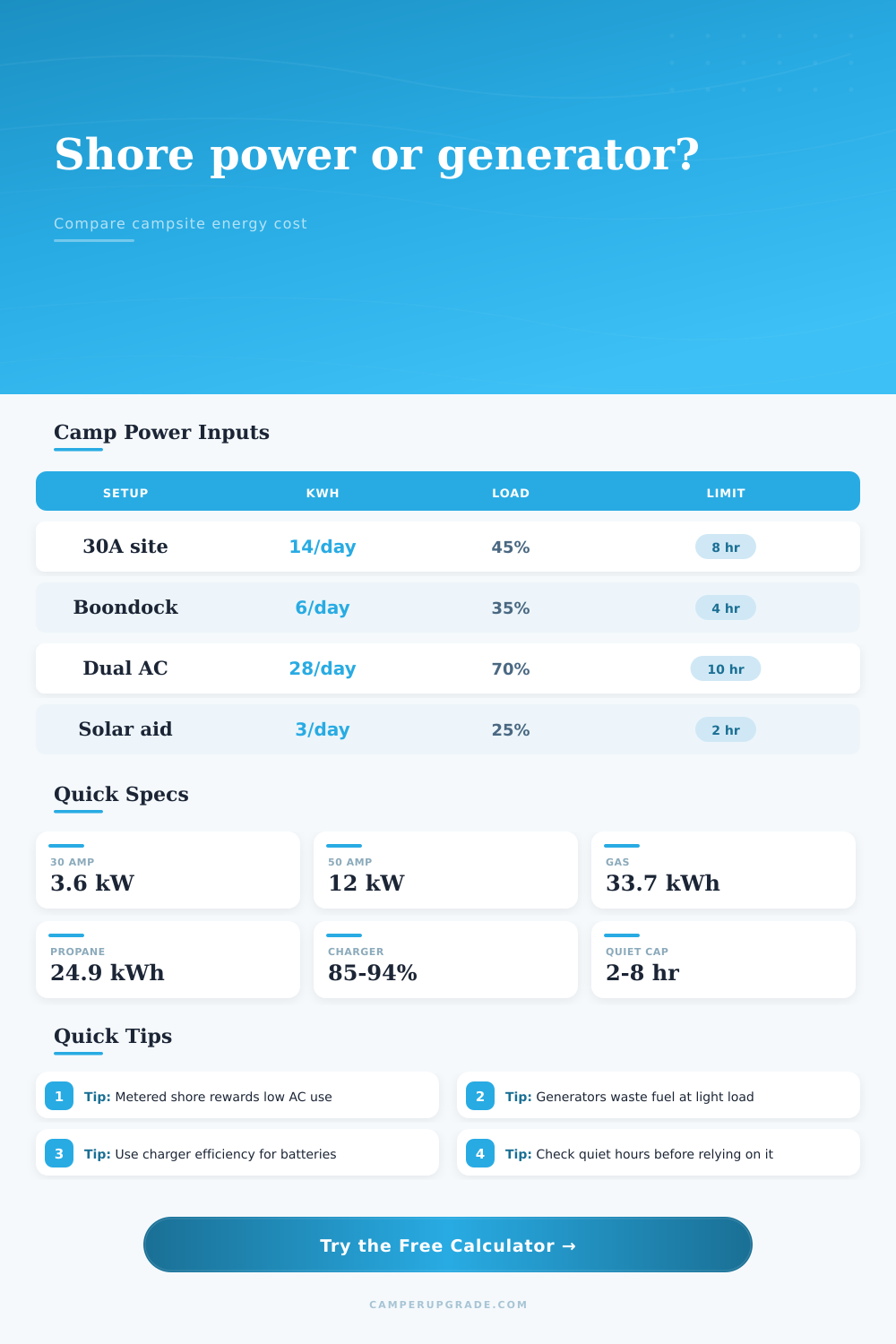
Shore Power vs Generator Cost Calculator
Compare metered campsite electricity with generator fuel use using daily kWh, charger efficiency, load percentage, fuel burn curves, hookup limits, runtime windows, and quiet-hour rules.
Calculation breakdown
| RV appliance or load | Typical watts | Example hours/day | Estimated kWh/day |
|---|---|---|---|
| 13.5k BTU roof air conditioner | 1,200 to 1,700 W running | 4 to 12 hr cycling | 5.0 to 16.0 kWh |
| 15k BTU roof air conditioner | 1,500 to 2,000 W running | 4 to 12 hr cycling | 6.0 to 19.0 kWh |
| Electric water heater element | 1,200 to 1,500 W | 0.5 to 2 hr | 0.6 to 3.0 kWh |
| Converter or battery charger | 300 to 1,800 W | 1 to 6 hr | 0.3 to 10.8 kWh |
| Residential refrigerator | 80 to 180 W average | 24 hr | 1.9 to 4.3 kWh |
| Microwave or induction burst | 900 to 1,800 W | 0.1 to 0.5 hr | 0.1 to 0.9 kWh |
| Starlink, router, and laptop | 90 to 220 W | 4 to 10 hr | 0.4 to 2.2 kWh |
| Furnace blower and controls | 80 to 180 W DC equivalent | 3 to 10 hr cycling | 0.3 to 1.8 kWh battery side |
| Generator type | 25% load | 50% load | 75% to 100% load |
|---|---|---|---|
| 2,200 W inverter gasoline | 0.10 to 0.14 gal/hr | 0.17 to 0.22 gal/hr | 0.28 to 0.45 gal/hr |
| 3,500 W inverter gasoline | 0.16 to 0.22 gal/hr | 0.28 to 0.38 gal/hr | 0.48 to 0.75 gal/hr |
| 4,500 W open-frame gasoline | 0.25 to 0.35 gal/hr | 0.45 to 0.60 gal/hr | 0.70 to 0.95 gal/hr |
| 5,500 W onboard gasoline | 0.35 to 0.50 gal/hr | 0.55 to 0.75 gal/hr | 0.85 to 1.20 gal/hr |
| 4,000 W propane RV generator | 0.30 to 0.45 gal/hr | 0.55 to 0.75 gal/hr | 0.85 to 1.30 gal/hr |
| 8,000 W diesel onboard generator | 0.22 to 0.35 gal/hr | 0.38 to 0.55 gal/hr | 0.65 to 0.95 gal/hr |
| Hookup | Nominal volts | Usable continuous watts | What it usually supports |
|---|---|---|---|
| 15 amp household adapter | 120 V | About 1,440 W at 80% | Battery charger, fridge, laptops, and light loads; avoid AC plus water heater. |
| 20 amp pedestal | 120 V | About 1,920 W at 80% | Small trailer basics and careful single high-draw appliance use. |
| 30 amp RV pedestal | 120 V | About 2,880 W continuous | One roof AC plus converter and modest appliance management. |
| 50 amp RV pedestal | 120/240 V split | About 9,600 W continuous | Two AC units, water heater, charger, and larger coach loads with headroom. |
| Fuel | Approx energy per gallon | Practical electric output | Planning note |
|---|---|---|---|
| Gasoline | About 33.7 kWh/gal | 5 to 9 kWh/gal at small-generator efficiency | Common for portable inverter generators; stale fuel and carburetor storage matter. |
| Propane | About 24.9 kWh/gal | 4 to 7 kWh/gal equivalent | Cleaner storage and onboard convenience, but usually more gallons per kWh. |
| Diesel | About 38.6 kWh/gal | 7 to 12 kWh/gal in larger onboard sets | Often efficient under heavier continuous coach loads. |
| Shore power | Metered directly in kWh | Nearly all delivered after pedestal and charger losses | Usually quiet and predictable, but billing rules and electric fees vary by site. |
total AC kWh = nights x (daily appliance kWh + battery recharge kWh / charger efficiency)shore total = total AC kWh x metered shore rate + hookup or meter feegenerator load percent = average running watts / rated watts x 100; fuel burn is linearly interpolated across idle, 25%, 50%, 75%, and 100% curve pointsgenerator total = total AC kWh / average running kW x interpolated gal/hr x fuel price
It’s July. You drive up to an RV park that uses meters and the manager give you a plastic tag. For the first 100 kilowatts, it’s three cents a kilowatt hour. After that, it spikes. The AC kicks on as you do some calculations in your head: Will you save money by dragging generator to the back bumper? That’s the age-old camping problem. On one hand, you’re there for the experience; on the other, you don’t want to get sticker shock at checkout time.
Thankfully, we’ve got a calculator to do the math for you. But to understand what all those numbers mean and why they can change so much, you has to look deeper than just the sticker price.
How to Calculate Your RV Power Costs
People vastly over-estimate their electrical usage. It’s easy to say “Well, I’ve got this fridge and these lights,” which are inexpensive, but what about battery charger? That’s the quiet budget buster. Charging lead-acid or lithium banks draws a lot of current from AC power, and the process is inefficiently. Much of energy turns into heat in the converter, which is lost to you. Plug in the number of amp hours you need each day to charge your batteries and input a reasonable figure for charger efficiency (let’s assume it’s eighty-eight percent). The tool will then calculate your load based off those numbers. So your shore power cost includes more than the electrons you’re storing; it also includes wasted ones. And if you burn fuel by running a generator, the physics don’t change: you still burn energy inefficiently.
Another pitfall is generator efficiency. Inverters with small engine love to be run harder. Running at low wattage, such as nine hundred out of a twenty-two-hundred-watt machine, means the engine is idling inefficiently. This table on page makes that clear. Engine burn isn’t linear. A surprising amount of fuel can be burned while running at say twenty five percent load, but that still adds up across a three day trip. You aren’t paying for power output, you are paying for the time it runs.
So if the park limits generators to four hours a day but your calculations shows six, the tool flags a runtime shortfall. No amount of cash buys an extension into quiet hours. At most campground you still can’t run the noisy engine past ten PM.
Just as important are the shore power caps. That means if you’re plugged into a thirty-amp pedestal, you’re limited to about three thousand watts all day long. You plug in the microwave. You flip on the air conditioner. And then you get to flip off the circuit breaker. The calculator compares your expected load with amount of power you can get on hook-up. With a fifty-amp service, you’ve got headroom to heat water and run both AC unit. It’s a different dynamic entirely. Sure, you may be paying more in metered fees but you’ll also save on fuel logistics and maintenance headaches associated with running the generator. Shore power has its own comfortably value, one that is difficult to put a price tag on in dollars.
Practical constraints like noise aren’t something money can fix. Open-frame generators is noisy. While inverter models run quieter, they’re also audible in an otherwise quiet campground. The peace and quiet have a price tag that you may not notice at first. You’ll get to pay $10 less for gas but lose out on eight hours of quiet time each night. It’s a tough choice between sleeping soundly and paying a few extra bucks at checkout.
But first check your appliances: Do you have a lot of LEDs? Are you cooking in? That lowers your base load. Add an electric kettle or a hair dryer and boom: spikes comes back. With this tool, you can model those differences. Enter the number of days you’ll be there, your estimated daily kWh usage, and what fuel costs where you’re traveling. See which column wins out.
In most cases, it’s not the cheapest thing, but rather whatever works for your lifestyle and won’t break the bank. Saving money isn’t realy the point. The point is that we don’t have to worry about doing math in our heads while we’re out there. We’ll know how much power we use. That way, when we pull up to a campground, we won’t sweat trying to figure out if we should of fill up or plug in. By the time it’s hot, we’ll know what we’re dealing with. Knowing that is invaluable.