Alternator Charge Rate Calculator
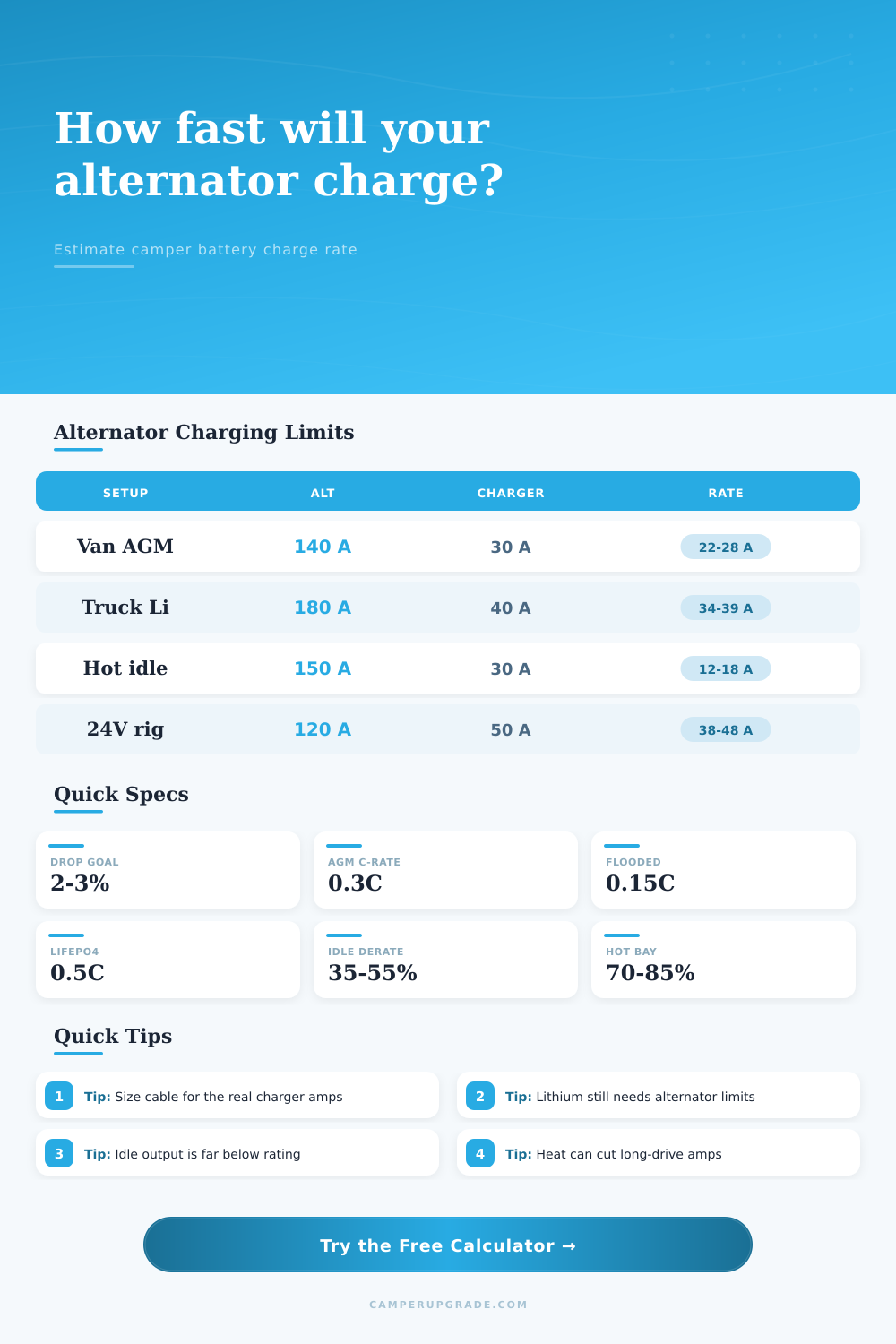
Estimate camper battery charging amps from alternator rating, DC charger limit, engine speed, cable voltage drop, battery chemistry acceptance, SOC target, usable amp-hours, and heat derating.
Full charge-rate breakdown
| Chemistry | Typical acceptance | Taper starts near | Calculator use |
|---|---|---|---|
| Flooded lead-acid | 0.10C to 0.20C | About 80% SOC | Uses 0.15C and strong high-SOC taper for slower absorption charging. |
| AGM lead-acid | 0.20C to 0.35C | About 85% SOC | Uses 0.30C with moderate taper near the target SOC. |
| Gel lead-acid | 0.15C to 0.25C | About 80% SOC | Uses 0.20C and conservative acceptance to protect gel batteries. |
| LiFePO4 with BMS | 0.30C to 0.70C | About 95% SOC | Uses 0.50C and light taper because lithium holds current longer. |
| Cold-limited LiFePO4 | 0.10C to 0.25C | About 90% SOC | Uses 0.20C for cold-weather or BMS-restricted charging. |
| Condition | Derate factor | Where it applies | Why it matters |
|---|---|---|---|
| Parked idle or crawling | 0.45 | Alternator output | Low shaft speed and little airflow can cut available charging current sharply. |
| Low-speed town driving | 0.65 | Alternator output | Output rises above idle but is still well below rated alternator current. |
| Mixed road driving | 0.82 | Alternator output | Good average for normal camper travel with starts, stops, and cruising. |
| Steady highway driving | 0.95 | Alternator output | Higher RPM and airflow usually support near-maximum safe spare current. |
| Hot climb or desert bay | 0.72 | Alternator and charger | Thermal protection can reduce sustained output even when the charger is rated higher. |
| Copper cable | Ohms per 1000 ft | 40A drop over 20 ft one-way | Best camper use |
|---|---|---|---|
| 10 AWG | 0.999 | 1.60 V | Short low-current 20A charger runs only. |
| 8 AWG | 0.628 | 1.00 V | Compact 20A to 30A chargers with short routing. |
| 6 AWG | 0.395 | 0.63 V | Common 30A to 40A camper DC-DC chargers. |
| 4 AWG | 0.249 | 0.40 V | Longer 40A to 60A runs where voltage drop matters. |
| 2 AWG | 0.156 | 0.25 V | High-output chargers or rear-mounted house banks. |
| 1/0 AWG | 0.0983 | 0.16 V | Large lithium banks and long high-current alternator paths. |
| Camper setup | Typical charger | Likely real net rate | Main limiting factor |
|---|---|---|---|
| Compact camper with AGM house battery | 20A to 30A DC charger | 14A to 27A into battery | Battery acceptance and lead-acid taper. |
| Van conversion with 200Ah LiFePO4 | 30A to 50A DC charger | 28A to 46A into battery | DC charger rating or alternator spare output. |
| Truck camper with rear battery bank | 40A to 60A DC charger | 32A to 55A into battery | Cable drop if the run is long or undersized. |
| Older van with flooded batteries | 20A to 40A DC charger | 10A to 28A into battery | Alternator heat and flooded battery taper. |
| Expedition rig with 24V lithium bank | 40A to 80A DC charger | 36A to 72A into battery | Charger rating, cable design, and thermal limits. |
alternator cap = alternator rated amps x safe share x RPM derate x heat derate.final charger output = minimum of alternator cap, heat-derated DC charger limit, battery acceptance limit, and cable voltage-drop current ceiling.net battery rate = final charger output x efficiency; time to target = usable Ah needed / net battery rate, adjusted for chemistry taper above the taper SOC.
You bought fancy lithium batteries because they like charging fast, only to discover your camper’s alternator is still slow-charging. If you’re a van lifier, this might sound familiar. An upgrade in battery storage doesn’t address what feeds it: the electrical system. And alternators is frequently the weak point of an otherwise solid electrical setup.
Alternators are mechanically governed and limited by heat. To know true charge rate, ignore the alternator’s label; instead, look at physics of engine bay. When most folks hear “it has a 150-amp alternator”, they think it put out 150 amps to the house bank. It won’t. At best, it may put out thirty amps. The remaining current go to the starter battery, the vehicle’s computer, the cooling fan and the headlights. All of those soak up current without your knowlege.
Why Your Batteries Charge Slowly
The calculator takes all that into account (along with battery chemistry and voltage drop) and does math for you. You’ll understand what each input mean, so you can trust the answer.
Choosing an RPM derate based off idle or highway speeds accounts for the fact that alternators are shaft driven generators. At idle speed, the belt turn slowly, creating less magnetic field and thus lower output; it’s just basic mechanics, not a flaw.
Efficiency usually goes out the window with cable run. Maybe you’ve got a fancy 40-amp DC-DC charger but that’s bottlenecked in a ten-gauge wire over a fifteen foot run. This turns electrons into heat before they reach the battery and voltage drop is energy actualy lost to resistance. Based on length and copper gauge, the tool will estimate how much of this are happening, and whether or not your wiring is limiting efficiency.
More than three percent? The charger throttles back output to avoid damage as it believes the input voltage is sagging. A little detail for sure but it kills efficiency.
“Alternators are far more sensitive to heat then amps, and higher temperatures reduces charging rates. They will throttle way down in a hot engine bay without a lot of air flow before they reach their rated output. Slow climbing and hot temperatures mean that lithium batteries will pull lots of current from the alternator, stressing it out.”
The calculator takes into account thermal derating, which prevents you from planning a charging session that would overheat your vehicle’s electrical system. Better to be conservative than blow out a diode.
The filling speed of your battery are also determined by the type of battery chemistry you have. Lithium accepts current pretty much to the last, while lead-acid slows down its acceptance rate as it fills. It accounts for that in the tool and it will tell you that even if you had thick cables and a perfect alternator, your flooded lead-acid bank may only accept ten amps when full. That’s simply the nature of the chemistry and there is no forcing electrons into a saturated sponge.
This shifts the emphasis off what you want it to be to what actualy happens. You will see if your alternator size are correct or too small. You’ll notice if your cabling isn’t right for your needs. You’ll realize that your expectations of how long it takes to charge batteries may be out of whack.
If you’re running a three-hundred-amp alternator, you don’t really need one in most van builds. You need good wires. And you should of understand that charging batteries is a thermal, slow process.
That means you stop guessing when you make your travel plans with real-world charging rates instead of those numbers on the back of the box. The numbers never lie (but they are hiding in plain sight). All you have to do is learn where to find them.