RV Parasitic Drain Calculator
Estimate how quickly always-on RV loads can drain a parked battery bank, including detector current, control boards, inverter idle draw, trackers, USB ports, temperature derating, and solar maintainer offset.
Calculation Breakdown
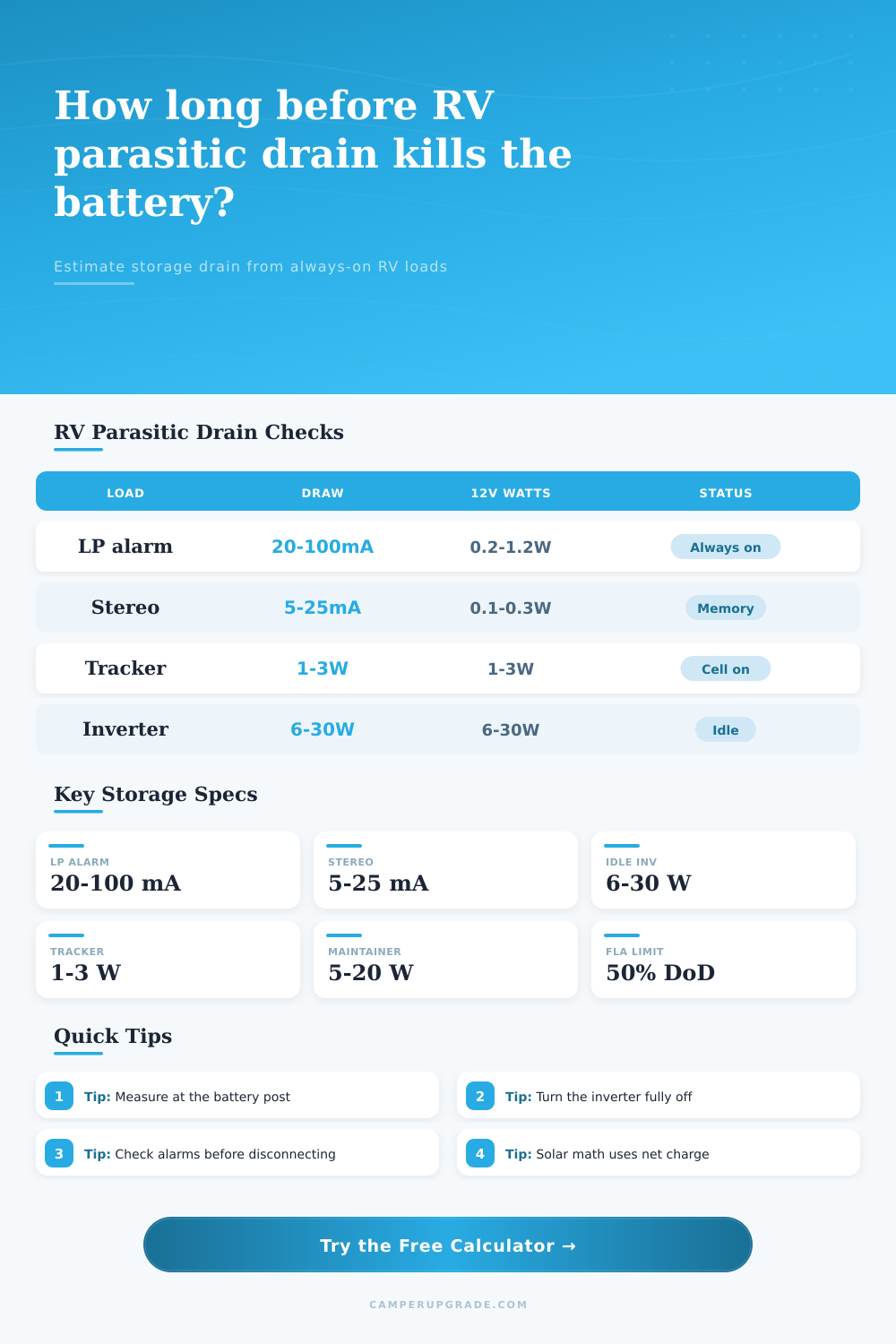
| Always-on RV load | Typical current or power | 12 V equivalent | Storage calculation note |
|---|---|---|---|
| LP gas detector | 20 to 100 mA | 0.24 to 1.20 W | Often wired ahead of convenience switches so the safety circuit stays alive. |
| CO or smoke detector with hardwire feed | 40 to 70 mA | 0.48 to 0.84 W | Use the label or measured current because combination alarms vary. |
| Radio memory, clock, dash module | 5 to 25 mA | 0.06 to 0.30 W | Small by itself, but meaningful during multi-week storage. |
| Propane fridge or water heater board | 50 to 150 mA | 0.60 to 1.80 W | Control boards can stay awake even when burners are not firing. |
| Battery monitor, shunt display, tank monitor | 0.5 to 2 W | 42 to 167 mA | Watt ratings convert to current with amps = watts ÷ volts. |
| Cellular tracker, security modem, hotspot | 1 to 3 W | 83 to 250 mA | Network devices can pulse higher while connecting, so measured averages help. |
| Inverter idle standby | 6 to 30 W | 0.5 to 2.5 A | This is usually the largest avoidable storage drain if the inverter is not fully off. |
| Battery type | Conservative storage cutoff | Typical self-discharge | Calculator input guidance |
|---|---|---|---|
| Flooded lead-acid deep cycle | Keep above about 50% SOC | About 4% to 8% per month | Use 50% reserve, and reduce condition input for cold or aged batteries. |
| AGM lead-acid | Keep above about 50% SOC | About 1% to 3% per month | Use 50% reserve unless you have a different manufacturer storage limit. |
| Gel lead-acid | Keep above about 50% SOC | About 1% to 3% per month | Plan gently; gel batteries dislike deep discharge and aggressive recharge. |
| LiFePO4 lithium | Keep above about 10% SOC | Often under 3% per month | Use a reserve that protects the BMS cutoff and allows cold-weather uncertainty. |
| Maintainer setup | Sun hours used | Net charge at 12 V | Best-fit storage use |
|---|---|---|---|
| 5 W dash maintainer at 70% net efficiency | 2 hours/day | 0.58 Ah/day | Offsets alarms and memory loads, not inverter idle draw. |
| 10 W portable maintainer at 75% net efficiency | 2.5 hours/day | 1.56 Ah/day | Useful for normal detector and control-board standby loads. |
| 20 W roof maintainer at 75% net efficiency | 3 hours/day | 3.75 Ah/day | Can cover several small loads if the panel is not shaded. |
| 50 W storage panel at 80% net efficiency | 3 hours/day | 10.00 Ah/day | Enough for higher standby electronics, but still verify charge controller settings. |
| Storage profile | Connected draw | Daily drain at 12 V | Days to use 50 Ah |
|---|---|---|---|
| Detector plus radio memory only | 90 mA | 2.16 Ah/day | 23.1 days |
| Detector, appliance boards, battery monitor | 300 mA | 7.20 Ah/day | 6.9 days |
| Tracker plus security module | 250 mA | 6.00 Ah/day | 8.3 days |
| Inverter left on at 15 W idle | 1.25 A | 30.00 Ah/day | 1.7 days |
| Battery post cutoff with direct-wire alarm | 40 mA | 0.96 Ah/day | 52.1 days |
After a month or so, you return to your battery and it’s dead. What happened? Parasitic drain typicaly occurs when small circuits remains on continuously and slowly sap battery life. This calculator will show you the extent of parasitic drain in amps, and how quickly the battery will die if left in storage.
Small power users is overlooked by people. Most people overestimate the impact of big loads and underestimate cumulative effect of small ones. Twenty milliamps are not much power. That’s what the stereo head unit pulls. But that happen all day every hour for thirty days. You also have to add the carbon monoxide alarm, the smoke detector, the propane fridge control board, and your cellular tracker on top of that. Those little things will kill your battery within weeks.
How to Stop Your Battery from Dying
The tool translates those numbers into a real image of your charging situation. And it incorporates solar offset. If you have a small rooftop panel working right, it can offsets minor power usage.
Inverters are a threat. Owners often fail to turn off their inverter. If they’re not using their air conditioner, they don’t believe anything is drawing power. Wrong. Your inverter will constanty draw between six and thirty watts even when idle. That’s a lot of power. In as little as a week your big battery bank could be drained. Enter this wattage into the calculator. It will tell you how long you has remaining.
Storage life is affected by battery chemistry. Sulfation occurs when you leave lead-acid batteries discharged. Keep them over half-charge. It will help them last through the winter. Lithium iron phosphate batteries can tolerates lower charges more effectively. But their management system shuts down at too low a voltage. The calculator accounts for battery type/condition. If your lead-acid batteries is old, the available amp-hours drop significantly.
Available energy decreases in cold environments. Lower chemical activity in the cold means you don’t have as much to give, nor do you have as much ability to take a charge.
People overestimate solar maintainers. I’m talking about a 5 watt panel. That hardly puts out 5 watts. Angle of the panel reduces it. So does cloud cover. There are always wiring losses. There is also efficiency lost to the controller. You might only get half of a five-watt panel‘s actual output. Use reasonable sun hours on the calculator. That way you won’t be falsely confident that the panel can do much. It will display the net loss. That’s what you need to plan for.
Keep in mind, there are two types of circuits, safety and convenience. Safety circuits can’t be easily turned off. In this case, turning off the LP gas detector would be a hazard. Accept that circuit as power drain. Convenience circuits CAN be turned off or pulled. Radio memory is one. Remove cellular tracker, if you don’t need that. Inverters can also be completely turned off. The goal is to have as few circuits drawing power while the RV is parked.
Compare your scenarios using the presets. A motorhome with a radio and steps. Now consider a travel trailer with only alarms. What’s the difference in daily drain? Knowing those numbers lets you know what switches to flip. Which fuses to pull. It turns that guess into a plan.
So the lights come on when you turn the key. So the batteries stays charged for the spring. You should of planned based off these numbers.