Van Conversion Weight Budget Calculator
Estimate your van conversion payload, installed build weight, passengers, liquids, loose cargo, GVWR margin, and a practical front/rear axle split before the rig is fully loaded.
🚐Van Weight Presets
⚖Vehicle Ratings And Empty Weight
Use scale weights when available. Door sticker ratings are maximums; the calculator compares loaded weight against GVWR and compares estimated axle loads against each GAWR.
🧱Installed Conversion Weight
🎒People, Liquids, And Travel Load
Formula summary: payload capacity = GVWR minus empty weight. Loaded weight = empty weight + conversion subtotal with buffer + occupants + liquids + gear + hitch load. Axle estimates distribute each added load by its front/rear share.
Van Weight Budget Results
🔧Conversion System Weight Grid
📊Component Weight Reference
| Conversion Item | Light Estimate | Typical Estimate | Heavy Estimate |
|---|---|---|---|
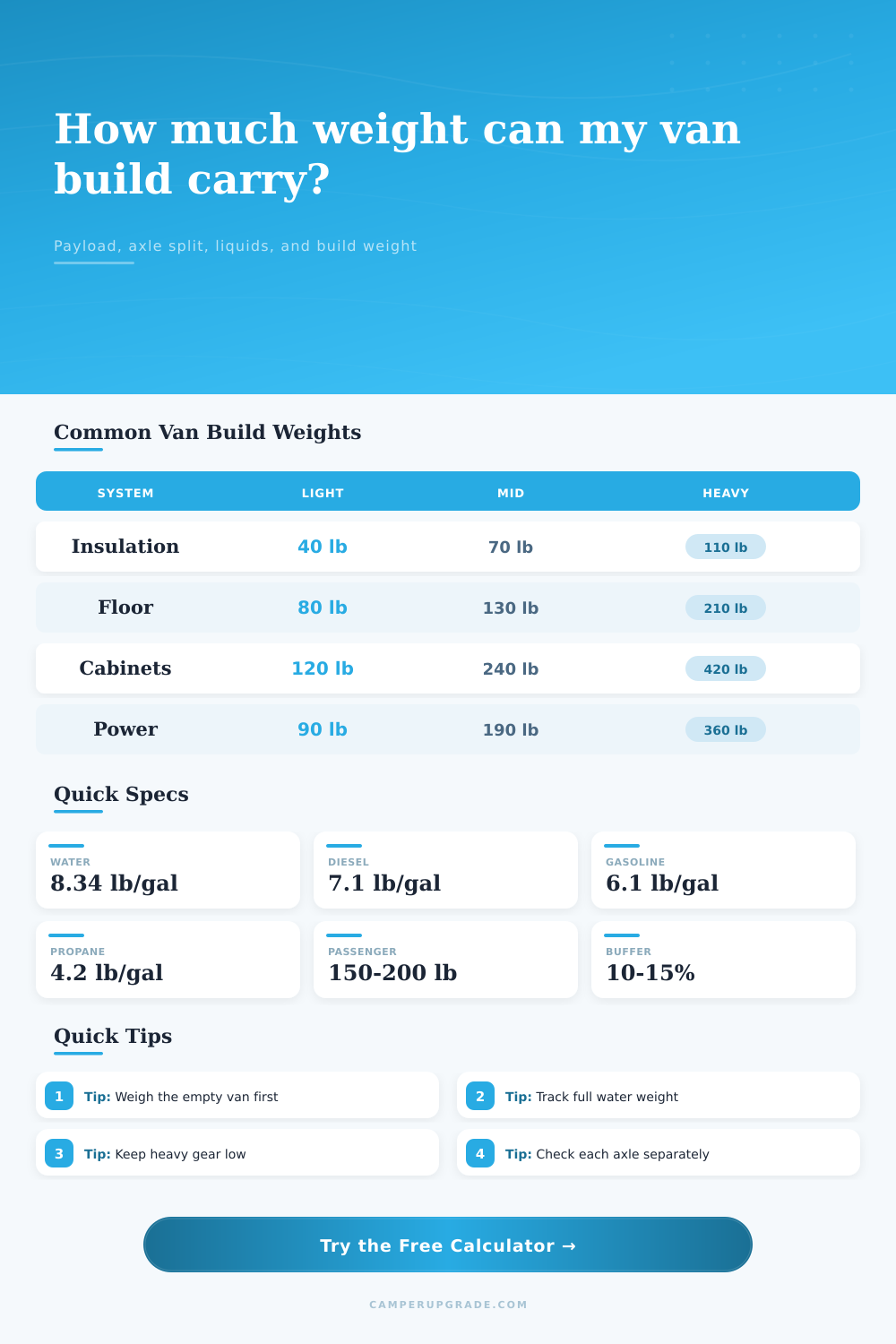
| Insulation and sound control | 40 to 60 lb | 60 to 90 lb | 90 to 130 lb |
| Plywood subfloor and finish floor | 80 to 110 lb | 120 to 160 lb | 180 to 240 lb |
| Wall and ceiling finish panels | 90 to 130 lb | 130 to 190 lb | 200 to 280 lb |
| Cabinets and drawer systems | 120 to 200 lb | 220 to 320 lb | 340 to 500 lb |
| Bed platform and seating base | 80 to 130 lb | 140 to 220 lb | 230 to 330 lb |
| Electrical gear without batteries | 50 to 90 lb | 90 to 150 lb | 160 to 240 lb |
| Lithium battery bank | 30 to 90 lb | 90 to 180 lb | 180 to 320 lb |
| Solar panels and roof rack | 50 to 90 lb | 100 to 160 lb | 170 to 260 lb |
💧Liquid And Travel Load Reference
| Load Type | Weight Factor | Metric Factor | Calculator Use |
|---|---|---|---|
| Water | 8.34 lb per gallon | 1.00 kg per liter | Fresh and gray water carried on travel days |
| Gasoline | About 6.1 lb per gallon | About 0.73 kg per liter | Extra cans, generators, or small fuel bottles |
| Diesel | About 7.1 lb per gallon | About 0.85 kg per liter | Diesel cans, heaters, and carried fuel |
| Propane | Enter net cylinder weight | Enter net cylinder kg | Use the filled fuel weight, not cylinder tare only |
| Passenger allowance | 150 to 200 lb each | 68 to 91 kg each | Use real passenger weights when planning close to GVWR |
🚚Payload Class Reference
| Van Category | Typical GVWR Band | Common Payload Band | Weight Planning Note |
|---|---|---|---|
| Minivan camper | 5,500 to 6,200 lb | 1,000 to 1,600 lb | Great for light no-build layouts and compact gear loads |
| Midsize cargo van | 7,000 to 8,600 lb | 1,500 to 3,000 lb | Watch water, roof loads, and rear storage weight |
| Full-size cargo van | 8,500 to 9,950 lb | 2,500 to 4,000 lb | Works for many two-person builds with measured systems |
| Extended high-roof van | 9,000 to 11,030 lb | 3,000 to 5,000 lb | Extra length invites extra storage; axle balance matters |
| Heavy-duty dually van | 10,000 to 12,300 lb | 4,000 to 6,000 lb | Higher payload still needs front and rear axle checks |
📍Axle Placement Reference
| Load Location | Rear Axle Share | Front Axle Share | Example Van Items |
|---|---|---|---|
| Cab area | 20% to 35% | 65% to 80% | Driver, passenger, front console storage |
| Near sliding door | 45% to 60% | 40% to 55% | Galley, fridge, water pump, day gear |
| Centered over wheelbase | 50% to 60% | 40% to 50% | Floor, walls, roof panels, long cabinets |
| Rear garage | 70% to 90% | 10% to 30% | Bikes, tools, batteries, water tanks, storage bins |
| Hitch carrier | 100% plus leverage | Can unload front | Swing-away boxes, rear racks, motorcycle carriers |
📐Build Style Comparison
| Build Style | Installed Build Band | Travel Load Band | Best Weight Check |
|---|---|---|---|
| No-build weekend setup | 150 to 450 lb | 300 to 800 lb | Loose cargo and passenger payload |
| Light modular conversion | 500 to 1,000 lb | 500 to 1,000 lb | Water and removable boxes |
| Balanced full-time build | 1,200 to 2,200 lb | 700 to 1,400 lb | GVWR and rear GAWR together |
| Adventure garage layout | 1,500 to 2,600 lb | 900 to 1,800 lb | Rear axle and hitch load first |
| Winter electric build | 1,800 to 3,000 lb | 700 to 1,500 lb | Batteries, heating, and water tanks |
💡Weight Budget Tips
Van life dreams include sunsets, off-the-grid camping spots and being able to work from anywhere. Reality includes 300-plus-pounds-over-the-limit scales, a backside that droops like a worn-out spring and throwing anything you can find onto the roof rack in a mad rush.
You’ve probably seen some beautifull vans online. What you don’t see as much are the spreadsheets that makes them safe and legal to drive. After plugging in your build plan and your chassis specs, the van conversion weight budget calculator does the rest: it spits out numbers that you can live with, converting abstract into concrete.
How to Use the Van Weight Calculator
You start from zero. First things first, you start with an empty van. How can you build a house without knowing how much your land weighs? So many builders just look at the door sticker for their Gross Vehicle Weight Rating. It’s a max, not a starting point. Your starting point comes from weighing the van with the fuel you would normally carry and person who usually drives it. It is even better to get these measured axle weights by using a CAT scale. This is where the calculator want them so that we can calculate your payload exactly. Most people guess they have more space than they really do because the sticker seems high. And even though a full size cargo van may have a very large total rating, the rear axle are often much more limited.
After that, there’s no way around it (you gotta spend it). The actual weight of converting is more then you’d expect. Cabinets, insulation and plywood flooring add up faster than you think. With the tool, each item gets broken down by category, showing you exactly what’s going on with those pounds. For example, even if you’re building something basic, that means anywhere from a thousand- to two-thousand pound build might just be weight of the installed systems alone. No wiggle-room there.
The calculator uses a buffer percentage when you list things out. This includes glue, the tape, fasteners and all the other tools and stuff you figure you want in there. Nothing huge, but it makes sense.
The quiet gainers are liquids. A gallon of water weighs eight and a third pounds. Fresh water in a 30 gallon tank is more than two hundred fifty pounds. That’s like having big adult in the back seat with you. You can break out your water, gas, and propane separately on the calculator. Why? Because you’re never traveling totally full, but you’re also not always traveling completely empty. With a realistic estimate of how much liquid you plan to carry, you won’t be overweight and stranded the moment you pull into that first filling station.
The calculator will also divide those weights between the front and rear axles. Batteries and water tanks is heavy, especially together. They can puts too much weight on the rear axle even though the overall weight might be okay. Physics meets comfort at the point of axle split. A well-balanced van goes down the road more comfortabley and wears its tires equally. Where you put your gear influence what percentage of the load go onto each wheel. Weight up high (say putting your solar panels and air conditioning on the roof) spreads out over the whole vehicle. Weight down low (like putting a big water tank in the back garage) comes close to landing only on the back axle. The calculator calculates those loads for both the front and rear axles, then lets you see how the tradeoff plays out. Maybe you notice shifting your water tank forward just one foot improve your rear axle margin from negative to positive.
Then there’s that other stuff: the people and the stuff. There’s your weight. And there is the weight of your friends who came along. There’s the weight of your laptop. There is also that extra bag of clothes. There is the weight of your food. There is weight of your bike. There’s even a section on loose gear and passenger in the calculator.
At the end of the day, you want a number that represents an actual adventure and not some random showcase in a dealership window. You’re trying to keep everything under your GVWR. Stay under each axle limit. And when you finish, you should of be leaving yourself with a healthy cushion. This cushion will give you a safety net. One that gives you leeway to buy groceries without pulling out a calculator.
Begin with the scale. Build with purpose. Leave room for the unexpected. The road can be long enough as it is; no need to fight against yourself.