Camper Garage Bay Volume Calculator
Estimate gross, obstruction-cleared, and practical packable storage space for camper garages, pass-through compartments, under-bed bays, truck camper lockers, and trailer nose boxes.
🛒Camper Storage Bay Presets
⚙Bay Size And Access Inputs
Formula summary: bay length x width x height gives gross shell volume; shape loss, wheel wells, and utility boxes are subtracted; clearance and packing efficiency estimate usable gear volume.
Garage Bay Volume Results
📦Storage Style Efficiency Grid
📏Common Camper Garage Bay Sizes
| Camper Bay Type | Typical Inside Size | Gross Volume | Typical Gear Fit |
|---|---|---|---|
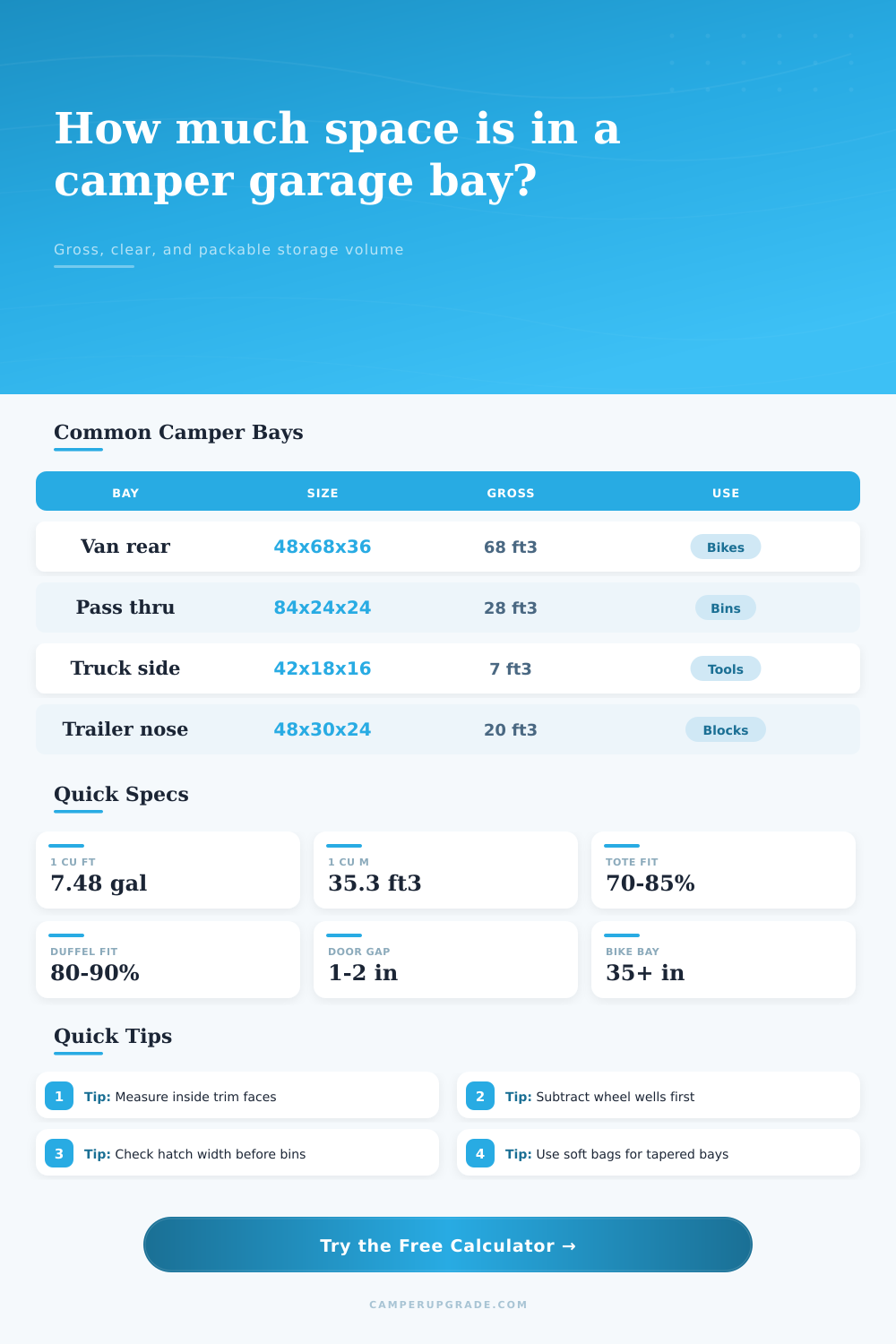
| Class B raised bed rear garage | 68 x 48 x 36 in | 68.0 cu ft | Two bikes, camp chairs, soft bags |
| Wide van raised platform bay | 72 x 56 x 34 in | 79.3 cu ft | Bikes, totes, outdoor table, tools |
| Fifth wheel pass-through bay | 84 x 24 x 24 in | 28.0 cu ft | Long bins, hoses, folding chairs |
| Travel trailer front compartment | 48 x 30 x 24 in | 20.0 cu ft | Leveling blocks, cords, small bins |
| Truck camper side locker | 42 x 18 x 16 in | 7.0 cu ft | Tools, recovery kit, compact gear |
| Teardrop rear galley storage | 44 x 20 x 18 in | 9.2 cu ft | Cook kit, soft pantry bags, small crates |
🚪Hatch Opening And Box Fit Reference
| Smallest Hatch Opening | Safe Box Face | Useful Length Limit | Best Storage Style |
|---|---|---|---|
| 18 x 14 in | 16 x 12 in | 18 to 24 in bins | Tool cases, hoses, leveling blocks |
| 24 x 18 in | 22 x 16 in | 24 to 30 in totes | Medium totes and folding camp gear |
| 36 x 24 in | 34 x 22 in | 30 to 36 in bins | Large totes, chairs, camp kitchen bins |
| 42 x 31 in | 40 x 29 in | 36 to 48 in gear | Bike wheels, large duffels, stacked crates |
| 50 x 34 in | 48 x 32 in | 48 to 60 in gear | Bike frames, long tables, bulky bags |
⚠Common Obstruction Volume Reference
| Obstruction | Typical Dimensions | Approx Volume | Measurement Note |
|---|---|---|---|
| Small wheel well hump | 8 x 22 x 12 in | 1.2 cu ft | Measure the rectangular envelope around the hump |
| Large wheel well hump | 11 x 30 x 16 in | 3.1 cu ft | Use two if both sides enter the bay |
| Plumbing or wiring chase | 6 x 30 x 8 in | 0.8 cu ft | Include the service gap around the cover |
| Battery or utility box | 14 x 12 x 10 in | 1.0 cu ft | Count it if it cannot be removed for loading |
| Water tank corner block | 20 x 16 x 12 in | 2.2 cu ft | Use direct tank volume only for empty tank space |
📊Gear Volume And Conversion Table
| Gear Or Container | Typical Size | Volume | Bay Planning Use |
|---|---|---|---|
| Medium storage tote | 24 x 16 x 12 in | 2.7 cu ft | Good base unit for pass-through compartments |
| Large storage tote | 30 x 20 x 15 in | 5.2 cu ft | Check hatch width before assuming it fits |
| Soft expedition duffel | 36 x 16 x 14 in | 4.7 cu ft | Fits tapered spaces better than hard bins |
| Folding camp chair bundle | 38 x 8 x 8 in | 1.4 cu ft | Often uses long narrow space above totes |
| Bike wheel envelope | 30 x 30 x 4 in | 2.1 cu ft | Bulky shape creates low packing efficiency |
| One cubic meter | 100 x 100 x 100 cm | 35.31 cu ft | Metric comparison for large garage bays |
💡Bay Volume Calculation Tips
Parking stuff in there will tell you what you’re dealing with. A lot of times that back of a camper look like a garage, but it won’t be. Plumbing lines take up some of the space. Wheel wells sticks out into the space. Also, when it rains, the hatch seal expands and closes off even more room. Even if you imagine an open space, it isn’t.
What we have is a function of length x width x height. And that formula has a bunch of constants and conversions based off the size of the shell, how much structure you want in the shell, how much space you want for storage, etc. That’s the kind of math this does for you after you put in the measurements of your bays. You don’t have to do any conversions or guess at coefficients.
How to Measure Your Storage Space
First measure the interior faces of trim. That’s where your bin will live and sheet metal on the outside doesn’t matter. Go ahead and type in the interior measurements: length x width x height.
Next look at the hatch; that’s the bottleneck for storage. You may have an eighty cubic foot gross volume bay but it won’t hold a sixty gallon tote if its only twenty-four inches wide! The calculator compare the width of the hatch to size of the usable box. Even if the bay is deep, the effective storage capacity will be reduced by narrow doors.
Then, eliminate immovable obstacles, These tend to be the most space-hogging obstacle in your van conversion. They are irregular, often deep, and usually unyielding. Measure the height, length, and depth of those wheel wells. If you have two identical arches, it will account for both. Permanent wall or floor objects like utility boxes (water heater tank, battery bank, etc.) eats up valuable space too. How many folding camp chairs can you fit into a space the size of a battery bank? Account for that fixed space with its volume.
What’s left over is honest amount of space available once all of the structure needs are thought about. Efficiency also depends on what you’re storing it in. A soft duffel fits snugly into the bay’s contours, but a hard sided tote contains air pockets at corners and around curves. Our calculator assign different efficiency ratings according to your storage method. If you’re going to transport bikes, that reduces your efficiency even more due to those odd shaped gaps created by wheels and handlebars. Use is greater with soft bag/textile materials. That’s why knowing this makes sense when considering flexible sacks vs. Rigid crates. In tight quarters, soft wins the math.
Account for door swing/access: Leave some wiggle room (extra space) so you can reach into the bin and open the door without bumping things into each other or yourself. This should of be about 10 percent, since that also includes hinges, latches, and of course human error. Sometimes these bins will fit on paper but not in reality if you don’t have any clearance. It reserve this space as a realistic amount you can pack.
This last number is what you’ll use for your gear list. To help understand these measurements, there are reference tables showing what will fit inside the typical size bay. For example, a truck camper has tool storage in the side lockers but no tent storage; a Sprinter rear garage have room for two bikes and a camp chair. That makes the numbers more real. So if the number is seven cubic feet of packable space, well, that’s a toolbox, maybe a small cooler, but it isn’t a full kitchen set-up.
The best way to use this data is to understand what you’re measuring. Gross volume is how much you could fit in there. Clear volume shows how to lay things out. Packable volume is how much you’ll really be able to bring. And remember, measure inside the door to learn the reality.
No more hoping. Just facts. That allows you to pack smarter. Maybe you decide not to take that bulky grill? Or maybe you swap your hard sided bags for something softer that fits those tapered corners better.
The fact remains: the space is finite. And knowing what it realy is makes every roadtrip easier when you don’t have to guess.