Camper Headroom Clearance Calculator
Estimate real standing room after floor build-up, ceiling panels, shoes, roof curve loss, and comfort clearance.
🚙Quick camper presets
📏Clearance inputs
Measure the raw interior height at the exact standing location. In curved vans, side aisles often lose usable height faster than the centerline.
Subfloor, insulation, mat, adhesive, underlayment, and finish layer.
Furring, wiring gap, insulation, paneling, fabric, and fasteners.
Headroom results
🧱Build-up comparison grid
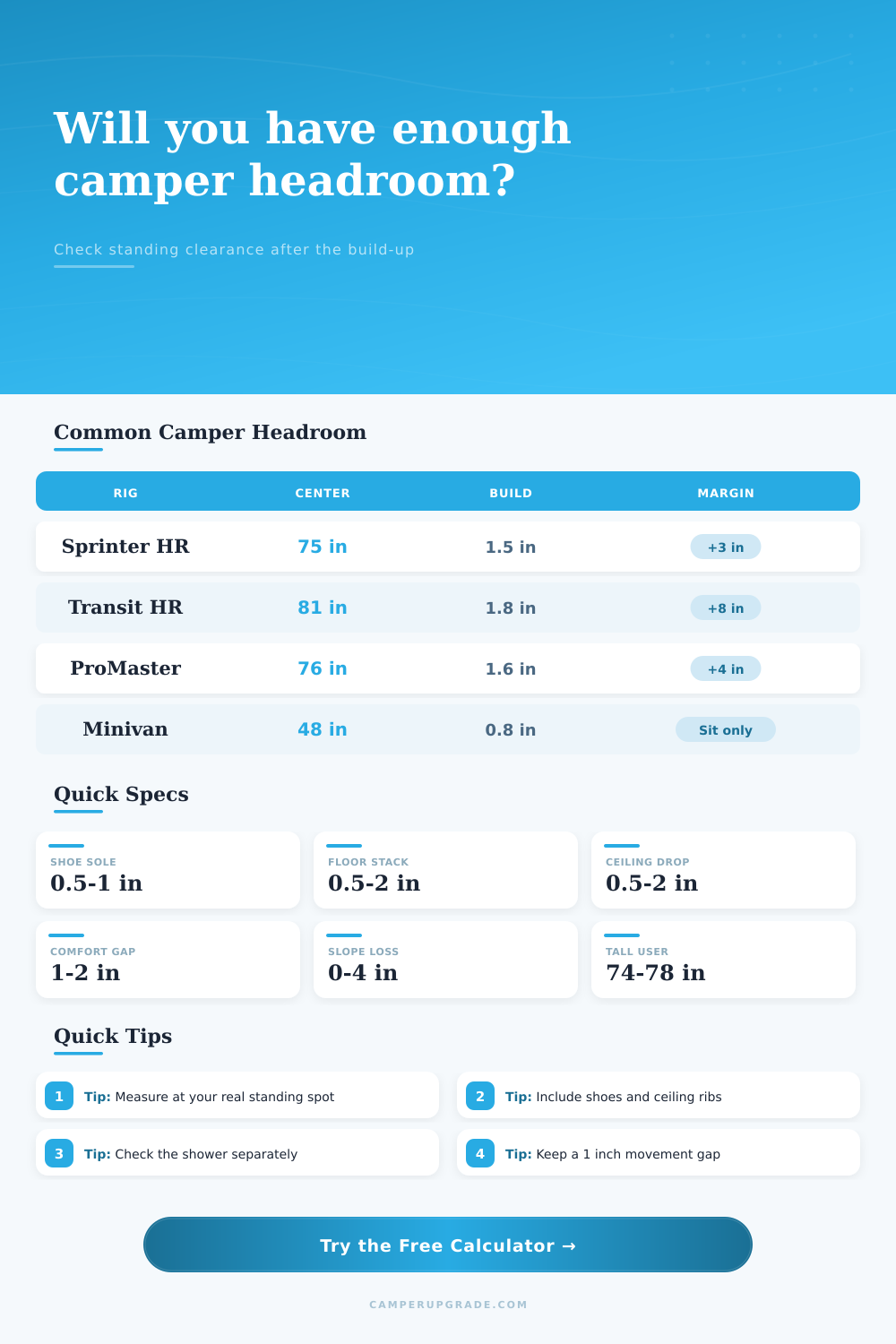
📋Common camper headroom reference
| Camper type | Typical raw center height | Common finished loss | Best use case |
|---|---|---|---|
| High roof cargo van | 74 to 81 in | 1.5 to 3.0 in | Most standing layouts for users under about 6 ft 2 in |
| Medium roof cargo van | 66 to 72 in | 1.0 to 2.5 in | Partial standing, crouch cooking, or shorter users |
| Pop-top camper | 78 to 86 in raised | 0.5 to 1.5 in | Standing mainly inside the lifted roof footprint |
| Truck camper shell | 72 to 78 in | 1.0 to 2.5 in | Compact galley, cabover step-down, and shower checks |
| Minivan or low roof van | 45 to 55 in | 0.5 to 1.5 in | Seated, kneeling, or rear-hatch changing layouts |
🛠Floor and ceiling build-up allowances
| Layer group | Lean build | Typical build | Thick build |
|---|---|---|---|
| Floor insulation plus subfloor | 0.50 to 0.75 in | 1.00 to 1.50 in | 1.75 to 2.50 in |
| Floor finish layer | 0.10 to 0.25 in | 0.25 to 0.50 in | 0.50 to 0.75 in |
| Ceiling furring plus panel | 0.50 to 0.75 in | 0.75 to 1.25 in | 1.50 to 2.00 in |
| Lights, vent trim, roof ribs | 0.25 to 0.50 in | 0.50 to 1.25 in | 1.25 to 2.50 in |
| Soft headliner fabric | 0.05 to 0.15 in | 0.15 to 0.25 in | 0.25 to 0.40 in |
👤User clearance and posture table
| Use condition | Comfort gap | Posture allowance | Notes |
|---|---|---|---|
| Barefoot standing test | 0.5 to 1.0 in | 0.5 in | Useful for checking the absolute minimum |
| Daily cooking aisle | 1.0 to 2.0 in | 0.75 to 1.25 in | Allows normal shoulder and neck movement |
| Indoor shower stall | 2.0 to 3.0 in | 1.0 to 1.5 in | More gap helps when reaching overhead |
| Winter footwear | 1.0 to 2.0 in | 0.75 to 1.25 in | Boot soles often add more than casual shoes |
| Tall guest planning | 2.0 in or more | 1.0 in or more | Use the tallest likely person, not the average |
📐Roof curve and standing-zone reference
| Roof profile | Typical side loss | Safe standing zone | Calculator setting |
|---|---|---|---|
| Square camper body | 0.0 to 0.2 in per ft | Nearly full aisle width | Square or boxy camper shell |
| Mild curved van roof | 0.2 to 0.4 in per ft | Center aisle and galley strip | Mild curved van roof |
| Curved cargo van roof | 0.4 to 0.8 in per ft | Measure where your head actually lands | Curved cargo van roof |
| Pop-top canvas roof | 0.0 to 0.3 in per ft | Mostly inside the raised roof opening | Pop-top canvas roof |
| Low roof or minivan | 0.2 to 0.6 in per ft | Seated and kneeling zones dominate | Low roof or minivan |
💡Measurement tips
An empty high roof van might make you think you’re tall. The interior seem big. You envision walking from the front to the back without bumping into anything. That’s appealing.
But it’s deceiving. An empty van doesn’t tell you much about how tall the usable space will be. When building a house, you aren’t just building a shell; various layer reduce the total height. However, it doesn’t take long for finish and insulation materials to eat away at the height.
Why You Lose Height in Your Van Build
If you’re thinking “I’ll only drop 1/2 inch with my flooring”, you probably won’t. Add in the subfloor, adhesive, foam board and wood veneers or vinyl. All of those adds up. It all adds up.
And then there is height lost on the ceiling. You have to use furring strips to run wire. Next is the panel. Maybe there is a fabric liner.
How do those layers all adds up? The height calculator does that math for you (and based off your materials). It prevents you from guessing how thick the space between the metal and the finished product will be.
There are human factors as well. The majority of folks measures their height from the floor to the top of their head. And then they neglect to account for footwear. Footwear like slippers, boots, or sneakers adds another half inch to an inch to your height.
Additionally, you’re moving. Washing dishes, chopping vegetables… You don’t just stand there. You reach up; you lean down; you turns your head.
A comfortable space should of have a buffer zone. A one to two inch buffer zone is typically sufficient. It allows you to shift your weight without feeling constricted, without that margin it feels cramped.
Planning is more difficult on curved roofs. Vans has a lot of height in the center and drop quickly at the sides. A counter against the walls can result in having to crouch down when using the sink.
To account for that, you enter the amount of slope loss per foot from the middle into the tool. That will help you visualize where your standing zone ends.
Until you do that, it’s easy to forget about it. Then the finish work is complete and you’ve glued the cabinets to the wall, now you’re stuck with an undersized kitchen.
Showers are special. Steam counts. So does water pressure. Headroom counts. You want enough space to get above you and wash your hair! No one wants to be in a shower stall that feel like they’re in a cave.
In some cases this means adjusting the configuration or switching to a lower profile vent. That’s where the reference tables comes into play. They explain how adding material can make a high roof a medium roof. They highlight how quickly a high roof can become a medium roof once you add real-world materials.
Comfort: Headroom A millimeter doesn’t mean a lot. An inch makes the world of difference each and every day that you are in this space. Openness is what you want.
Take some time to measure exactly where you are standing. Don’t just measure mid-floor. Total up all layers (subfloor to ceiling ribs). Move around and consider your footwear.
The numbers will be less than what you hope. But they will be accurate. Accurate keeps you from banging your head for years. Actually, it keeps you from bangin your head for years.