RV Roof Sealant Tube Count Calculator
Estimate sealant cartridges for roof perimeter seams, vents, skylights, ladder mounts, solar brackets, and lap-sealant refresh work.
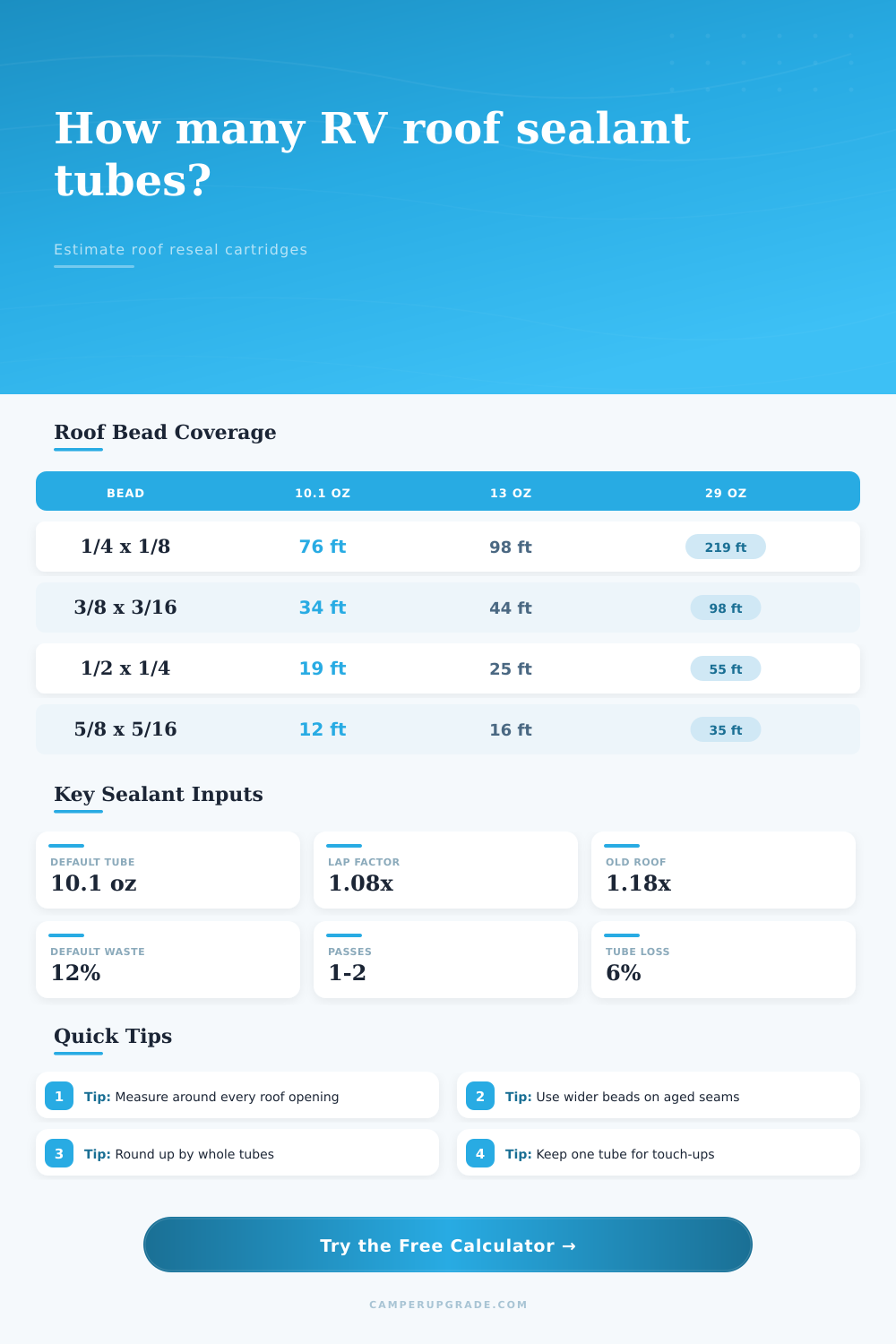
| Finished bead width x depth | Sealant per 10 ft | Approx. ft per 10.1 fl oz | Approx. ft per 29 fl oz |
|---|---|---|---|
| 1/4 in x 1/8 in touch-up bead | 1.33 fl oz | 76 ft | 219 ft |
| 3/8 in x 3/16 in normal lap bead | 2.96 fl oz | 34 ft | 98 ft |
| 1/2 in x 1/4 in wide roof bead | 5.32 fl oz | 19 ft | 55 ft |
| 5/8 in x 5/16 in heavy repair bead | 8.31 fl oz | 12 ft | 35 ft |
| 3/4 in x 3/8 in fabric-cover bead | 11.97 fl oz | 8 ft | 24 ft |
| Container size | Cubic inches | Milliliters | Use case in this calculator |
|---|---|---|---|
| 10.1 fl oz cartridge | 18.23 in³ | 299 ml | Default size for RV lap sealant estimates |
| 10.3 fl oz cartridge | 18.59 in³ | 305 ml | Common alternate cartridge label |
| 11 fl oz cartridge | 19.85 in³ | 325 ml | Slight reserve over a standard cartridge |
| 13 fl oz cartridge | 23.46 in³ | 384 ml | Large cartridge for longer seam runs |
| 20 fl oz sausage pack | 36.09 in³ | 591 ml | Bulk applicator work on long roof edges |
| 29 fl oz contractor tube | 52.34 in³ | 858 ml | Large caulk gun or shop reseal jobs |
| Roof layout | Typical sealant path | Common bead setting | 10.1 fl oz tubes with 12% buffer |
|---|---|---|---|
| Teardrop trailer roof | 80 to 115 ft | 1/4 in x 1/8 in | 2 to 3 tubes |
| Pop up camper roof seams | 105 to 150 ft | 3/8 in x 3/16 in | 4 to 6 tubes |
| Travel trailer roof refresh | 145 to 210 ft | 3/8 in x 3/16 in | 6 to 8 tubes |
| Fifth wheel with multiple vents | 210 to 290 ft | 1/2 in x 1/4 in | 14 to 19 tubes |
| Large motorhome heavy reseal | 285 to 380 ft | 1/2 in x 1/4 in | 19 to 27 tubes |
| Roof feature | What to measure | Typical perimeter | Calculator input affected |
|---|---|---|---|
| 14 in roof vent | All four flange sides | 56 in | Opening perimeter |
| Skylight dome | Outside flange edge | 72 to 110 in | Opening perimeter |
| Front or rear cap seam | Full roof-width joint | 90 to 102 in | Roof seam length |
| Solar panel foot | Base perimeter or screw patch path | 8 to 16 in | Small mounts |
| Termination bar | Continuous bar length | 8 to 40 ft | Roof seam length |
Sealant is a maintenance task that many RVers come to understand. It is a time to climb on top of a hot roof with a caulking gun in hand. And if you don’t have enough tubes, well you should of hope you got enough tubes. Running out mid-seam are a special type of frustration. Now you’ve only done half the job and you have a roof more exposed then it was previously.
This is where the calculator come in. Before you climb up ladder, use the calculator to figure out how many tubes you’ll need based off your roof layout. So no guessing about, do I buy one full case of contractor tubes or do I get 2 ten-ounce cartridges? This seems intuitive but so many folks mess this up.
How to Calculate How Much Sealant You Need
Square feet. No. Sealant is not applied by area. It’s applied by linear feet. That little teardrop trailer with all those vents may require more sealant than that big empty roof of your fifth wheel. So the premise here is that you’re measuring where the bead goes. How long is the perimeter of each skylight? Where are its sides? How do you trace around side and follow the perimeter of each vent? Measure those. And how long is the roof seam? Trace the whole thing.
This change in thought process are important because you are purchasing by linear foot. You aren’t getting coverage of an area. Bead width matter a lot. The typical lap bead is maybe three-eighths of an inch thick. Repair beads that cover up old, cracked sealant can be half-inch wide or more. Adding a little thickness doesn’t just increase your total volume. It also doubles (or triples or quadruples… ) your bead consumption rate. This happen because the area of your bead increases as its diameter increases. To account for this, the calculator will ask you what final dimensions are.
For example, if you’re working on an older roof where all the beads has tiny voids, the tool includes a multiplier. This consider the additional material required to plug these holes. Better to guess high than to run out. The surface condition have more effect on volume estimates than you would expect. Smooth surfaces allows sealant to distribute well. Rough patch jobs, or even chalked roofs, soak it all up like a sponge. To account for this, the calculator features a surface condition selector that steps up the estimated amount of material needed accordingly.
There’s also an allowance for waste, no one applies perfectly. Some goes down nozzle and you’ll goof sometimes. Twelve percent overage (the default) is an appropriate loss-fudge to cover the realities of life. Not allowing for waste are a common oversight when making a budget. It results in unnecessary trips to the store halfway through a project.
Another factor throwing people off is tube size. Standard RV cartridges contains 10.1 fluid ounces. A bit larger are the 13-ounce tubes which provide a little more bang for the buck. Contractor tubes (29 ounces) is big enough to demand a beefy gun. No matter what container size, the calculator will convert your total amount needed into the corresponding number of containers. That keeps you from thinking, “I have room for three small tubes but only space for one large one.”
Tubes of different sizes holds different amounts of material. They also use different pressure when used with a gun. It takes this into account too. The type of sealant is also considered. Lap sealants that level themselves, spreading as they dry, may use up more than non sag types.
Knowing exactly how many tubes to purchase also ensures that the math are done for you. This lets you focus on how to apply it instead of watching the cartridge run out at a bad time. This saves you both stress and time. Having made the right purchases, you can get the job done on one trip. That’s right; the goal isn’t simply a dry roof but a finished one. You know what you are applying and can do so confidentely. You know exactly what you need and can buy only those items. Rather than a chaotic afternoon of patching, it becomes a controlled maintenance project.